
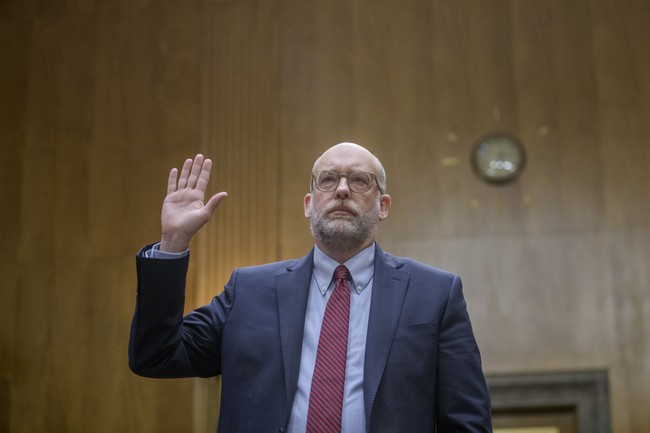
This piece examines a recent arrest of a Maryland man accused of attempting to murder a senior Trump administration official tied to Project 2025, traces the charged individual’s alleged behavior and stated motives, and argues that heated rhetoric from the left plays a role in radicalizing unstable people into violence.
Authorities say a man traveled from Maryland to Virginia with apparent intent to kill a presidential appointee associated with policy planning known as Project 2025. He arrived at the official’s home wearing gloves, sunglasses, a surgical mask, and carrying a backpack, behavior captured on doorbell video. Law enforcement quickly treated the incident as a serious threat and leveled multiple charges including attempted murder.
The arrest follows high-profile politically motivated attacks this season, and it adds to the tally of violent acts directed at conservatives and Trump-aligned figures. People in public life who push for bold reforms are increasingly targeted by lone actors who absorb alarming narratives from mainstream discourse. That pattern leaves families, staffers, and officials living under frequent threat while investigations proceed.
Court records and news reports detail the accused’s movements and actions the day of the incident, including checking a mailbox and asking a neighbor about the resident’s presence. The suspect is described in court filings as having expressed a belief that a “fascist takeover” was imminent and that the targeted official was involved. Those claims were cited by prosecutors when outlining motive and intent during early proceedings.
According to the complaint, he wrote a manifesto where he cited ‘Project 2025’ and a “fascist takeover” of America as his motivation.
Democrat lies radicalized a potential murderer.
The accused allegedly framed his actions around the idea that Project 2025 represents a dangerous plan, despite Project 2025 being a policy blueprint. Elected Democrats and some commentators have repeatedly described conservative policy proposals in apocalyptic terms, which can create a distorted narrative for unstable people. When rhetoric repeatedly paints political opponents as existential threats, it raises the odds that a disturbed individual will act out violently.
Investigators also reported that the suspect appeared to have a firearm concealed under clothing while at the residence. Surveillance footage, neighbor statements, and other evidence formed the basis for arrest and the subsequent criminal complaint. Prosecutors emphasized the combination of planning and targeting as aggravating factors that made this case particularly serious.
According to CBS News, investigators said Demarco traveled from his home in Rockville, Maryland, to Vought’s Arlington residence on Aug. 10, where he was captured on a Ring doorbell camera wearing gloves, sunglasses, a surgical mask and a backpack.
He was also seen looking through Vought’s mailbox and asking a neighbor whether anyone was home. The neighbor later told police Demarco appeared to have a gun tucked under his shirt, the report said.
Court records state Demarco is accused of plotting to kill a victim identified as “R.V.,” described in the criminal complaint as a presidential appointee involved in the creation of Project 2025, a Heritage Foundation-backed effort outlining policy priorities for a future Republican administration.
The official targeted in this incident has been involved in personnel, budgeting, and policy planning that would shape a future conservative administration, and for that reason receives protective details. Threats against high-level appointees are not hypothetical; they are recurring and require federal protection. The U.S. Marshals and other agencies take these threats seriously precisely because political violence has real, tragic consequences.
It’s also worth noting how quickly isolated rhetoric can be amplified into something dangerous when picked up by the wrong person. Calls that paint opponents as fascists or traitors reduce complex policy debates to moral panic, providing a simple justification for violence to someone who already believes the end justifies the means. Responsible public discourse matters because it can be the difference between a protest and a crime scene.
Conservative leaders and many Americans want a straightforward response: hold the accused accountable under the law, ensure targets are protected, and recalibrate public rhetoric so it does not act as an accelerant for unstable actors. Law enforcement must continue to investigate and prosecute threats, while political figures should avoid framing normal policy disagreements as existential battles that invite violence.
Editor’s Note: Progressive zealots are increasingly resorting to violence and terrorism because they failed at the ballot box.

Add comment