
At Shannon Airport in Ireland, a lone attacker breached the perimeter and used a hatchet on a parked U.S. Air Force C-130 Hercules, causing what local reports call extensive damage to the $75 million transport plane; police arrested the suspect, the airport briefly closed, and officials are investigating motive while the aircraft’s operability and repairs are assessed.
Shannon is a regular refueling and stopover point for U.S. military flights traveling between the United States and operational theaters overseas. On Saturday a C-130 Hercules sat on the tarmac when a man managed to get into restricted space and climb onto the aircraft. Reports say he attacked the wing and fuselage with a hatchet, and local outlets described the damage as extensive.
A maniac reportedly attacked a US war plane with a hatchet at a major civilian airport in Ireland Saturday, causing extensive damage at a controversial stopover site for American military.
He snuck into restricted space at Shannon Airport in County Clare, where the US Air Force’s $75 million C130 Hercules military transport aircraft was parked, local outlet The Journal reported.
The lunatic — in his 40s but yet to be identified — climbed onto the wing of the plane and started hacking away at the wing and the fuselage, causing extensive damage, according to GB News.
Aircraft skin and control surfaces are vulnerable if struck with force, and metal damage can compromise pressurization and aerodynamic integrity. If the attacker reached engines or propellers, the risk to the airframe’s readiness grows, and even superficial gouges can force a grounded, out-of-service status until inspected and repaired. At this stage authorities have not released a full damage report, so the timeline to return the plane to service remains uncertain.
Airport operations were disrupted; local police detained the man after a short closure of the airfield. Garda Síochána officers arrested the suspect and secured the scene while forensic teams and military liaisons assessed the aircraft. Security lapses are under scrutiny, because a single individual reached a high-value military asset parked at a public airport.
The shocking attack caused the airport to close for just under 30 minutes, before police from the Garda Síochána arrested the man.
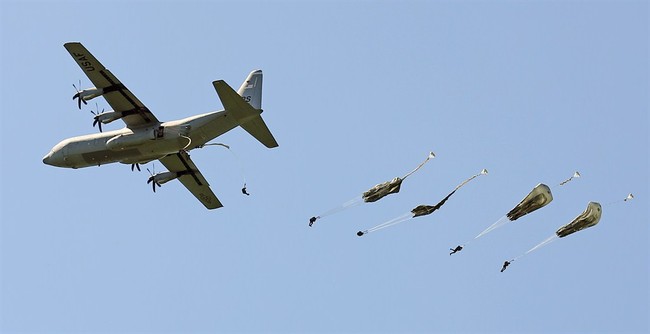
The C-130 Hercules is a transport aircraft that is used in a wide range of military situations.
One of the models was shot down in Iran and crashed in Kuwait on April 5 during a rescue mission for the pilots of the downed F-15E.
Motivation remains unclear; some observers point to recent demonstrations at Shannon demanding inspections of U.S. military aircraft for weapons bound for conflict zones. The airport has seen protests tied to wider geopolitical disputes, and that context cannot be ignored while investigators piece together this incident. However, law enforcement must follow evidence rather than assumption when determining whether this was a politically motivated act or the action of a lone individual.
From a security and national-interest perspective, this type of breach highlights the need for robust perimeter enforcement and rapid response coordination between civilian airports and U.S. military personnel. Shannon’s role as a refueling hub for American flights makes it an operational necessity, and a temporary closure or scare cannot be allowed to interrupt strategic logistics. The United States will continue to rely on trusted stops abroad to move personnel and materiel where needed.
Reports reference the broader operational picture, including ongoing conflicts and the movement of munitions, which fuels public debate in host countries. Still, a single attacker with a hatchet will not change strategic realities or stop allied logistics. The aircraft can be repaired, protocols can be tightened, and flights will resume once inspections and fixes are complete.
Authorities in Ireland are pursuing charges and will determine whether additional security or legal measures are warranted to prevent similar incursions. The incident also offers a moment for partner nations to reassess on-the-ground safeguards for military assets housed at civilian facilities. For now, law enforcement handling of the case and the Air Force’s technical assessment will define the next steps.



Add comment