
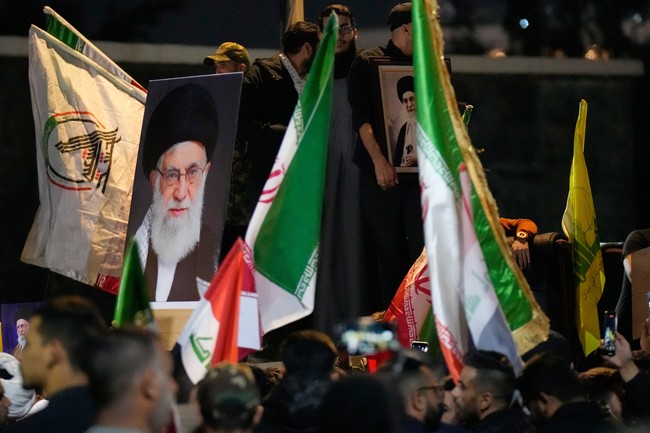
The piece breaks down a blunt admission from Iran’s foreign minister about Operation Epic Fury, explains how the strikes hit their marks with astonishing precision, lays out what Iran’s leadership reportedly ignored, and frames the episode as confirmation that decisive American action under President Trump changed the game for U.S. national security.
Iranian Foreign Minister Abbas Araghchi acknowledged, in a televised interview, that the joint U.S.-Israeli airstrikes known as Operation Epic Fury struck with exceptional accuracy. His description that one wing of a compound was destroyed while the wing he occupied remained intact reads like confirmation of a carefully planned decapitation strike. From a Republican perspective, this is proof that strength and clear intent deliver results where years of talk did not.
The admission is notable because Iranian officials rarely credit American or allied capabilities, even when facing undeniable evidence. Araghchi’s recounting moves beyond rhetoric into operational detail, making it hard to dismiss as misinformation or spin. That kind of candor, even when begrudging, gives a window into how these strikes were executed and perceived inside Tehran.
“Well, the building we were sitting in was targeted, but the wing we were in remained intact while the other wing of the building was destroyed,” Araghchi said in an interview that aired June 4 on the Lebanon-based, Hezbollah-backed Al Mayadeen television network.
Araghchi described emerging from rubble after the attack and referenced footage of around 50 fighter jets hitting the compound, a detail corroborated by observers tracking the event. That level of force, combined with the selective removal of key leadership nodes, fits the pattern of a decapitation operation designed to degrade command and control rapidly. For conservatives who favor robust deterrence, this is validation that striking at leadership can break the spine of a hostile regime’s ability to wage further aggression.
https://x.com/warsurv/status/2062942538047136098
Iranian Foreign Minister Araghchi says,
he survived strikes that targeted Ali Khamenei’s office, recalling that he was inside the building when it was hit and later emerged from the rubble.
He also referenced Israeli footage showing around 50 fighter jets striking Khamenei’s compound.
Counterterrorism analysts noted that Araghchi’s statements effectively acknowledge U.S. strategic reach and precision. When an adversary admits you hit exactly what you intended to hit, you have not only tactical success but also psychological leverage. Politically, that leverage shifts the calculus for Tehran and for other actors who watch how the United States responds to clear, existential threats.
Araghchi also relayed that Supreme Leader Ali Khamenei was reportedly advised to move to a secure location but declined, stating he would not shelter unless all Iranians had shelters. The foreign minister quoted Khamenei as saying, “I will not go to a shelter or to a secure location unless every member of the Iranian people also has access to a safe place and to shelters. Since that possibility is not available to everyone at this time, I too will remain above ground alongside the people. Whatever happens to my people will happen to me as well.” Those words, whether genuine or performative, underline a leader who chose solidarity over personal survival and, in doing so, accepted extraordinary risk.
From the Republican viewpoint, the message here is straightforward: when adversaries see credible, overwhelming force used precisely, they reconsider their behavior. Decades of ambiguous responses did not deter Iran’s worst impulses, but a clear, decisive operation that neutralizes core leadership changes incentives quickly. That change in incentives is what prevents future attacks and protects American interests abroad.
Some commentators framed the strikes as part of a broader doctrine that pairs decapitation with an off-ramp for de-escalation, giving the adversary room to stand down without total annihilation. That balance between strength and a pragmatic path out resonates with conservative strategy: achieve mission objectives while minimizing long-term occupation or entanglement. It is a hard-edged realism that accepts tough choices and prioritizes American safety and strategic clarity.
Araghchi’s account that he survived only because he happened to be in a different wing is a sober reminder of how narrowly leadership structures can be disrupted. When regimes concentrate decision-making in a few locations and people, those nodes become legitimate military targets in wartime under accepted rules of engagement. Republicans argue that removing those nodes when they pose imminent threats is a legitimate, necessary act of national defense.
Inside Iran, the narrative will be curated for domestic audience consumption, painting leadership decisions as noble sacrifices for the people. Outside Iran, the takeaway for allies and rivals should be different: well-executed force, backed by political will, works. That reality should inform how the United States and partners plan deterrence and crisis response going forward.
Regardless of how Tehran spins it, the practical result is clear: Operation Epic Fury demonstrated a capability and willingness to act. In Washington, the lesson for conservatives is simple — deterrence requires clarity, capability, and the readiness to use both. That combination keeps Americans safer and forces adversaries to think twice before escalating toward conflict with the United States or its allies.


Add comment