
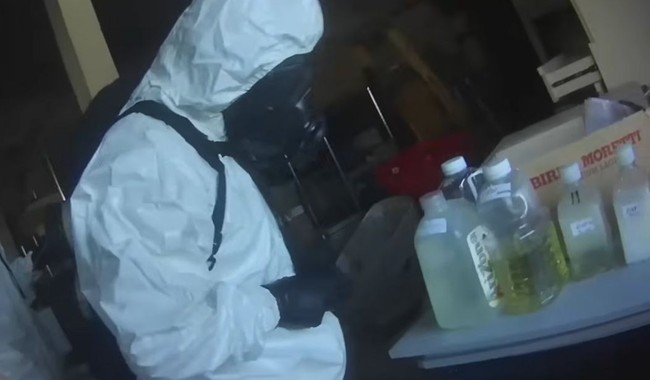
The FBI raid on a Las Vegas garage earlier this year turned up a cache of lab gear and biological samples that the National Bioforensic Laboratory says included materials related to COVID and pregnancy test kit production, influenza vaccine compounds, and human blood and urine, but officials concluded the items posed no community threat.
Federal testing found a mix of stored reagents and biological specimens in a residence used to hold lab gear, and investigators determined much of it had degraded over time. The lab report noted many samples were too old or stored at room temperature long enough that reliable testing was not possible. Despite that degradation, officials identified items consistent with diagnostics and vaccine research rather than an active bioweapons program.
FBI Special Agent in Charge Christopher Delzotto explained that the site looked more like a storage facility than a functioning laboratory, and he emphasized the safety conclusion reached by federal analysts. He said some material could not be tested due to age and storage conditions, but the overall assessment was that the community was not at risk from what was discovered. That assessment allows investigators to focus on how and why such materials ended up in an unlicensed private residence.
Authorities tied the Las Vegas storage to a broader pattern involving an illegal lab previously uncovered in Reedley, California, and the people connected to that operation. The owner linked to the Reedley lab has been in federal custody since late 2023 on charges stemming from that facility, and while he has been detained, equipment and samples were moved from other properties into the Nevada location. Family and property managers appear to have handled logistics after his arrest, which complicated efforts to trace chain of custody and intent.
Delzotto put the core question plainly: why would someone keep biological materials and laboratory supplies in a private home that was not licensed as a medical or research facility. He also flagged concerns about the provenance of human blood and urine samples found at the site. That line of inquiry is now central to investigators trying to determine whether any laws were broken in obtaining or storing those specimens.
Public interest in this case intensified because of earlier reporting on the Reedley operation, which had prompted local enforcement actions and widespread scrutiny. The Reedley lab became a flashpoint for questions about unregulated biological work and how homegrown labs can slip under the radar. When the Reedley lab received attention in mid-2023, the owner reportedly attempted to move materials and sought licensing in Nevada, then cut contact with Reedley authorities as the controversy grew.
With the owner detained, others handled property and assets, and that movement of equipment likely explains why the Nevada garage contained refrigerators, freezers, vials, and other cold-storage items. Investigators found hundreds of containers, and more than a thousand samples were sent to the National Bioforensic Laboratory for detailed analysis. The volume of material and the makeshift storage setup raised red flags for law enforcement even after lab analysts determined the immediate public health risk was low.
Community safety remained a priority for investigators even as they worked through forensic testing limits caused by sample degradation. Officials stressed that degraded samples and unrefrigerated storage reduced the ability to detect viable pathogens or perform conclusive analyses. Still, the presence of vaccine-related compounds and diagnostic kit components in an unlicensed setting prompted continued concern and further inquiry into regulatory compliance and ethical sourcing of human samples.
“I would describe it as a bio-storage facility where a lot of the remnants from what we know as the 2023 Reedley lab seem to have been stored in this garage for years. There were samples of liquids that had been there for years that have degraded to the point, based on being at room temperature, not refrigerated, again for an extensive period of time, that are degraded to the point where we can’t test them.”
That quoted assessment frames the scene: a garage acting as long-term storage for lab remnants, not an active research site. Investigators are piecing together ownership and movement of materials, which is critical for any potential criminal or regulatory actions. Determining who procured blood and urine samples, and under what pretenses, remains a key investigative focus.
The case will continue through the courts, with a trial in California scheduled for the individual connected to the Reedley lab in April. Meanwhile, federal and local agencies are documenting findings and building a record that explains how unregulated biological materials were stored and distributed. Ongoing investigations aim to tighten oversight gaps and prevent similar situations where potentially hazardous materials are kept outside licensed, monitored facilities.



Add comment