
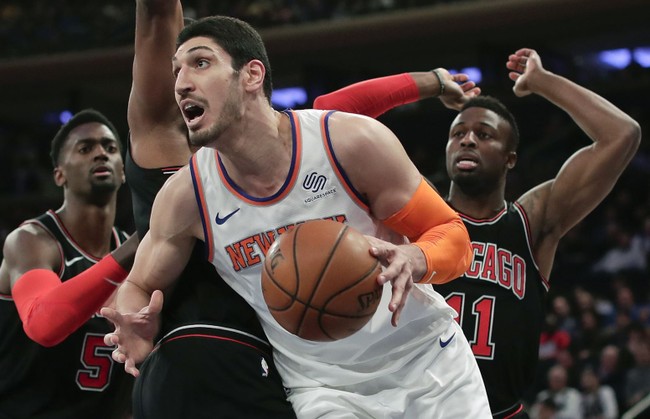
I’ll explain why Enes Kanter Freedom’s courtside appearance and ejection in Chicago matters, how the WNBA’s response highlights a cultural double standard, what this incident reveals about the league’s priorities, and why conservative observers see it as proof the league is out of touch with its stated mission to support women.
Enes Kanter Freedom walked into Wintrust Arena and caused an immediate stir simply by being himself and voicing support for female athletes. The former NBA big man announced plans to enter the WNBA draft and that move alone has the league and its supporters in full panic mode. That panic looks less like principled concern for fairness and more like a reflexive defense of a narrative that resists scrutiny.
The scene before the game was chaotic, with a vocal section taunting him as he tried to take his seat courtside. Security escorted him in after heated exchanges, and the crowd’s reaction set the tone for the night. When a Chicago Sky player directed barbs at Kanter Freedom, things escalated quickly because he pushed back and stood up for himself.
Instead of confronting the player who initiated the taunting, officials singled out the courtside spectator and removed him from the arena during the third quarter. Fans in the building booed as security escorted him away, and the optics were striking: the paying customer who challenged the player got ejected while the instigator remained on the floor. Critics argue that this approach says more about the league’s priorities than about any rules about conduct.
https://x.com/EnesFreedom/status/2091655642981274028
Here is how it was reported about the confrontation and ejection:
Former NBA center Enes Kanter Freedom, who is trying to make his way into women’s basketball, was escorted out of Wintrust Arena during the third quarter Sunday after a heated shouting match with Chicago Sky guard Natasha Cloud.
With the Indiana Fever holding an 81-75 lead during a third-quarter timeout, Cloud began barking toward Freedom, who was seated courtside.
Freedom responded and stepped toward the floor, prompting security to intervene and usher the 11-year NBA veteran out as the Chicago crowd rained down boos.
Kanter Freedom immediately called out the WNBA publicly after his removal, pointing to what he sees as blatant hypocrisy. He framed the ejection as evidence the league will enforce discipline selectively, depending on whether the target fits the preferred narrative. Conservatives watching this play out see it as predictable: tolerance when it fits a story, punishment when it challenges it.
The controversy over former NBA players declaring for the WNBA draft isn’t only about a single game; it’s about how the league defines fairness and safety for female athletes. When biological males compete in women’s sports, many argue that outcomes change and competitive opportunities disappear for women. That concern is rarely treated with equal weight compared to the league’s cultural or political signaling.
Those pointing this out, including Kanter Freedom and another former NBA player who declared for the draft, say the uproar exposes the WNBA’s weakness in defending its stated mission. They contend the league has prioritized ideological alignment over clear, consistent rules for competition. The result is a public relations mess that keeps getting worse for the Association.
People on the right view this as a winning tactic: force the issue, and watch institutions scramble and contradict themselves. The WNBA’s reaction to Kanter Freedom’s presence—booing fans, on-court taunts, and an ejection that some see as unevenly applied—feeds into a broader narrative. That narrative alleges organizations embrace performative inclusivity while sidelining substantive protections for women in sport.
At its core, this episode is not just about one man at one game; it’s about institutional responses when someone publicly challenges prevailing groupthink. For critics, the WNBA’s handling of the situation demonstrates a fear of confronting the underlying questions about fairness and safety. Meanwhile, conservative commentators take satisfaction in seeing a cultural institution reveal its contradictions under pressure.
The ejection, the crowd reaction, and the postgame commentary combine to create a story the league would rather avoid. It forces a choice: either engage seriously with questions about competitive fairness in women’s sports, or keep doubling down on messaging that looks performative under scrutiny. Until that choice is made, incidents like this will keep surfacing and creating headaches for the league’s leaders.


Add comment