
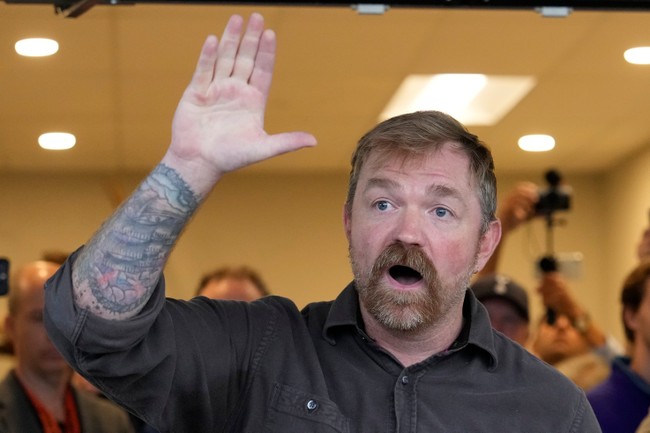
The Democratic Party backed a weak nominee in Graham Platner and now faces the fallout as allegations, polling shifts, and public calls for him to step aside force an unraveling of their plan in Maine. This piece lays out how the party defended him, how the latest accusations changed the race, which prominent figures are reacting, and what Republicans see as predictable consequences for Democrats who backed an outsider with baggage.
Democrats insisted on nominating Graham Platner despite warning signs that should have stopped this train early. From troubling imagery to reports of abusive behavior, red flags kept piling up while party officials defended him anyway. That gamble now looks like a classic miscalculation, one the GOP expected and warned about from the start.
New allegations have expanded the problem beyond old controversies, with a sexual assault claim from a 41-year-old Maine woman surfacing publicly. That accusation is serious and makes it much harder for Platner to remain a viable nominee in a competitive Senate race. His mention of “reflecting” on the campaign reads like the first step toward an exit, but Democrats have already wrecked their credibility by pushing him forward.
Polling shows this trouble has concrete consequences. A recent survey puts Platner trailing Senator Susan Collins by four points, flipping a race Democrats hoped to contest aggressively. Where they once dreamed of replacing a longtime Republican, they now scramble to limit the damage and figure out replacement mechanics if they want to swap him before the ballot deadline.
The reaction inside the party has been messy and predictable. Some Democrats are quietly urging him to step down while others loudly pull endorsements to distance themselves. That kind of public unraveling is a political disaster: voters see infighting, donors get nervous, and opponents smell blood — exactly what Republicans hope for in contests where the left overreaches.
It’s time for Mr. Platner to step aside and be replaced by July 13th. Platner needs time to heal, focus on his family and well-being. Enough. Enough.
https://x.com/IAPolls2022/status/2074207703455731842
The plea that Platner “needs time to heal” oddly centers the campaign’s inconvenience rather than the alleged victims. Republicans point out the irony: the party that talks loudly about moral standards kept backing a candidate with serious issues until the trouble became unavoidable. This looks less like accountability and more like damage control for a failed recruitment decision.
Other prominent Democrats are getting pulled into the mess, too, with high-profile voices publicly wrestling with their earlier support. Some who defended Platner now face calls to explain how they missed or ignored red flags. The scramble exposes how sloppy candidate vetting can cost a party time, money, and political ground it can ill afford to lose.
Commentators across the left-right spectrum are weighing in, but the tone differs. Left-leaning hosts and influencers seem torn between defending an ally and acknowledging the severity of allegations, while conservative voices treat the situation as proof-of-concept for warnings Republicans issued months ago. That split only amplifies the sense that Democratic leadership badly misread the race.
Rep. Ro Khanna’s role in pushing Platner reflects a broader pattern: ambitious Democrats elevating outsiders who excite grassroots money but bring theater-level risk. Khanna looks badly bruised by this episode, and his early enthusiasm is now a liability that opponents can exploit across forums and ads. For Republicans, it’s a gift — a messy headline that turns what should have been a defensive contest into an offensive opportunity.
Some on the left, like Cenk Uygur, refuse to accept mainstream reporting and instead cast it as an elite media conspiracy. That posture plays well to a base allergic to establishment narratives, but it won’t change hard facts or steady polling shifts. Voters want credible answers, not hot takes blaming the media for investigations prompted by real allegations.
This is what I know for sure about Platner – every legacy media outlet is trying their hardest to make sure he loses. They are investigating every minute and every facet of his life. They never do this for insiders. They despise outsiders who challenge power.
The minute a candidate says he’s not going to listen to the donors, especially AIPAC, he is set upon 24/7 by people posing as reporters. They are the attack dogs of the wealthy and powerful people who run this country – and they hate it when their orders are not follwoed.
So, no, I don’t believe any mainstream media story. I think they are agents of propganda and not real news. And to my knowledge, they haven’t investigated a single component of Susan Collins very long and very corrupt life. Because that’s precisely the type of corruption that national media loves and wants you to think is normal.
The fallout will keep rippling through the Democratic bench as they decide whether to replace Platner or let the clock run out and try to explain the loss. Republicans smell an opening to run a disciplined, contrast-focused campaign against a party that appears chaotic and out of touch with voters’ expectations. Expect conservative strategists to press that advantage hard through November.
For voters in Maine and observers nationwide, the Platner episode is a reminder about candidate quality and the costs of ignoring warning signs. The GOP will keep the pressure on and highlight the party’s mistakes, while Democrats work to paper over a self-inflicted wound that could determine control of a pivotal Senate seat.

Add comment