
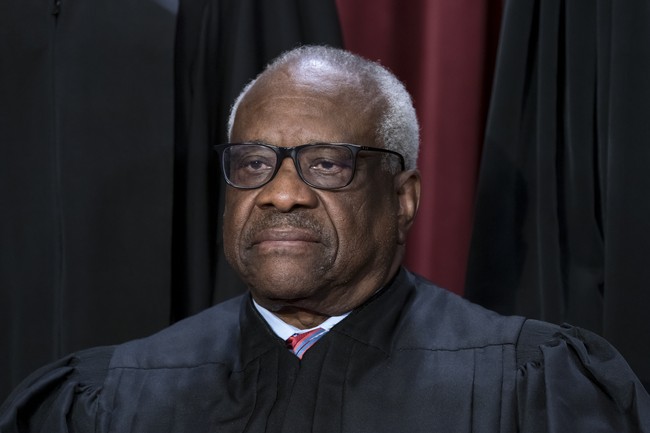
I’ll explain the Supreme Court’s recent decision on birthright citizenship, outline Justice Clarence Thomas’s forceful dissent, note the vote split and key legal precedents, and highlight the political and legal fallout from the ruling.
The Supreme Court handed down a narrow 5-4 ruling that affirms children born in the United States to parents who are unlawfully or temporarily present are citizens at birth. The majority relied on longstanding precedent, and the decision struck down an executive order that sought to deny automatic citizenship in these cases. That ruling has already set off strong reactions from conservatives who view the decision as a missed opportunity to restore a narrower reading of the Constitution.
Justice Clarence Thomas wrote a lengthy 91-page dissent that does not mince words, and he was joined in that dissent by Justice Neil Gorsuch. Thomas argues the majority misread the original meaning of the Fourteenth Amendment’s Citizenship Clause and repurposed it beyond what the Reconstruction Congress understood. His opinion frames the decision as a departure from the Clause’s historical limits, particularly regarding children of foreign temporary visitors.
Thomas levels a direct charge at the majority for changing the Clause’s application. He wrote, “The Citizenship Clause ‘added greatly to the dignity and glory of American citizenship.’ Today’s opinion devalues that citizenship.” He warns that the Court’s approach “repurpos[es] the 14th Amendment ‘to protect its own set of preferred rights that the Reconstruction Congress never contemplated and that cannot find support in its text.'”
The five-justice majority relied heavily on United States v. Wong Kim Ark, the 1898 precedent that adopted the English common law principle of jus soli, or right of the soil. That case, the Court held, controls the interpretation of the Citizenship Clause, with exceptions narrowly drawn for diplomats’ children and similar circumstances. The effect was to block an executive effort to reinterpret the Clause by administrative fiat, preserving automatic citizenship for those born here regardless of their parents’ immigration status.
Thomas argues that the Clause was “consistently interpreted not to apply to the children of foreign temporary visitors, who were by definition not domiciled in the United States.” He insists the President’s order should have been treated differently, and that the Court went too far in declaring the executive action constitutionally defective on its face. In Thomas’s view, the majority’s ruling inserts policy judgments into constitutional law under the guise of original meaning.
On the bench, the split was clear: Justices Barrett, Jackson, Kagan, Roberts, and Sotomayor formed the majority, while Thomas and Gorsuch authored and joined the dissent. Justice Alito filed a separate dissent, and Justice Kavanaugh wrote to concur in part and dissent in part. That alignment underscores how sharply the issue divides conservative jurists who favor originalist restraint and others who emphasize precedent and stability.
Thomas reaches back to the Civil War and Reconstruction era to frame his critique, pointing to cases like Plessy v. Ferguson and Dred Scott as context for the Clause’s intended scope. He warns that the Court has “add[ed] to the sad history of the Fourteenth Amendment, which was designed and understood to secure equal rights for the freed blacks but has instead been repurposed for political projects that the Reconstruction Congress did not support.” His language signals deep concern about turning a narrow remedial provision into a broad instrument for contemporary policy.
The political implications are immediate. Conservatives who sought a narrower constitutional reading hoped the Court would curb the expansion of birthright citizenship through executive action. Instead, Thomas’s dissent becomes the rallying cry for those who believe the decision rewrites original constitutional commitments. The debate now shifts from the courtroom to Congress and the ballot box, where Republicans may press for statutory or constitutional fixes.
https://x.com/FoxNews/status/2071973149088928111
Beyond politics, the ruling raises practical questions about administrative authority and the limits of presidential power to interpret fundamental constitutional provisions. If executive orders cannot change settled citizenship rules, then the pathway for policy change runs back to Congress and, potentially, to future courts. For those committed to originalist interpretation, Thomas’s dissent offers both a legal roadmap and a political argument for pursuing change through democratic institutions.


Add comment