
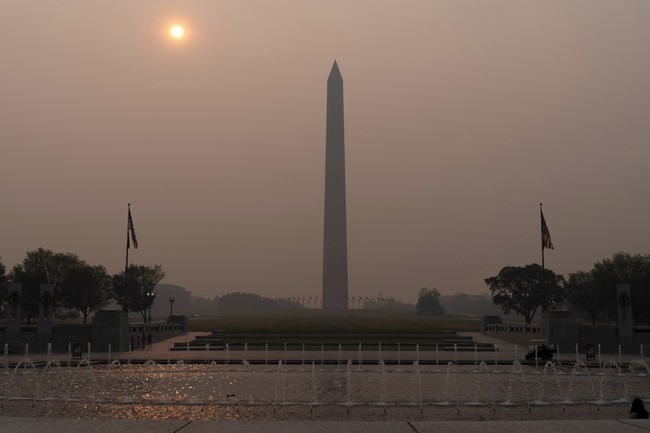
The western and northern wildfires have once again pushed thick smoke into large swaths of the United States, dragging hazy skies, poor air quality alerts, and public-health headaches from Canada down into American communities this weekend.
Morning commuters and families woke to orange haze, choking smells, and smartphone warnings about dangerous particulate levels in the air. Local officials issued advisories and health warnings while people scrambled to find masks, air purifiers, or indoor refuge. This isn’t just a temporary inconvenience; it’s a recurring cross-border problem with real health and economic impacts.
Many point to forestry practices and policy choices north of the border as a major cause of these runaway fires that spawn the smoke plumes. Critics argue that hands-off approaches to forest management, linked to broader environmental goals, are leaving vast swaths of timber more prone to blaze uncontrollably. Those blazes produce massive volumes of smoke that travel great distances, settling into valleys and metropolitan areas far from their origin.
Some commentators have framed the situation as a consequence of policy priorities, suggesting that certain climate initiatives have deprioritized traditional fuel-reduction tactics. One blunt assessment captured that tone: “Turns out the Canadian eco police are letting hundreds of tons of carbon pour into our atmosphere hourly, which is more than the USA produces in half a decade.” That line has been repeated in conversations about accountability and the trade-offs of different land management philosophies.
When the smoke arrives, the effects on daily life are immediate. Schools reconsider outdoor recess and sports, public events get postponed or canceled, and people with respiratory vulnerabilities—children, the elderly, and those with asthma—face heightened risk. Economies feel it too: tourism, outdoor work, and local businesses that rely on foot traffic all take a hit when air quality warnings linger for days.
https://x.com/spann/status/2077944773508268142
The air-quality readings have shown spikes into the “very unhealthy” and even “hazardous” ranges in several urban regions, prompting public-safety messaging that is hard to ignore. Medical providers reported an uptick in respiratory complaints and visitors seeking relief from burning eyes and coughs. The narrative on the ground is stark and sensory: smoke coats surfaces, visibility drops, and the smell of char lingers indoors if windows are open.
As a cold front pushed a dense plume of wildfire smoke from Canada southward, the DC area awoke Friday to widespread very unhealthy (code purple) to hazardous (code maroon) air quality. An acrid, woody/rubbery smoke smell hits as soon as you step outside.
“My eyes are burning,” said a Capital Weather commenter in transit to work.
Cross-border tensions flare when one country’s policy choices have clear consequences for its neighbor’s health and economy. Observers ask how accountability or cooperation should work when pollution and smoke ignore political boundaries. That question becomes louder when the same regions have experienced similar episodes in recent years and the cycle repeats.
Policy discussions now include whether more active forest management, such as controlled burns and fuel removal, should return to prominence as tools to reduce catastrophic wildfire risk. Some experts advocate for a balanced approach that combines emission reductions with pragmatic land stewardship to limit megafires. Those who support more proactive treatment of forests argue it reduces the intensity and scale of fires, which in turn reduces the volume of smoke crossing borders.
Meanwhile, local governments and communities on the receiving end have to invest in resilience: improving indoor air filtration, updating public-health messaging, and planning emergency responses for prolonged smoke events. Building a stronger local capacity to protect vulnerable populations is becoming an urgent part of municipal planning in affected regions. Residents are learning practical steps, from creating cleaner indoor spaces to modifying outdoor activities while the air is unsafe.
The recurrence of these smoke events has cultural and political effects as well, fueling frustration and jokes directed northward and inspiring pointed commentary about priorities. For many affected Americans, the visceral experience of smoke in the sky translates quickly into demands for clearer cross-border dialogue and more practical fire-mitigation measures. People want policies that prevent future summers from being dominated by thick, travelling smoke that disrupts life and threatens health.
The conversation is not only about blame but about realistic, shared solutions that respect both environmental goals and public safety. It will require technical cooperation, political will, and a willingness to rethink certain practices that have proven risky under changing climate conditions. Until then, communities will continue to adapt as the smoke drifts across the continent.



Add comment