
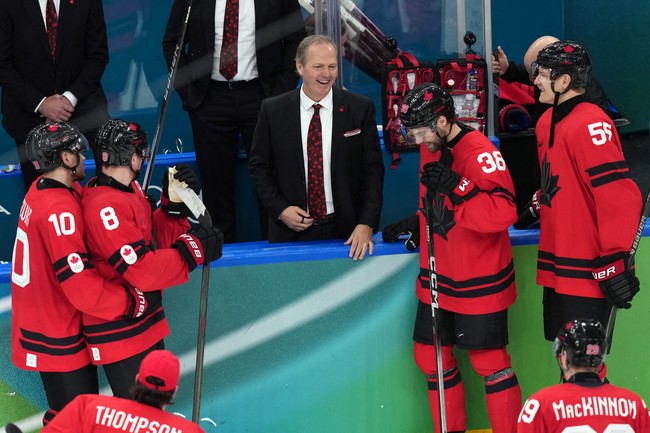
The U.S. men’s hockey team stunned the world with an overtime win against Canada in the Winter Olympics, and the aftermath has focused less on the goal and more on Canada’s coach criticizing the tournament’s three-on-three overtime format as “not hockey anymore.” This piece lays out the sequence of events, Jon Cooper’s remarks, how the format differs from NHL playoffs, reactions from players, and why the Olympics are allowed to use a faster overtime system.
The gold medal game ended with an overtime goal by Jack Hughes, and the timing added drama: the win came 46 years to the day after the famous 1980 “Miracle on Ice.” That coincidence and the opponent being Canada made the victory feel extra sweet to American fans. For Canada, losing to a rival on such a stage intensified scrutiny and emotion around the result.
After the game, Jon Cooper, coach of Team Canada, criticized the Olympic overtime rule and said, “not hockey anymore.” He pointed specifically to the three-on-three overtime format used at the Games, arguing that reducing on-ice players changes the character of the game. He suggested the change was driven by television and the desire to finish games quickly.
Cooper offered a clear summary of his view: “You take four players off the ice, now hockey’s not hockey anymore. There’s a reason overtime, and shootouts are in play — it’s all TV-driven to end games, so it’s not a long time. There’s a reason why (3-on-3) is not in the Stanley Cup final or playoffs.” That sentence captures his discomfort with the format and his belief that the traditional playoff structure preserves a different kind of contest.
He quickly added a clarifying point that undercuts any claim of pure sour grapes: “All the teams know the rules going into these beforehand. So you can’t come up here and say we’re the losing team because we lost in a 3-on-3 and that’s not fair. We knew the rules coming in. We won a game in this tournament 3-on-3, so that’s not the way it is.” His follow-up acknowledges that Canada benefited from the same rule earlier, which complicates any narrative of simple complaint.
The Olympic three-on-three format is intended to speed overtime, and it already influenced other results in the tournament. The U.S. defeated Sweden in a three-on-three quarterfinal, and Canada also used the format to beat the Czech Republic in extra time. Faster overtime tends to open the ice, create more scoring chances, and produce dramatic finishes in a shorter window than traditional five-on-five sudden-death overtime.
If Cooper believes the rule is a genuine problem, the logical channel is the International Olympic Committee, not postgame press conferences. The Olympics operate under different priorities than the NHL, most notably a global schedule and broadcast considerations tied to multiple time zones and numerous sports. That context lets the Games adopt formats that differ from professional playoff series.
Not every Canadian reaction was critical. St. Louis Blues goalie Jordan Binnington, who conceded the winning goal, kept his comments straightforward and sportsmanlike: “What a hockey game. We left it all out there, and we’ve got to hold our heads high.” Those words reflect the perspective of a player who accepts the result and honors the contest’s intensity despite the loss.
Social media captured the contrast between official critique and player-level response. Nate McKinnon offered a pointed line after the game: “You be the judge of who was the better team today.” That quote landed with a mix of defiance and acceptance, and it became one of the more memorable off-ice moments of the aftermath.
There are legitimate precedents for different rule sets in various hockey leagues. College hockey, for example, has overtime regulations that diverge from the NHL, and the Stanley Cup playoffs maintain a longer, more traditional sudden-death structure. Those distinctions are well known within hockey circles, and they help explain why a coach might view the Olympics’ approach as foreign to playoff-style hockey.
Ultimately, the U.S. celebration and Canada’s critique now exist side by side: a gold medal earned in dramatic fashion and a coach publicly questioning a format that has reshaped overtime outcomes across the tournament. The disagreement over format speaks to broader tensions between tradition and spectacle, between league customs and international event design, and between the perspectives of coaches and the realities of global broadcasting.



This is why they make crying towels get them while they’re on sale. Go USA.