
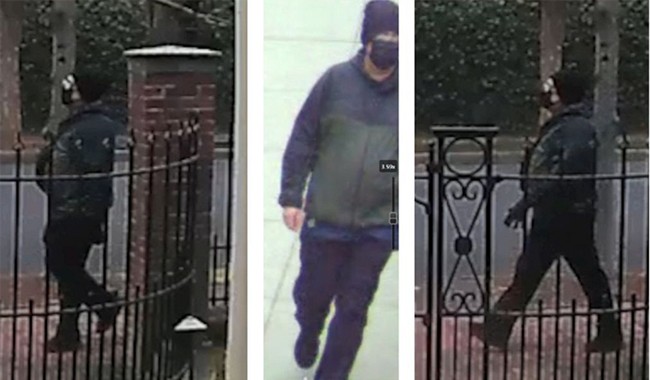
The latest Providence press conference on the Brown University campus shooting offered a few new surveillance clips and a lot of unanswered questions, leaving investigators focused on identifying a person of interest captured on exterior cameras while basic details about how the attack unfolded remain unclear.
City and state leaders spoke at the press event, but much of what they announced was limited to a compiled video feed and status updates on the wounded. Officials emphasized public patience while they continue piecing together footage and witness accounts, but they provided few concrete leads about motive or method.
Mayor Brett Smiley introduced the newly released compilation — a stitched-together set of surveillance clips taken from exterior cameras near the scene. The footage shows a single individual in a dark stocking cap, zip-up jacket, dark pants, dark gloves, and a mask, who appears to be carrying added bulk around the midsection and walking through the area from several angles.
Providence Police Chief Oscar Perez said the goal of releasing the enhanced exterior video is to let the public study the person’s body language, posture, and the way they carry their weight in hopes someone recognizes them. Perez asked residents who have private camera systems, including dashcams on Teslas, to check recordings going back at least a week to see whether the individual was present earlier that morning and possibly casing the location.
FBI Special Agent in Charge Ted Docks confirmed the Boston field office is assisting local and state investigators. Rhode Island Attorney General Peter Noronha said the probe is “going really well,” noted the dozens of agents and prosecutors working the case, and urged the public to offer “a little patience.” Both remarks were framed as reassurances that the investigation is active and coordinated across agencies.
Governor Daniel McKee and Brown University President Christina Paxson also made brief remarks but added little new information to the public record. Their comments centered on community support and institutional cooperation rather than operational breakthroughs, leaving journalists to press for specifics that were not supplied.
Perez and Noronha clarified the scope of available footage when asked whether interior cameras captured the person of interest. Noronha explained there is interior video, but it does not show the suspect and instead records the chaos of students fleeing. He noted a newer addition to the building has cameras while the older section — where the shooting occurred — has fewer, if any, interior cameras.
The officials were explicit that the only footage of the person of interest comes from exterior cameras, and they said they would release any interior clips that might help identify the suspect. That distinction matters because it means investigators currently lack visual evidence of how the shooter accessed the older portion of the building or what occurred inside during the attack.
Details about the weapon, entry points, and whether any victims were specifically targeted remain unresolved. Chief Perez said the question of whether the two students killed were targeted is still under investigation, and repeated inquiries about shouts, commands, or statements made by the shooter produced no definitive answers from the podium.
The press conference included an update on the survivors’ conditions: of the eight people hospitalized, one has been discharged, one remains in critical condition, five are in critical but stable and improving condition, and one is in stable condition. That breakdown was provided to convey the scope of the injuries and the ongoing medical response.
Aside from medical updates and the exterior footage release, the public takeaway was that investigators have compiled an enhanced exterior video of a person believed to have been in the area before the shooting and are asking for help identifying them. Officials said they discovered the individual in the area at 10:30 that morning, which prompted a broader canvass of nearby camera systems to search for earlier appearances.
There were moments when the exchange between reporters and officials highlighted confusion about the evidence rather than clarity. Multiple officials stepped in to clarify what videos exist and why certain clips are being withheld, and that back-and-forth underscored how tightly officials are managing the release of investigative material while also trying to reassure a shaken campus and city.
Investigators continue to urge anyone with relevant footage or information to come forward, but the public still lacks answers on many core questions: how the shooter accessed the building, the type of weapon used, whether victims were singled out, and what, if anything, the attacker shouted during the incident. For now, the exterior surveillance compilation is the centerpiece of the public investigation strategy.
The community, survivors, and families of the deceased are awaiting clearer progress as law enforcement sifts through evidence and interviews. Officials insist the multiagency effort is underway, even as the most basic elements of the crime scene timeline remain to be confirmed by investigators.
Add comment