
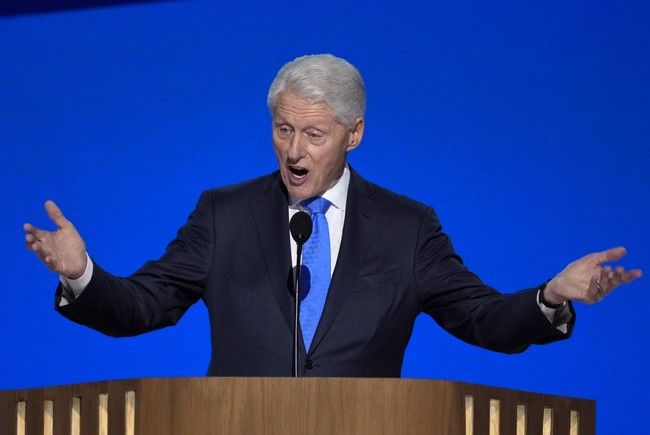
Bill Clinton’s July 4 letter sparked sharp reactions by attacking today’s government and institutions, and it highlights how far the Democratic Party has shifted. This piece looks at his most incendiary lines, contrasts them with his past statements, and points out the political consequences his timing and tone create. I examine the inconsistency between his history and his current rhetoric and why that matters for the coming elections.
Americans spent July 4 celebrating the country’s 250th anniversary, but the holiday also exposed a political divide. Some on the left used the occasion to criticize the nation and its leaders rather than join the celebration. Those attacks drew strong pushback from conservatives and independents who saw the holiday as a moment to affirm national pride.
One stark example came from Bill Clinton, whose letter landed on July 4 and read more like a political broadside than a patriotic message. On a day set aside for unity, his words targeted the current administration, the judiciary, and Congress with sweeping allegations. That choice of timing showed an unmistakable willingness to politicize a national celebration.
At first glance many dismissed the letter as a long, unfocused rant. But the details are what made it politically dangerous for Democrats who once positioned Clinton as a moderate. His language—about agents, unconstitutional wars, and weaponized government—echoed the most extreme critiques from the left and undercut any claim that the party remains centrist.
The most contentious passage accused those “in charge” of unleashing masked agents to seize people and of starting wars without clear goals. Those are serious charges to level on Independence Day, and they come with heavy political baggage. For critics, the timing felt like an intentional provocation rather than sober analysis.
https://x.com/BillClinton/status/2073377780423692689
Clinton did not limit his critique to the executive branch; he included the Supreme Court and Congress in his list of offenders. He wrote that lifetime appointees and a compliant legislature had “weaponized government to settle personal scores, prosecute enemies, stamp out free speech and made the federal government a new profit center for themselves and their allies.” That is sweeping language aimed at eroding trust in major institutions.
“The people in charge have unleashed masked agents on American communities to seize people from their homes, workplaces and the street,” Clinton said.
“They have started an unconstitutional war on a whim, with no clear objectives or exit strategy, and zero regard for the consequences to the lives of millions of people around the world,” he added.
It is worth noting the irony and the historical contrast. Critics pointed out incidents from Clinton’s own tenure and the broader Democratic history—like Elian Gonzalez and Waco—to highlight the disconnect between his past actions and his current rhetoric. Those references suggest a selective memory that undermines the moral high ground he attempted to claim.
Imagery of masked agents and unchecked authority is powerful and designed to inflame. That makes his words useful political ammunition for opponents who can point to past controversies and argue the criticism is hypocritical. The result is a widening gap between the party’s current leadership and its traditional or moderate supporters.
On immigration, Clinton’s present stance clashed with his own earlier declarations, exposing a shift in priorities. Democrats now often frame immigration enforcement as a moral failing of the other side, while historical Democratic positions were more nuanced and focused on enforcement and legal process. This change looks tactical, aimed at opposing the current administration rather than advancing consistent policy.
The 1995 Clinton quote about being “a nation of immigrants” but “also a nation of laws” once anchored a more balanced approach to enforcement and compassion. Revisiting that line shows how the rhetoric has moved; the earlier message promoted both welcome and order, while the new tone emphasizes grievance and attack.
“We are a nation of immigrants, but we are also a nation of laws,” Clinton said then in 1995.
“It is wrong and ultimately self-defeating for a nation of immigrants to permit the kind of abuse of our immigration laws we have seen in recent years, and we must do more to stop it (huge applause).”
Given the tone of his letter and its timing, Republicans and conservatives have a clear opening to contrast past moderate positions with today’s leftward drift. Highlighting these inconsistencies could shape voter perceptions ahead of midterms by framing Democrats as out of touch with mainstream concerns about law and order. The political stakes are real and immediate.
Clinton’s July 4 message won’t be a footnote for long; it feeds into a broader narrative about the Democratic Party’s trajectory. Whether one agrees with his claims or not, the effect of his words is to sharpen divisions and give opponents concrete examples to use in campaign debates. That dynamic will play out in the coming months as both parties fight for control of the national story.


Add comment