
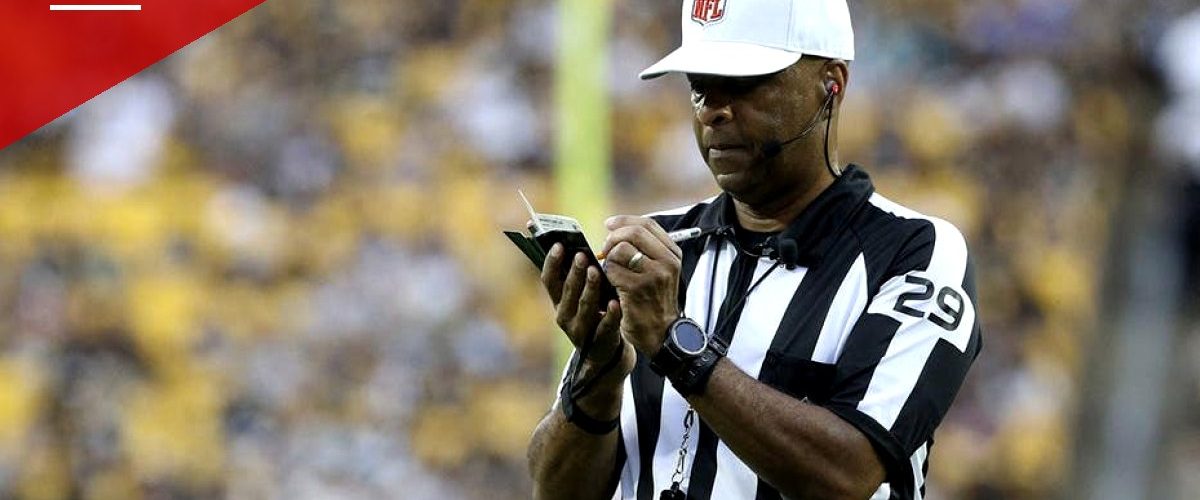
Former NFL quarterback Sean Salisbury says referees should have to explain themselves to reporters right after a game, the same way players and coaches do, rather than letting missed calls get sorted out through a league statement the next day.
“I want to know what they saw on the field immediately after the game, when their emotions were up, just like the players and coaches,” Salisbury told OutKick.
Salisbury’s comments came amid a broader conversation about recent confrontations between officials and players on the field, and why the people tasked with keeping order sometimes appear to lose their own composure.
“It’s like officials are instigating certain situations,” Salisbury said.
How officiating explanations work now
Currently, reporters covering NFL games can request explanations of disputed calls through what’s known as a pool interview process. A designated pool reporter asks questions on behalf of the media, and the answers are distributed afterward in a transcript. That’s the source of many of the officiating explanations that show up in game coverage.
Salisbury wants officials to go further and take questions on camera after games, just as routinely as the players and coaches do.
While pressing for more accountability, Salisbury said he respects the difficulty of the job. His frustration, he said, is reserved for errors that shouldn’t require replay review to spot.
“You can’t miss the ones that the naked eye can see. You just can’t. That’s their gig.”
He also questioned whether the existence of replay review has made some officials slower to commit to a call in real time, describing it as a kind of “security blanket” that can affect an official’s initial judgment.
Recent suspensions
Salisbury pointed to two recent NFL suspensions as evidence the league is already holding officials accountable for conduct on the field. On Oct. 5, the league suspended line judge Jeff Seeman for two games and referee Adrian Hill for one game following separate confrontations with players during Week 4.
Seeman was caught on video appearing to yell an expletive at Cardinals tight end Trey McBride during Arizona’s game against the Giants. Hill yelled at Vikings linebacker Eric Wilson after Wilson was accidentally knocked into him during Minnesota’s game against Miami. Wilson later said Hill accepted his apology and explanation for the collision.
Salisbury argued that officials carry a distinct responsibility when tempers flare, since they’re the ones meant to defuse a dispute rather than escalate it.
“Your job is not there to pour gasoline.”
He said the best officials know how to settle a confrontation before it worsens, whether by calming a player down or being firm, without letting a disagreement turn personal. He also noted that a heated exchange with a player can color how a team views that official’s calls for the rest of the game.
“You start to think, well, if you miss a call later on against the team, well, he had it in for us,” he said.
Salisbury also raised the role of sports betting in fueling suspicion around disputed calls, arguing that fans who believe a call cost them money are already inclined to question an official’s motives — and a visible shouting match only adds fuel to that doubt.
“We hold players accountable. I think officials need to be held accountable,” Salisbury said.


Add comment