
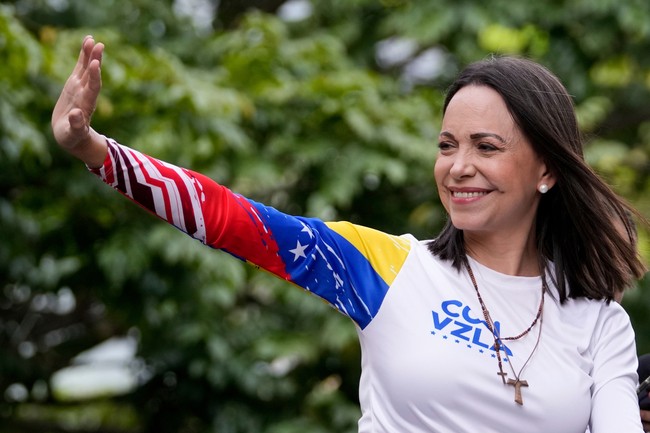
This article reports on Venezuelan opposition leader María Corina Machado’s interview about Nicolás Maduro’s weakening regime, her praise for U.S. pressure, and plans for a post-Maduro transition while preserving key quotes and embed markers.
María Corina Machado, a Venezuelan opposition leader in exile and Nobel Peace Prize awardee, told CBS News host Margaret Brennan she supports the Trump administration’s approach toward Caracas. She credited the United States and President Trump with being instrumental in applying pressure on Nicolás Maduro’s government. Machado framed that pressure as a defense of liberty in the hemisphere and expressed gratitude for the role the U.S. has played.
Machado’s endorsement was unambiguous. “We, the Venezuelan people, are very grateful to him and to his administration, because I believe he is a champion of freedom in this hemisphere,” she said on Face the Nation. Her comments signal alignment between Venezuelan opposition aims and a U.S. policy that leans on sanctions and political isolation to weaken authoritarian officials.
The opposition leader also acknowledged the moral and practical complications of escalating sanctions. “Machado acknowledged that more sanctions and more possible seizures of oil come with the risk of cutting off the already impoverished people of Venezuela. But she said “what we’re doing is for the well being of the Venezuelan people.”” Machado recognizes that actions against Maduro will have collateral effects, yet she frames those measures as part of a broader effort to save lives and restore institutions.
“What we want to do is to save lives, but Maduro was the one who declared a war on the Venezuelan people,” Machado said. “A war we didn’t want. A war we are suffering with hundreds of thousands of killings and forced executions in the last years.” Those words lay responsibility at the feet of the regime and argue that international pressure seeks to stop ongoing abuses rather than punish victims.
Strategically, the opposition sees Venezuela not just as a humanitarian case but as a geoeconomic opportunity for the region and for the United States. Machado stresses Venezuela’s natural resources and advantageous location, arguing that a stable, market-oriented Venezuela would be a near-shoring partner and a regional ally. She envisions transforming the country from a “criminal hub” into a security partner and economic contributor for the Americas.
Machado was specific about what a post-Maduro transition would require. “We will need a lot of support. Advice, information, technology, not only from the United States but from multilateral organizations, and some of which we are already working to gather,” she said. Her list includes security, energy restoration, food supply, financial restructuring, and creating conditions that attract international investment in oil, gas, infrastructure, and critical minerals.
Her timeline claims readiness: teams, plans, and a sequence for action. “We have the plans ready. We have the teams ready. We know what we have to do the first 100 hours, and the next 100 days. Most importantly, and I want to insist on this, we have the people.” Machado emphasizes popular legitimacy and an initial operational blueprint that would require international cooperation to prevent chaos and a new refugee wave.
From a conservative viewpoint, the U.S. interest in pushing for Maduro’s removal is framed in terms of regional security, economic stability, and the defense of freedom against authoritarianism. The argument is that strong, targeted pressure can create the political space for opposition forces to execute a transition. Machado’s praise for U.S. leadership reinforces that case and portrays American engagement as catalytic.
There are clear risks, and Machado does not shy away from them: sanctions can deepen suffering in the short term, and any transition could be messy. Yet she insists the cost of inaction is higher, pointing to mass killings and enforced deprivation as ongoing harms that demand intervention. Her stance is that restoring governance and markets ultimately benefits Venezuelans and regional partners alike.
Machado’s interview reflects both urgency and a longer-term perspective: immediate pressure to weaken the regime coupled with concrete plans for governance, energy, and financial recovery. Her emphasis on international assistance and near-term action frames the post-Maduro period as one that must be carefully managed to stabilize the country and reintegrate it into regional commerce and security frameworks.
Editor’s Note: Thanks to President Trump and his administration’s bold leadership, we are respected on the world stage, and our enemies are being put on notice.
There was an interesting exchange, as well, on a possible transition – meaning, of course,
Add comment