
The Balogun red card controversy swung from a heated match call to an international back-and-forth involving FIFA, the Belgian federation, and even a phone call from President Donald Trump, with FIFA ultimately suspending the red-card implementation so Folarin Balogun could play while the disciplinary process proceeds.
The match in question saw Folarin Balogun shown a red card for a foul against Bosnia and Herzegovina that left the United States down a key striker and facing a suspension for the next game. The initial on-field officials did not call the foul; the red card came after a VAR review, which opened immediate debate about whether slow-motion replay distorted the sequence. Critics argued VAR’s slow motion can exaggerate angles and timing, making routine contact look worse than it was in real time.
https://x.com/PFF_Nicky/status/2073913592693284984
The uproar was loud and fast. Fans, analysts, and team officials questioned the protocol and whether the disciplinary outcome matched the spirit of the play on the field. Balogun himself handled the moment with professionalism, even as the team had to adapt to playing without one of its top forwards.
On Sunday FIFA moved unexpectedly by invoking Article 27 of its Disciplinary Code to suspend implementation of the automatic suspension tied to the red card. That meant Balogun could be available for the next game while the disciplinary process continued, but it did not erase the red card itself. The decision rested on FIFA’s ability to pause disciplinary measures pending review, a mechanism that exists for cases where proportionality and context warrant further examination.
The choice to suspend implementation under Article 27 immediately drew pushback. Belgium, the next opponent, indicated discomfort because the change affected competitive balance between the teams. FIFA rejected Belgium’s procedural challenge on the basis that the Belgian federation did not have standing in the disciplinary proceedings, since it was not a direct party to the matter. FIFA’s handling highlighted the narrow legal pathways federations must use when contesting internal decisions.
“By operation of Article 27 FDC, the implementation of the automatic suspension for USA player Folarin Balogun is suspended for a probationary period of one [1] year,” the soccer governing body said in a statement.
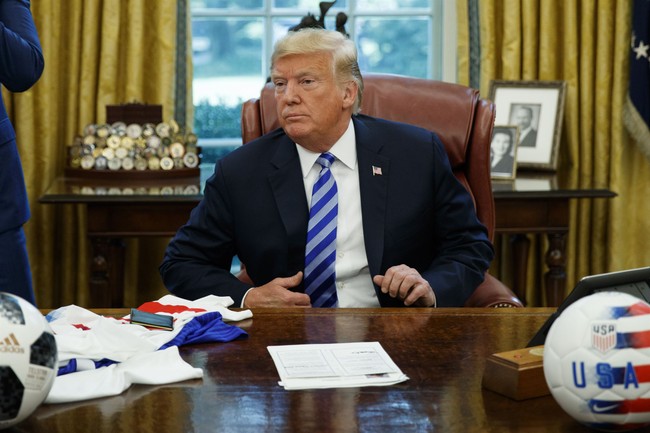
The procedural bounce continued when reports surfaced that President Donald Trump had placed a call to FIFA President Gianni Infantino asking for a review of the matter. The phone call became a lightning rod for critics who claimed interference, even though the nature of the call, as described by Trump and acknowledged by Infantino, was a request for explanation rather than a directive. From a Republican viewpoint, asking for clarity on a questionable call affecting an American player is reasonable; it is not the same as ordering an outcome.
Infantino publicly emphasized FIFA’s legal safeguards and the autonomy of its judicial bodies, noting that the committee decision process is independent and grounded in the applicable codes. He said the case would be handled by the competent bodies and reiterated that governance and judicial independence are foundational to FIFA’s credibility. That statement aimed to reassure stakeholders that decisions hinge on regulatory frameworks, not outside influence.
“FIFA’s judicial bodies are independent. They operate autonomously, apply the FIFA Disciplinary Code, and decide cases based on the applicable regulations and the specific facts before them. Their independence is essential to the credibility and integrity of football, and this must always be respected.
“Yes, I regularly discuss matters related to the FIFA World Cup with the President of the United States, and on this matter, I did receive a call from President Donald Trump, just as I receive calls from heads of state, government officials, football stakeholders and business executives from around the world on many different issues. During our conversation, I explained that there was an ongoing legal process involving FIFA’s independent judicial bodies and that the case would be decided in due course by the competent bodies. That is how FIFA’s system works, and it is a principle that I will always uphold.”
The episode echoes prior instances where FIFA utilized Article 27 to temper disciplinary impacts, including cases involving high-profile players who faced partial suspensions to preserve competitive fairness at major tournaments. Those precedents demonstrate the body can and will apply discretion when a strict enforcement outcome seems disproportionate. That does not erase the original decision, but it does allow matches to proceed with fewer distortions to tournament competition.
What remains clear is that refereeing technology, governance rules, and the role of national leaders now intersect in ways that can influence public perception, even when formal decision-making rests with independent committees. This case will likely prompt renewed conversation about VAR standards, disciplinary transparency, and how FIFA communicates its rulings to a global audience. The disciplinary process will continue, and the procedural tools FIFA used will be scrutinized for fairness and consistency as the tournament moves forward.

Add comment