
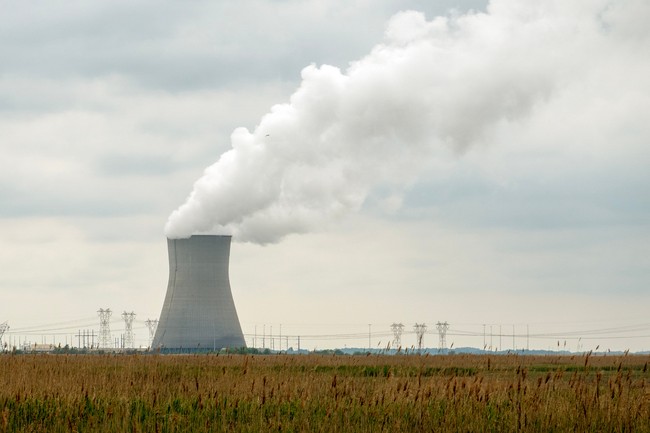
The United States just saw two privately built advanced reactors reach criticality within weeks of each other, a milestone that underlines a rapid revival in American nuclear innovation and the success of bold policy goals set by the current administration. One project, Antares Nuclear in Idaho, reached criticality less than three weeks before Valar Atomics’ Ward 250 unit in Utah completed a zero-power fueled criticality demonstration at the Utah San Rafael Energy Lab. These milestones show private teams moving fast, using Department of Energy authority to test breakthrough designs, and meeting a July 4 target laid out by federal leadership. The developments matter for energy independence, resilient military power, and a domestic industrial strategy that aims to scale cleaner, dispatchable power quickly.
Valar Atomics went from stealth to a field site and then to a critical reactor in a remarkably short window. The company incorporated in 2023, came out of stealth in February 2025, broke ground in September 2025, and achieved criticality within nine months after construction began on an otherwise empty site. That speed shows what happens when private capital, experienced defense and tech investors, and streamlined federal support converge around a clear national priority. It’s a contrast with the decades when regulatory inertia and lack of market focus froze progress in advanced reactor builds.
The Ward 250 design is compact and novel: a high-temperature gas-cooled reactor using tri-structural isotropic TRISO fuel, helium coolant, and graphite moderation. It’s small enough that its core components can be transported in unusually modest transport envelopes, a deliberate design choice that emphasizes portability and rapid deployment. Valar describes plans to operate these units remotely and scale to roughly five megawatts of electricity per unit when fully developed, which opens a range of use cases from remote military bases to industrial facilities that need dependable heat and power.
The company ran a smaller NOVA Core configuration at the National Criticality Experiments Research Center in December 2025 to confirm physics and zero-power criticality before shifting to the full Ward 250 machine. That phased testing approach reduced technical risk and let the team validate core behavior under controlled conditions. Moving the unfueled components to Utah required three U.S. Air Force C-17 Globemaster III flights, marking a first for airlifting a small reactor on a military transport and demonstrating logistics options that conventional plants can’t match.
“Nine months ago, this was an empty site. Today, there’s a critical reactor on it, built and operated by the Valar team. We met the milestone the executive order set. This reactor was built to make power, and that’s exactly where we’re headed.”
Energy leadership at the Department of Energy highlighted the novelty and importance of these engineering and logistical firsts. The Ward 250 demonstration used DOE authority under the Atomic Energy Act to authorize a research reactor outside of a national lab, which is an important legal pathway for testing advanced concepts without waiting for full Nuclear Regulatory Commission commercial licensing. That pathway accelerates innovation while preserving a route to eventual NRC oversight for commercial deployment.
“From the first-ever airlift of a small reactor aboard a U.S. military C-17 to successful zero-power criticality testing, Valar Atomics is delivering achievements that mark a revolutionary moment for advanced nuclear in this country.”
Strategically, a flyable reactor that can be moved to forward sites or deployed to locations isolated from the civilian grid changes how we think about resilience and national defense logistics. Smaller reactors reduce the need for long fuel convoys and provide local, firm power that adversaries cannot easily disrupt. Military leaders are already eyeing full-power generation tests and delivery to installations once the designs are proven at scale.
Valar is backed by a mix of high-profile tech and defense investors who see the potential to scale these units into dense clusters, which the company calls “gigasites.” Those clusters would stitch thousands of small reactors into sites capable of supplying electricity, industrial heat, and feedstock for carbon-neutral fuels, at costs competitive with fossil fuels in many applications. Reported fundraising has reached roughly $580 million and the company’s private valuation moved toward $2 billion earlier this year, signaling strong investor conviction in commercial prospects.
Regulatory friction remains a critical next hurdle. While DOE authorizations enable testing, commercial sales and deployments still require NRC licensing under current law. Valar has joined other industry players and states in litigation that seeks to shift exclusive commercial licensing authority or at least broaden pathways, reflecting industry pressure to modernize the regulatory framework for small advanced reactors. That fight will determine whether this spike in private innovation translates into a widespread commercial rollout or stays limited to experimental and defense applications.
Two companies hitting a shared deadline shows more than public relations savvy; it shows disciplined execution against clear policy objectives. The last time the country saw breakthroughs like this at scale was decades ago, and the new pace suggests a different trajectory: faster iteration, modular manufacturing, and a national industrial focus on secure, domestic energy production. If the momentum holds, these projects could reshape parts of the electricity system and strengthen American energy and defense posture without waiting for slow-moving legacy processes to catch up.
Editor’s Note: Thanks to President Trump’s leadership and bold policies, America’s economy is back on track.



Add comment