
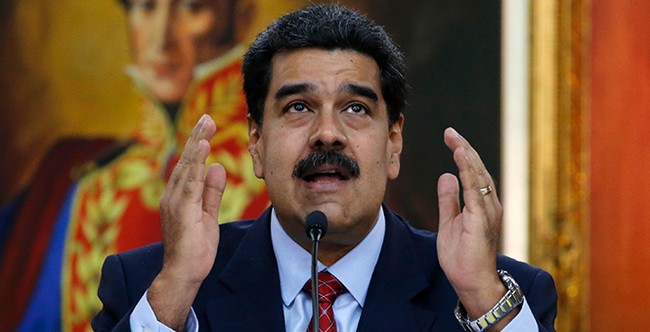
Nicolás Maduro was brought to a Manhattan federal courthouse under heavy guard, facing a superseding indictment that accuses him of narco-terrorism and weapons crimes; the transfer, the courtroom assignment, the legal team, and the political fallout are all in play as the U.S. handles the case. This account follows the courthouse arrival, the charges listed in the indictment, who else is charged, the judge overseeing the matter, reaction from political figures, and the tactics used in the operation that led to Maduro’s capture.
Now That’s a Perp Walk: Watch Maduro Hauled to Court Under Heavy Guard
Venezuelan strongman Nicolás Maduro arrived at Manhattan federal court under a heavy security detail, escorted in an armored vehicle and moved through a secured area before appearing before a judge. The scene drew a large presence of federal and local law enforcement on the streets near the courthouse.
The ousted Venezuelan president and his wife have now arrived at the Manhattan federal court where they’ll go before a judge later today on narco-terrorism charges.
The armored car carrying Nicolas Maduro and Cilia Flores reversed into a secured area at the courthouse just before 7:45 a.m.
Scores of heavily armed DEA officers and NYPD cops swarmed the streets as the transfer took place.
The visual of Maduro being stashed into an armored car and brought to court is exactly the kind of public accountability moment many conservatives have been waiting to see. It’s a very public demonstration that the rule of law can reach even entrenched foreign regimes when national security and law enforcement are aligned. The images and the operation’s precision feed into broader discussions about American resolve and operational competence.
Maduro is charged in a superseding indictment that lists four counts: narco-terrorism conspiracy, cocaine importation conspiracy, possession of machineguns and destructive devices, and conspiracy to possess those weapons. Others were charged alongside him; his wife Cilia Flores faces three of the counts but not the narco-terrorism charge. Each count carries severe potential penalties and lays out a broad criminal case the government will pursue in federal court.
The indictment’s criminal counts underscore the gravity of the accusations and the national security angle behind them. The docket puts the matter before U.S. prosecutors who will seek to present evidence connecting Maduro and co-defendants to drug trafficking and prohibited arms possession. Observers on the right see this as a long-overdue accountability moment for a regime that sponsored rivers of narcotics and violence.
The case was assigned to U.S. District Judge Alvin K. Hellerstein, a senior jurist with a lengthy record handling national security and terrorism-related litigation. He’s a veteran judge whose docket has included major, complex matters tied to national events. Given his experience, the courtroom will be navigated with attention to classified or sensitive materials that could arise in pretrial proceedings.
The born-and-bred New Yorker has presided over a slew of cases tied to the 9/11 terror attacks and others related to national security.
Maduro’s legal representation was reported as longtime Manhattan criminal defense attorney David Wikstrom, though it’s not yet clear how long that counsel will remain in place or how the defense strategy will evolve in federal court. The presence of established defense counsel is typical in high-profile federal prosecutions, and the courtroom contest will hinge on documentary evidence, witness testimony, and the government’s ability to tie leadership to criminal enterprises.
The operation that brought Maduro into U.S. custody was named Absolute Resolve, and it involved rapid extraction from Caracas with no reported U.S. casualties. That outcome, and the speed of the transfer, sparked immediate partisan reactions at home. Democrats criticized the military action and expressed concern about leaks, while many Republicans praised the decisive use of force to remove a dangerous actor and bring him to justice.
The partisan flare-ups included public remarks that illustrated the divide: critics warned about escalation and legal complications, while supporters highlighted mission success and accountability. Senate Minority Leader Chuck Schumer’s comments about the operation’s secrecy added fuel to the debate, with some conservative voices pointing to those remarks as an example of why operational security matters. The incident sharpened contrasts between political approaches to national security and decisive action.
In the days ahead, the case will move through arraignment, discovery, and pretrial motions, and the public will watch how prosecutors handle classified or sensitive evidence tied to international operations. The charges are serious and complex, so the legal process is likely to unfold across many hearings and filings. Conservatives will be watching not only for legal outcomes but for how this episode influences broader policy debates on foreign leadership, drug trafficking, and the use of U.S. force abroad.
Add comment