
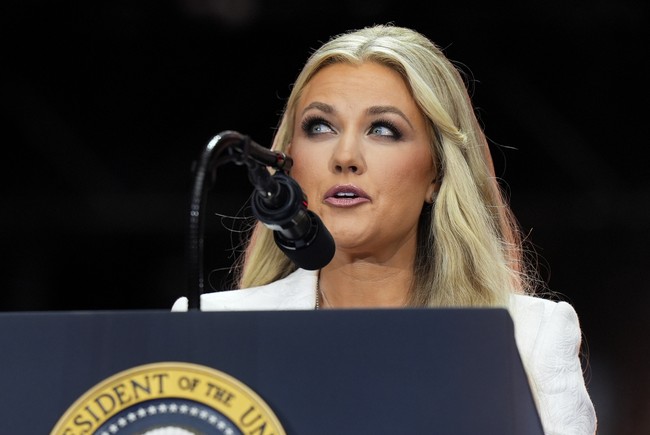
This article explains why Erika Kirk canceled a Turning Point USA appearance in Georgia after receiving threats, how TPUSA and Vice President JD Vance responded at the event, and the security concerns that led to her withdrawal while preserving the original quoted material and context.
Erika Kirk, widow of Turning Point USA founder Charlie Kirk, withdrew from a scheduled appearance in Atlanta after receiving what TPUSA called serious threats tied to her travel. TPUSA officials say the threats focused on her arrival and departure, with doxxing and direct messages making her security team worry they could not guarantee her safety. The decision came amid heightened fears after Charlie Kirk’s assassination and the public fallout that followed. Organizers and allies framed the cancellation as a necessary precaution rather than an indictment of the venue.
NEW: Regarding the threats to Erika Kirk that prevented her from attending today’s event with Vice President Vance, a TPUSA official tells me that their security had been monitoring the situation in the days leading up to today’s event.
People were doxxing her travel location and trying to track her arrival and departure, I’m told, and there were multiple direct threats against Erika specifically. This ultimately led to her security’s assessment that they couldn’t guarantee her safety.
“The event venue itself was fine, especially once VP was on site, but it was the travel portion that was of chief concern,” the official tells Daily Wire. “Her children are one parent away from being orphans, and so we take security’s assessments and advice seriously.”
At the start of the event, TPUSA producer Andrew Kolvet explained to the crowd why Erika was not on stage and asked Vice President JD Vance for his thoughts about the threats and the attacks she had faced. Kolvet framed the issue as both a security matter and a disturbing sign of public discourse, saying her absence underscored how hostile the environment had become. Vance answered directly from the podium, expressing personal support and emphasizing the severity of the harassment. His remarks mixed personal recollection with sharp criticism of those who attacked a grieving parent.
Mr. Vice President, I’m on stage here instead of our friend Erika Kirk because, unfortunately, she has received some very serious threats in her direction, which is terrible. It’s a terrible reflection on the state of reality and the state of the country. But it underscores a larger point, that she has received a lot of attacks, from surprising places, perhaps. Tell us what you think about that, and some of the people that have made part-time jobs out of attacking Erika, and this is the net result.
Vance described speaking with protective services and deciding to let Erika prioritize her family and safety. He said they had feared cancelation earlier in the day and credited the Secret Service with doing a strong job while acknowledging the unique vulnerability of someone who had just lost a spouse. Vance framed the attacks on Erika as a grotesque overreach, especially given her personal loss. His comments were forceful and unambiguous in defending her grief.
“Sure. Well, first of all, I love Erika, and I know that she did get some threats. And about two hours ago, as you know, Andrew, I was a little worried that we were gonna have to cancel the event, because Erika was not gonna come, and she was very worried about it. And I talked to the Secret Service, and obviously, these guys do a very good job, and I said, you know what, let’s let Erika do what she needs to do for herself and her family.
Vance went on to paint the last six months as an unbearable ordeal for Erika, split between mourning and trying to preserve Charlie Kirk’s work. He called attacks that questioned her grief “one of the most disgraceful things that I’ve ever seen in public life.” Vance also pushed back on narratives that sought to minimize or politicize her mourning, insisting his firsthand presence at a difficult moment contradicted those claims. His language was blunt and aimed at those he saw as exploiting tragedy.
“In so many ways, the last six months or so have been two separate living hells for Erika Kirk. And the first is, of course, that she lost her husband, she lost the father of her children.
. . .
“At the same time, you know, she’s trying to make sure that Charlie’s legacy doesn’t die. And in that context, everybody is attacking her over everything, and they’re lying about her, and it’s one of the most disgraceful things that I’ve ever seen in public life. And I’ve seen a lot of crazy stuff in my life as a political leader. And I will tell you that the people who tell you — I was there with her. I was holding her hand. My wife was hugging her while we loaded Charlie’s body onto Air Force Two and said the Lord’s Prayer. The people who tell you that Erika wasn’t grieving her husband are full of s**t, and we need to be honest about that fact.
. . .
“The thing is, when you become a public figure, the natural thing — I’ve talked to Erika about this privately — is a ton of crazy people say a ton of things about you that simply aren’t true. But the thing that makes it so egregious with Erika is that she’s a grieving person who’s trying to carry on her husband’s legacy.”
Vance acknowledged that criticism of Turning Point USA’s political choices is legitimate, but he drew a bright line at personal attacks on a grieving widow. He argued that questioning whether she grieved or suggesting complicity in her husband’s death crossed into a new low for public discourse. Vance also connected those attacks to a broader failure to target the real perpetrators of violence. The rhetoric underscored a demand for a tougher, more focused response to threats and political violence.
TPUSA sources reiterated that the venue was not the problem once on-site security was present, but that travel-related threats created the deciding risk. Organizers said doxxing and attempts to track movement made the situation untenable for Erika and her children. The episode highlighted the modern interplay between online harassment and real-world danger, especially for high-profile conservatives and their families. For now, the group chose to prioritize safety over optics, a calculation that sparked debate among supporters and critics alike.
Public reaction has been mixed, with some accusing Erika of overstating the danger and others insisting the cancellation was a clear example of why security must be taken seriously. Observers pointed to recent high-profile attacks and attempted assassinations as context for caution, arguing that Secret Service presence at a venue does not eliminate risk during travel. The choice to cancel reflected a risk-averse posture in the wake of violent events and intense online scrutiny. The debate over appropriate responses to threats is likely to continue as organizers balance outreach with safety concerns.
Add comment