
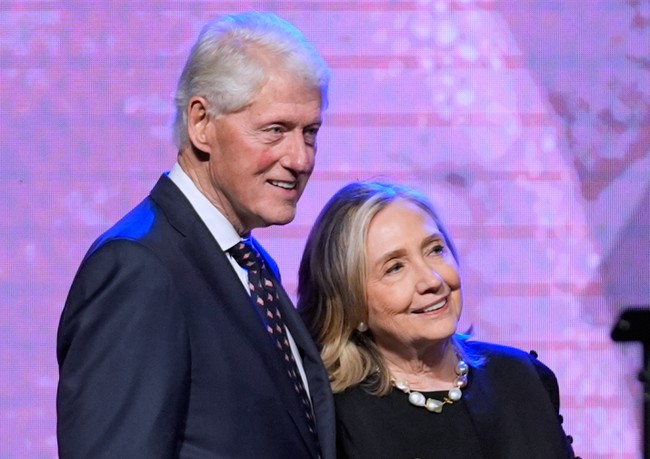
President Trump mocked Hillary Clinton after her comments about testifying before the House Oversight Committee on what she and Bill Clinton knew about Jeffrey Epstein, arguing the Democrats’ attempts to tie him to Epstein have repeatedly backfired and left the Clintons under scrutiny instead.
Speaking to reporters aboard Air Force One, Trump dismissed Hillary’s claim that her testimony is being treated as a “cover-up” and insisted he “has nothing to hide” regarding Epstein. He repeated that he has been “totally exonerated” and framed the Democrats’ efforts as a self-inflicted problem that keeps dragging other people into the scandal.
Trump went further, accusing Hillary of suffering from “Trump Derangement Syndrome” and saying Democrats keep getting “pulled in” as investigators and the public follow Epstein links. His comments aimed to turn the spotlight onto Hillary and other Democrats, asserting they were now entangled in a probe they tried to use against him.
The Clintons initially resisted testifying and only agreed after threats of contempt, with Hillary scheduled to appear on February 26 and Bill Clinton the next day. Epstein was convicted in 2008 for procuring a minor for prostitution and, according to authorities, faced sex trafficking charges before his death in 2019.
Trump and allies point to long-running questions about the Clintons’ association with Epstein, noting that Bill Clinton acknowledged taking “a total of four trips” on Epstein’s plane for charitable work. That admission is central to the argument that Clinton’s ties to Epstein deserve the same scrutiny repeatedly focused on President Trump.
Republican criticism highlights the contrast between how investigations have historically treated different figures, arguing the left’s selective outrage shows a political motive more than a quest for justice. From this angle, the Epstein files expose how partisan priorities shape which relationships become front-page scandals and which are quietly tolerated.
Hillary has insisted, verbatim, “We have no links.” She maintained a “very clear record” and said that her husband “took some rides on the airplane for his charitable work. I don’t recall ever meeting [Epstein].” She also said, “We are more than happy to say what we know, which is very limited and totally unrelated to their behavior or their crimes.” Finally, she asked, “Why do they want to pull us into this? To divert attention from President Trump. This is not complicated.”
Those denials, however firm, have not stopped Republican commentators from pointing to unsealed records and past interactions as reasons to keep pushing for details. The GOP view holds that transparency means treating every prominent connection the same way, regardless of political allegiance.
Trump’s defenders also recall a 2006 interaction in which he reportedly called police to warn them about Epstein, a line often cited to argue Trump acted responsibly long before Epstein’s 2019 death. That claim is deployed to contrast Trump’s alleged early warnings with the Clintons’ long-term associations and to question why those ties weren’t pursued more aggressively sooner.
Critics on the right have been unforgiving about Hillary’s Munich exchange, where a Czech politician bluntly told her she clearly does not like Trump, prompting an annoyed reply from Clinton. Conservatives used that moment to mock what they call Hillary’s obsession with Trump, saying it undermines her credibility and distracts from substantive answers on Epstein.
The fallout plays out in headlines and on Capitol Hill, with GOP lawmakers viewing the oversight process as a chance to expose inconsistencies and force sworn testimony under oath. For Republicans, every public admission, remembered trip, or documented connection becomes part of a broader case that the left’s handling of Epstein-related ties was inconsistent and politically convenient.
As testimony dates approach, the political theater will intensify, with Republicans eager to press for specifics and to highlight any gaps between public statements and available records. The expectation among conservative circles is that scrutinizing the Clintons will reveal more about how influential people navigated relationships with Epstein and whether accountability was applied evenly.
Whether that scrutiny changes anyone’s mind is uncertain, but from a Republican perspective the push is simple: treat all powerful figures the same way and follow the facts wherever they lead. The Epstein files, in this telling, are less about partisan scoring and more about forcing transparency from everyone involved.
The debate over what investigators will find continues, and questions remain about who warned authorities and when. Republicans want documentary answers, asking plainly whether any records exist showing the Clintons alerted law enforcement about Epstein’s conduct, the same way they point to records that mention other prominent figures.
Public reaction will be shaped by testimony and the documents that emerge, but the immediate political effect for conservatives is to spotlight perceived double standards in how elite connections are treated. That framing keeps the pressure on Democratic leaders to explain past interactions and on the oversight process to produce clear, public records.



Add comment