
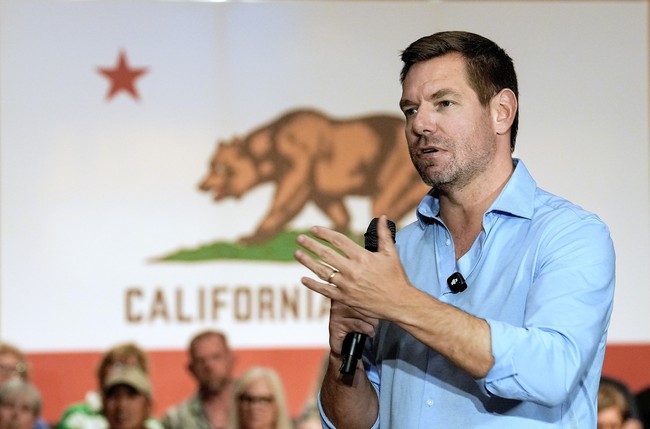
Eric Swalwell has resigned from the House effective immediately, triggering a vacancy in his California district and setting off a scramble among Democrats and union backers to pick a successor and reassess statewide strategies ahead of the fall. This article explains the immediate procedural steps, the likely special election timeline, the intra-party maneuvering that followed his departure, and the political fallout among California Democrats and their allies.
The resignation arrived hours after new allegations surfaced about Swalwell, and party operatives moved quickly to distance themselves. With the seat now empty, California’s governor has the authority to call a special election to fill the vacancy, and the timetable for that process is tightly scripted by state law. That reality turns what some Democrats hoped would be a slow crisis into an urgent scramble to consolidate support before ballots are set.
Republican observers will watch the calendar closely because the law sets specific windows for when a special election can take place. If the governor issues the proclamation promptly, the special election would fall in mid-August under the state code’s requirement that it be held between 126 and 140 days after proclamation. Winning outright requires more than 50 percent of the vote in that contest; otherwise, the seat could remain contested until a runoff or a subsequent process resolves it.
The regular primary for the next full term remains on the books for early June, which means candidates are juggling two timelines at once: the special election to fill the remainder of the current term and the primary for the upcoming term. That double calendar pushes potential contenders to decide quickly whether to mount campaigns that span both contests, and it gives well-funded groups a narrow window to test polling and messaging. For Republicans, the chaos among Democrats is an opportunity to highlight accountability and contrasts on character and governance.
Rep. Anna Paulina Luna announced Swalwell’s status on social media, and her post signaled how fast news can shift the conversation in Washington. Swift public statements and social posts from both parties shaped the first hours after the resignation, but the long-term damage to Swalwell’s political standing and to the groups that had recently backed him could be more consequential. Key donors and labor partners face decisions about whether to redirect resources to other candidates or double down behind an establishment pick.
The Democratic bench in the Bay Area already had names in motion, and the internal jockeying underscores how quickly a vacancy creates winners and losers. State-level players, transit board officials, and local party bosses are all positioning to capture endorsements and organizational support. Those dynamics will matter in a district that ordinarily leans Democratic, because a fractured field can produce surprising results even in blue territory.
California Democrats are maneuvering quickly in the aftermath of Swalwell’s precipitous fall.
Even before he announced his resignation from Congress on Monday, the race to succeed him was underway …. Contenders to fill his solidly blue Bay Area seat include state Sen. Aisha Wahab and Bay Area Rapid Transit board president Melissa Hernandez.
Meanwhile, Swalwell’s collapse is forcing California’s political establishment to reassess who to support for governor. Powerful labor unions, interest groups and consultants had lined up behind Swalwell’s campaign in recent weeks as his campaign appeared to gain momentum.
Within hours of his resignation, there were at least five new polls funded by outside super PACs underway to assess the remaining field, strategists told Playbook. As one prominent Sacramento power player, granted anonymity to speak freely, quipped, those powerful interests are now “picking through the trash bin to see what’s salvageable.”
Even prominent Democrats publicly criticized Swalwell in the wake of his departure, signaling how rapidly political liability can become toxic within a party. One high-profile colleague described betrayal and duplicity in blunt terms, underscoring the depth of the breach in political trust. Those sharp remarks will be used by opponents as evidence of a broader problem that extends beyond one individual.
For Republicans, the episode reinforces themes that can be emphasized in the midterm cycle: accountability, national security, and the importance of vetting candidates’ backgrounds. The vacancy provides a concrete example to contrast with Republican messaging about competence and character in office. Campaigns and conservative media will likely press those advantages as primary voters and general election electorates make choices later this year.
Ultimately, the immediate legal steps are straightforward but the political consequences are messy and fast-moving. Candidates, donors, unions, and consultants all have to act quickly to position themselves for a special election and the upcoming primary. What plays out over the next weeks will reshape part of California’s political map and offer lessons for how parties handle sudden, high-profile departures from office.

Same old story; where is the accountability of these elected officials or political insiders? And for nearly a decade a hot potato that he created with a Chinese Spy just went puff; until now perhaps! Time will tell!
Rep. Eric Swalwell, who announced he will resign from Congress on Monday, is facing mounting criticism over a series of sexual misconduct allegations, but another, decade-old scandal over the California Democrat’s ties to a suspected Chinese spy has also been revived amid reports the FBI is weighing whether to release documents on the matter.
The sexual misconduct claims, including from a former Swalwell staffer, have renewed scrutiny of the congressman’s past ties to suspected Chinese operative Christine Fang as critics and social media commentators demand the FBI release files related to Fang.
Article III Project President Mike Davis, a vocal Trump ally, said Congress must vote to release the investigative files — similar to how it voted to release Jeffrey Epstein’s case files — saying the FBI was legally barred from doing it without the legislative branch’s approval.
“It’s time for Congress to vote to release Eric Swalwell’s FBI file, which we must presume exists after his affair with a Chinese spy,” Davis wrote on X. “His counter-intelligence risks must be staggering.”
[Swalwell resignation collides with China-linked scandal as critics demand file release]
“The House Ethics Committee announced Monday it opened a new investigation into Swalwell based on misconduct claims”
Ashley Oliver By Ashley Oliver Fox News
And while they’re at it why not dig out all of the crud in the Adam Schiff treason and weaponizing of the Government that he orchestrated during the two phony Trump impeachments! I mean really these white collar criminals have done enough against America and the People to warrant being sent to GITMO! In past generations they would have been tried and executed already without any doubt! But yet all we see is these smoke and mirror circus acts to just pass the buck in the end; a whitewash!