
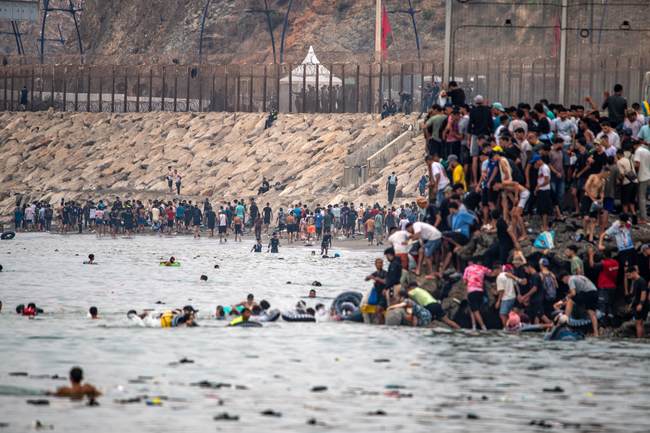
Ceuta, Spain’s North African enclave, has been overwhelmed by a sudden mass crossing from Morocco, with tens of thousands of migrants arriving, dozens reported dead, and Madrid scrambling to respond while the prime minister insists the government will act to protect residents and repatriate those who arrived irregularly.
Reports indicate roughly 60,000 migrants crossed into Ceuta in a single wave, arriving by land and sea and creating scenes of chaos on the enclave’s streets and beaches. Local officials and first responders faced a crisis beyond routine capacity as authorities worked to evacuate the most vulnerable and process huge numbers arriving at once. Communities on the ground found themselves dealing with immediate public safety and humanitarian challenges.
Independent reports put the death toll at least 41 people, with additional accounts saying dozens more suffered injuries or were in peril during the crossing. The Supreme Court ruling that people intercepted at sea cannot be summarily returned complicated operational responses and tied the hands of authorities trying to manage mass arrivals. Those legal constraints have turned a border surge into a full-blown governance and security test for Spain.
Harrowing videos have surfaced from the migrant surge:
With public order strained, Spain moved to deploy its military to support the Civil Guard in stabilizing Ceuta and restoring control of streets and border points. The armed forces were ordered to assist in containment, logistical support, and helping secure overcrowded facilities while civil authorities managed the influx. Officials warned the enclave could not handle the load on its own given the scale of arrivals.
Spain is deploying its military to the North African enclave of Ceuta after thousands of migrants overwhelmed the territory’s border with Morocco, prompting a major security response as officials confirmed at least 18 people died during the crossings.
The Spanish government said the armed forces will support the Civil Guard in restoring order after local officials warned the city could no longer handle the influx. Prime Minister Pedro Sánchez and Interior Minister Fernando Grande-Marlaska are expected to visit Ceuta as Madrid scrambles to contain the crisis.
https://x.com/visegrad24/status/2083117292510966129
Madrid’s official posture has been forceful in rhetoric: Prime Minister Pedro Sánchez labeled the events an “attack” and said Spain would work to return illegal arrivals “as soon as possible.” That public language is aimed at reassuring citizens that the state remains in charge even as critics say previous policy choices helped create vulnerabilities. The government also pledged to intensify cooperation with Moroccan authorities to disrupt the criminal networks that traffic in human beings.
Sánchez went further in a public post, promising increased security presence and a physical containment barrier at sea to facilitate repatriation, and vowing to “expedite the repatriation files of the migrants who arrived irregularly.” Those statements attempt to frame a two-track response: immediate security measures and administrative processing to remove those without legal claim. But skeptics point to past decisions and court rulings that limit quick returns and say political will must match statements.
About 60,000 migrants have crossed into Spain’s North African territory of Ceuta from Morocco in the last 24 hours, Ceuta’s president said, adding that at least 34 others died during the crossing.
The influx comes after Spain’s Supreme Court ruled that migrants stopped at sea while trying to reach Ceuta or Melilla, another Spanish exclave, cannot be summarily returned to Morocco.
Local leaders and residents described overwhelmed hospitals, schools pressed into emergency use, and border posts operating beyond capacity as they received the flood of people. Civil society groups and emergency teams tried to triage medical needs and register arrivals, but large numbers and limited infrastructure made orderly processing extremely difficult. That pressure highlights the practical side of migration policy debates: capacity and control matter when flows spike suddenly.
Political fallout is already spreading as Sánchez’s popularity has been affected by migration concerns and broader governance questions. Critics on the right argue that lax policies and judicial rulings have encouraged irregular crossings and made rapid removals impossible. From that perspective, this is not just a humanitarian story but a failure of political leadership to secure borders and protect citizens.
The human cost is undeniable: dozens dead, many injured, and countless lives disrupted by a dangerous crossing and the turmoil that followed. Authorities face the dual tasks of responding to immediate needs and crafting policies that prevent similar surges, all while navigating legal constraints and international cooperation. The situation in Ceuta will test Madrid’s capacity to combine security, law, and humane treatment in a high-pressure crisis.



Add comment