
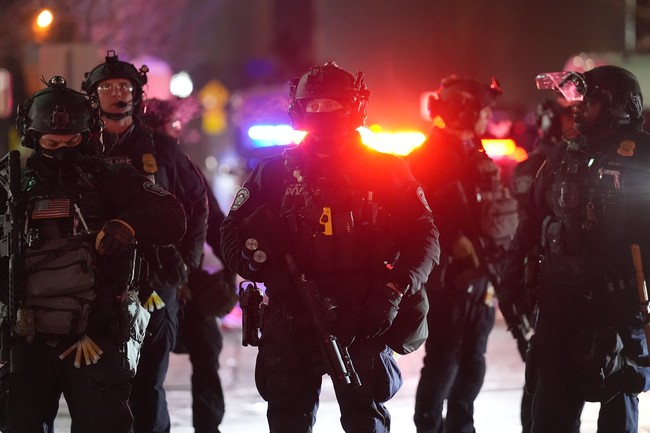
Protests labeled “No Kings” spread across U.S. cities over the weekend, and what started as demonstrations quickly turned confrontational in several places, producing clashes with law enforcement, arrests, and tense stand-offs outside federal facilities.
Reports from multiple cities describe chaotic scenes where protesters and officers confronted each other amid flying objects, shouting, and attempts to breach buildings. In New York, some participants held signs referencing a recent homicide suspect, a choice that shocked many observers and added a grim layer to an already volatile event. These incidents underscore how protests that begin with slogans can escalate into dangerous encounters when crowds turn aggressive.
In Los Angeles, organizers and demonstrators faced off with police in downtown areas already known for heated clashes during mass actions. Authorities moved to detain several people as tensions rose and officers tried to regain control of the streets. The unfolding situation drew attention because of injuries reported and the high-profile nature of the neighborhoods involved.
Some participants in New York displayed signs saying “,” a reference that many found sickening given the recent killing of a healthcare executive who left behind a family. The choice of that imagery at a public demonstration provoked outrage from residents and commentators who saw it as glorifying violence. For many onlookers, that moment crystallized how far some protesters were willing to push symbolic boundaries.
By Saturday evening, clashes were continuing in multiple places and did not fit the “mostly peaceful” label often used to describe protests. The violence included people throwing objects and physical confrontations with police, and officials began detaining those believed responsible for assaults. The sustained conflict made it clear that law enforcement was treating the gatherings as escalating public-safety incidents rather than simple demonstrations.
Authorities are detaining numerous protesters as tensions escalate, with some individuals throwing objects and engaging in physical confrontations with police.
Some observers compared the rhetoric used by protesters to the language of authoritarian states, noting an apparent double standard in how protesters treat Western institutions. Critics pointed out that tactics tolerated at home would meet lethal force in many other countries, arguing the protesters showed a lack of regard for the rule of law. That comparison inflamed debate about protest tactics and appropriate responses from authorities.
In several cities, demonstrators came close to federal buildings, and in Portland the situation grew particularly tense near an ICE facility. Witnesses reported masked agitators tackling officers and throwing items, with law enforcement responding to secure the perimeter and protect federal property. Spray-painted slurs appeared on building facades, escalating the sense that the protests had crossed into destructive behavior.
Staggering video showed masked agitators in Portland, Oregon, tackling federal officers to the ground on Saturday, hours after more than a dozen “No Kings” protests concluded across the city.
The violence unfolded outside the Immigration and Customs Enforcement (ICE) facility in Portland just after 6 p.m. local time.
Department of Homeland Security (DHS) officers were seen battling agitators as they shouted expletives and threw objects at law enforcement.
The word “nazis,” among other hate speech, was spray painted on the building.
Police issued explicit warnings to anyone attempting to breach federal facilities, stating that entering federal property without permission could lead to citation or arrest. Crowd-control measures, including impact munitions and other physical force, were named as possible responses if demonstrators failed to disperse. Officials emphasized that protecting federal employees and property would be a primary concern during any escalation.
The Portland Police Bureau posted a statement on X warning, “Do not breach the doors or enter the ICE facility or property. Failure to adhere to this order may subject you to citation or arrest.”
Police added that, if necessary, crowd control measures — including impact munitions or other physical force — may be used.
“You are directed to move away from the ICE Facility,” officials said.
Outside of Portland and Los Angeles, smaller rallies and celebrity appearances in places like Minnesota gave the nationwide demonstrations a scattered footprint and a mixed media narrative. Some events drew older, famous faces who amplified the spectacle but did little to calm tensions on the ground. That patchwork of actions made it harder for authorities to predict where trouble would erupt next.
Mobs reportedly surrounded an ICE building in at least one city, creating a standoff that required a law enforcement response to prevent a forced entry. Officers warned protesters to disperse and reiterated the legal consequences of attempting to enter restricted facilities. The confrontations left communities anxious about safety and the potential for further escalation as the night progressed.


Add comment