
This article examines how Democrats are increasingly backing independent candidates to sidestep their party’s unpopularity in conservative states, traces key examples from 2014 to 2024, and outlines the 2026 roster of left-leaning independents challenging Republican senators.
Over recent decades, many states that once split tickets have moved sharply Republican at the federal level. Voters in those states rejected national Democratic priorities on social issues, and the result was a solid realignment toward GOP Senate candidates. That shift forced Democrats to search for new tactics to remain competitive where their brand is a liability.
One of the more effective workarounds has been to back or inspire candidates who run as independents, allowing left-leaning interests to avoid the Democrat label. These are often well-funded candidates who cast themselves as post-partisan problem-solvers and emphasize outsider status. When successful, the approach can produce results that outpace recent Democratic performances without carrying a Democrat on the ballot.
The earliest high-profile modern example came in 2014 in Kansas, when Greg Orman ran as an independent against incumbent Republican Pat Roberts. Orman, a wealthy donor with a history of contributing to Democrats and previously running as a Democrat, positioned himself as anti-establishment and nonpartisan. His presence pushed Democrats off the ballot and tightened the race, producing a far stronger showing for the left than typical in that state.
Orman’s campaign ran ads that avoided taking clear positions, instead attacking partisan Washington dysfunction and promoting a professionally produced outsider image. Even Vice President Joe Biden publicly suggested Orman was effectively a Democratic stalking horse, but the strategy still made the contest more competitive than expected. On election day Pat Roberts won with 53.1 percent to Orman’s 42.5 percent, a result that narrowed the usual margin and signaled the tactic’s potential.
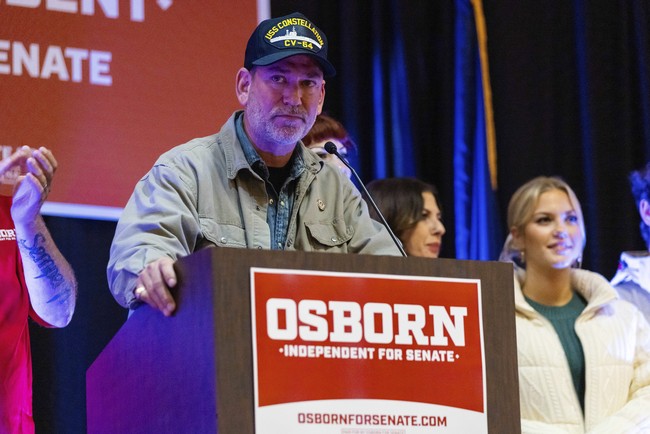
Fast forward to 2024 and you see the same playbook in Nebraska, where Dan Osborn, a former Democrat, Navy veteran, and labor leader, ran as an independent against Republican Senator Deb Fischer. Unions and left-leaning groups helped elevate Osborn, and the Democrats did not run a candidate on the ballot. Osborn campaigned as someone above partisan games and kept the race close, ultimately losing 53 percent to 46.5 percent.
The Osborn effort produced the same pattern: an independent with left-leaning support outperforming recent registered Democrats in the state. That outcome encouraged Democratic strategists to expand the tactic in 2026, recruiting or inspiring a slate of independent challengers in Republican-held Senate races. The goal is to win back seats or at least force closer contests by masking partisan alignment behind an independent label.
Politico noted how Democrats were searching for answers in unusual places after 2024. The narrative around independent candidates emphasized blue-backed messaging dressed in outsider clothes, with ads blasting elites and promising to rise above party influence. For voters tired of Washington, that pitch can be persuasive even if the candidate’s policy positions tilt left.
In 2026, five left-leaning independents are on the map. Idaho features Theodore B. “Todd” Achilles, a former Democrat state representative challenging Republican Senator Jim Risch, and polling from PPP shows Achilles competitive. Mississippi has Ty Pinkins, a U.S. Army veteran who ran as a Democrat in 2024 and is now running as an independent against Senator Cindy Hyde-Smith.
Montana presents a complicated scene: Senator Steve Daines maneuvered to influence the GOP nominee, but independent Seth Bodnar, a former Green Beret and university president, is mounting a campaign against Kurt Alme. Reports indicate the last Democrat senator has encouraged distancing from the Democratic Party, arguing the party brand was toxic in his statewide races. That dynamic highlights why independents are attractive to some left-leaning operatives.
Nebraska again fields Dan Osborn in a different seat, with both parties reportedly jockeying over nominees and potential plants who might stand down to favor an independent’s path. That kind of strategic coordination shows how parties can manipulate ballot dynamics without putting a traditional Democrat up front. In South Dakota, Brian Bengs, a veteran and former Democrat nominee, is running as an independent against Senator Mike Rounds, adding to the trend.
Labeling this pattern the “Indy Imitation Game” captures what’s at play: Democrats and allied groups backing independents who imitate centrist or nonpartisan profiles to attract swing and disaffected voters. Movie buffs might recall the title coincidence with the 2014 film The Imitation Game; here, the imitation is political rather than technological. Whether the tactic will flip seats depends on state partisanship, candidate quality, and whether voters see through the maneuver.
As one political observer quoted Donald Trump’s 2017 phrasing, “We’ll (Just Have to) See What Happens.” The coming election cycle will test if masking partisanship as independence can overcome entrenched conservative voting patterns or merely narrows margins without flipping outcomes.
https://x.com/PollTracker2024/status/2034842607193399452



Add comment