
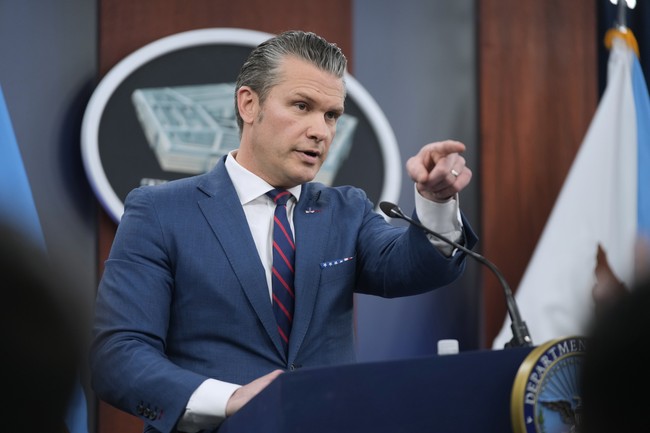
Washington’s latest Pentagon briefing saw Secretary of War Pete Hegseth call out what he labeled biased media narratives while updating reporters on Operation Epic Fury; he criticized coverage he said echoes Iranian propaganda, detailed battlefield progress that has degraded Iran’s military capabilities, and honored crew members lost in a noncombat tanker crash supporting the operation. The briefing mixed sharp critiques of legacy outlets with descriptions of sustained strikes, reduced Iranian missile activity, and firm warnings to foreign actors, all delivered alongside praise for the service and sacrifice of American personnel.
Hegseth Honors Fallen While Sounding Off on Legacy Media’s Embrace of Propaganda
At the Pentagon presser, Hegseth opened by addressing what he called poor journalism and outright falsehoods that he believes harm U.S. military efforts in Operation Epic Fury. He argued that some outlets have echoed talking points from the IRGC, undercutting public understanding at a moment when clarity matters most. The Secretary stood beside Joint Chiefs Chairman Gen. Dan Caine while making these points and pressed for reporting that matches battlefield realities rather than amplifying enemy narratives.
Hegseth pulled specific examples, confronting coverage he said mischaracterized U.S. moves in the Strait of Hormuz and the wider campaign. “We’re used to bad reporting,” he said, defending the Pentagon’s account and singling out a high-profile network for what he labeled repeated errors. “More fake news from CNN,” Hegseth stated. “The sooner David Ellison takes over that network, the better!”
The Secretary also objected to headlines that framed the region as escalating on its own terms, insisting the correct frame is Iran’s increasing desperation. He said narratives like “Mideast War Intensifies” miss the sharper truth that Iran’s tools and posture are deteriorating under pressure. That, he maintained, should shape both coverage and public expectations about how the campaign is proceeding.
Shifting to operations, Hegseth reported that Epic Fury is now in its 13th day and described rapid dismantling of Iranian capabilities. “Never before has a modern, capable military, which Iran used to have, been so quickly destroyed and made combat ineffective,” Hegseth proudly declared. He credited U.S. and allied strikes with degrading air defenses and knocking out key systems that once enabled Iranian aggression.
Gen. Caine outlined follow-up targeting that has methodically reduced Iran’s launch capacity and stockpiles, noting a reported 90 percent drop in missile attack volume. That level of attrition, they said, stems from sustained precision strikes and ample munitions availability across allied forces. Hegseth framed the logistics picture as an advantage that lets the joint force maintain pressure without worrying about supply constraints.
The Secretary warned foreign actors that the campaign will continue until measurable surrender or change happens, and he singled out Iran’s new leadership in blunt terms. Hegseth painted the new Supreme Leader as compromised and out of sight, asserting, “We know the new so-called not-so-supreme leader is wounded and likely disfigured,” and adding that recent communications were text-only with “no voice and no video. It was only a written statement… Iran’s leadership has gone underground, cowering. That’s what rats do.” Those remarks were delivered to underscore his view that Tehran’s command is fractured and hiding.
Hegseth described recent Iranian maneuvers in the Strait of Hormuz as “sheer desperation” and said the Department of War has a “range of options” to deter and stop repeated attacks on commercial shipping that unsettle global energy markets. He argued that the United States and partners are projecting control across the theater, using a mix of strikes and maritime measures to blunt assaults on tankers and to stabilize crude volatility for now.
The briefing also turned somber when officials addressed a KC-135 Stratotanker crash in western Iraq, which occurred while supporting Epic Fury. The noncombat incident claimed four crew members and left two still missing as search efforts continued, a loss Hegseth marked by naming them “American heroes, all of them,” and by stressing the courage and commitment such missions demand. He used that moment to remind listeners that even successful operations carry real human costs and responsibility.
Hegseth closed by suggesting legacy outlets will keep framing the campaign in ways that downplay sacrifice or amplify enemy messaging, saying the press often seeks narratives that fit their preconceptions. From his perspective, reporting that parrots Tehran’s line or minimizes Iranian culpability does a disservice to service members and to readers trying to understand what is happening on the ground. The Secretary’s remarks set a clear expectation: accountability in coverage, and continued pressure on a regime that has threatened U.S. interests and allies.


Add comment