
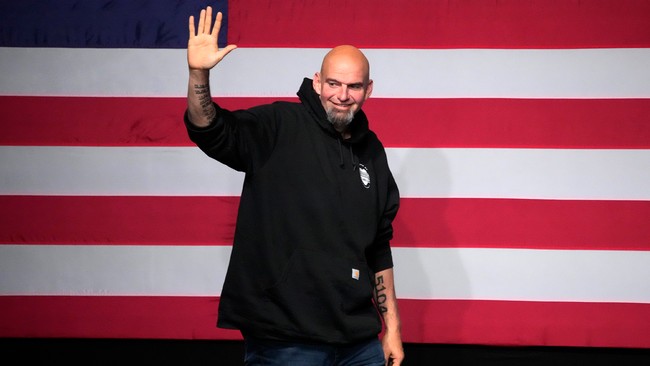
Sen. John Fetterman called out fellow Democrats for refusing to acknowledge that President Donald Trump’s recent military strike likely set back Iran’s nuclear ambitions, arguing partisan politics are preventing many from admitting an outcome they have long said they wanted.
For years, the national consensus across parties has been that Iran must not get a nuclear weapon, and Fetterman reminded listeners of that bipartisan stance. He highlighted how Democratic candidates and lawmakers have repeatedly said preventing Iran’s nuclear program was a top priority. That shared rhetoric makes the current refusal to credit a strike that appears to have degraded Iran’s capabilities striking and puzzling to him.
Fetterman asked why Democrats won’t simply say the operation made the world safer, noting that even past Democratic leaders flagged Iran as a major concern. He specifically mentioned remarks from Kamala Harris during the 2024 campaign as part of that history, underscoring the contrast between past warnings and present reactions. His point was blunt: if stopping Iran was always the goal, why deny an action that moved in that direction?
“I would just like to remind everybody watching that every single Democratic presidential candidate always identified that Iran is a top, top security issue, and every single Democrat in the Senate and in the House says we can never allow Iran to acquire a nuclear bomb.”
Fetterman reiterated that the outcome of the strike should be welcomed by anyone serious about preventing a nuclear Iran, and he found the silence from some on the left telling. He suggested the only plausible reason for the pushback is that President Trump carried out the operation, and that admitting its success would be politically costly within the party. That partisan reflex, he warned, undermines clear-eyed national security judgment.
“Now someone actually made that virtually impossible after this operation. I truly don’t understand why Democrats can’t even acknowledge that this has made the world more safe and more secure, not just for all of us, but especially the region as well.”
Fetterman also acknowledged the political reality in Washington: agreeing with an opposing president carries risks for a politician’s standing. He said that dynamic explains why Democrats hesitate to credit a result they used to demand. In his view, punishment for crossing party lines has become a barrier to acknowledging practical security wins.
“The only thing I can figure out is that it just happens to have been Donald Trump doing it, and now I know that it’s punishing as a Democrat to agree with the President on anything.”
He pushed back on reporters who pressed him to criticize the operation, calling the result an unambiguous removal of a dangerous actor. In one exchange he said, “one of the most evil people on the face of the earth was erased,” a blunt phrase intended to convey the gravity of the threat that was addressed. That frankness reflects a straightforward, results-oriented view of national security focused on outcomes, not optics.
Fetterman framed the debate as a test of consistency: if you’ve argued for years that Iran must be stopped, you should recognize when steps are taken to do that. He warned that refusing to accept clear improvements because of political tribalism weakens the country’s ability to respond to threats. For those who prioritize stability in the Middle East and the safety of American allies, this was a moment to acknowledge success regardless of who ordered the strike.
Democrats who remain silent or critical face a credibility problem when their long-stated priorities are at odds with their reactions to concrete actions that align with those priorities. Fetterman’s critique is about more than partisan scorekeeping; it’s about whether national security judgments will bend to political convenience. He challenged colleagues to put principle over party at a time when deterrence and capability reductions matter.
The broader debate now centers on whether political identity will continue to dictate responses to foreign policy moves that have bipartisan rationale. Fetterman’s challenge is to break that reflex and restore a pragmatic approach to threats that affect the United States and its allies. Whether others follow his lead will shape how future national security decisions are publicly debated and politically rewarded.

“Fetterman reiterated that the outcome of the strike should be welcomed by anyone serious about preventing a nuclear Iran, and he found the silence from some on the left telling. He suggested the only plausible reason for the pushback is that President Trump carried out the operation, and that admitting its success would be politically costly within the party. That partisan reflex, he warned, undermines clear-eyed national security judgment.”
Exactly John and now just leave that nightmare hellish Godforsaken party and tell them to Eat Shit 7 days a week 24 hours a day!
We need more like John Fetterman in both parties as Both Republicans and Democrats need to learn to work together for the American Citizens and Americas Success
That’s quite true! Uni-party and all the Rino’s add to the disaster in the making!
Politicians prove their worth continually; Zip, Nada, Useless much of the time!
Bunch of “Rules for Thee and not for ME” crowd!