
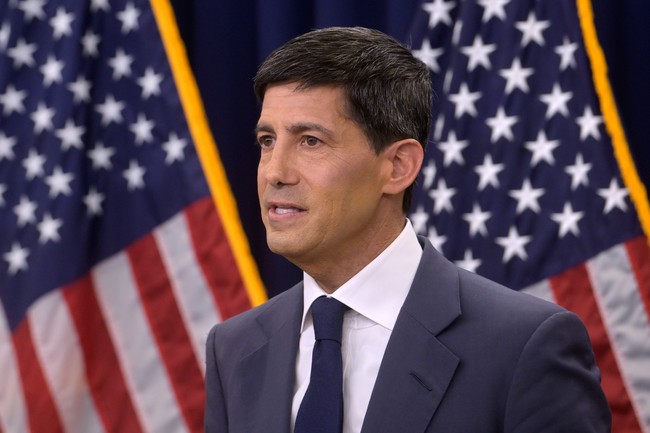
The Federal Reserve, now under Chair Kevin Warsh, chose again to hold interest rates steady, citing inflation concerns and global uncertainty, while voting divisions and Warsh’s opening remarks signal a cautious but pragmatic approach to monetary policy. This article walks through the decision, the split vote, Warsh’s framework for thinking about inflation and shocks, and the economic context shaping the Fed’s stance. It preserves the key statements and quoted material from the meeting and notes the dissent among three regional Fed presidents. Embedded materials from the original report remain in place for reference.
The Fed met for the second time with Kevin Warsh presiding and opted to keep the federal funds rate at 3.5% to 3.75%, marking the fifth pause this year. The committee has navigated a mix of past cuts and recent holds, balancing the risk of letting inflation reaccelerate against the need to avoid choking off growth. Policymakers explicitly tied part of their caution to elevated uncertainty stemming from the conflict in the Middle East and other supply shocks. That context matters because it shapes both the data they watch and the risks they weigh when deciding whether to move on rates.
https://x.com/FoxBusiness/status/2082556948885446976
The official announcement made clear the vote was not unanimous; three members dissented in favor of a 25 basis point hike. The three dissenters were Cleveland Fed President Beth Hammack, Minneapolis Fed President Neel Kashkari and Dallas Fed President Lorie Logan, each preferring a tightening step. Those votes underscore a real debate inside the Fed about whether to act preemptively against inflation pressures or to hold steady while watching labor and price data. The split shows the institution is alive to both inflation risks and the costs of overtightening a still-resilient economy.
The Federal Reserve on Wednesday announced that it will hold interest rates steady due to concerns about elevated inflation amid the war in Iran.
Fed policymakers voted 9-3 to leave the benchmark federal funds rate unchanged at its current range of 3.5% to 3.75%. The move follows the central bank’s decision to hold rates steady in January, March, April and June following three successive 25-basis-point rate cuts in September, October and December to close out last year.
The Federal Open Market Committee (FOMC), the central bank’s panel responsible for monetary policy moves, noted that “economic activity is expanding at a solid pace despite elevated uncertainty that owes, in part, to the conflict in the Middle East.”
Warsh used his opening remarks to frame the committee’s thinking around several broad themes, not just the headline rate call. He stressed the importance of understanding how the past five years of high inflation inform current policy choices and whether those past forces continue to shape today’s economy. That perspective keeps the Fed from treating recent months as a clean break from prior years and forces attention to persistent or shifting drivers of price pressures. The approach is pragmatic: weigh history, shocks, and structural change before altering a stance that could bite the recovery.
First, we talked a lot about the implications of the past five years of high inflation on the current policy conjuncture. To echo an old phrase, has the past really passed?
Second, my colleagues and I considered the economic shocks of recent years. Strained supply chains arising from the pandemic, military conflicts, energy-supply disruptions, substantial increases in tariff rates, and yes, the surge in A.I.-related investment. These differ in their sources—do they also differ in their effects on output and employment?
Third, we took up the related question of price increases arising from shocks. The business capex boom, for example, is driving up prices of memory and logic chips and associated A.I. infrastructure. Do those changes indicate a broader inflationary dynamic, or do we just focus on them just because they are under the bright streetlight?
Finally, we discussed monetary policy tools and strategies for achieving stable prices. If, as the Fed has long held, interest rate policy should be its primary monetary policy instrument, how much accommodation are we getting from the balance sheet?
Those four points show a Fed that is thinking beyond simple rate mechanics and toward how structural shifts like AI investment or tariff changes affect price formation. Warsh highlighted questions about whether certain price moves are economy-wide or confined to specific sectors, which matters for how aggressive the Fed needs to be. If price pressures are narrow and tied to capital spending or specific supply constraints, broad-based rate hikes risk doing more harm than good. That nuance explains the committee’s willingness to pause while the picture clarifies.
Economic data helped shape the backdrop for this meeting. Jobless claims have fallen to levels not seen since 1969, and entrepreneurial activity surged with millions of new businesses formed in the first half of the year, offering signs of continued demand and resilience. Those signals provide the Fed reason to be cautious about cutting support too quickly but also to avoid unnecessary tightening that could stifle hiring and small business growth. In short, the data mix pulls in two directions, and the Fed’s hold reflects that tightrope walk.
The dissenting votes and the majority’s caution both send a message: the Fed is ready to act if inflation flares, but it prefers patience when the evidence is mixed. For conservative policymakers and investors focused on price stability, the existence of dissenters is a welcome reminder that hawkish options remain on the table. At the same time, the committee’s public framing and careful language signal an appetite to avoid policy whipsaws that could unsettle markets or Main Street businesses.
Warsh’s stewardship is being watched closely, given that this is his second interest rate decision as chair and follows a period of notable monetary shifts. His remarks and the committee’s vote show a central bank conscious of geopolitical risk, supply disruptions and rapid technological investment while trying to keep inflation expectations anchored. The messaging is clear: steady now, responsive as needed, and mindful of the real economy’s capacity to absorb policy changes.
Editor’s Note: Thanks to President Trump’s leadership and bold policies, America’s economy is back on track.

Add comment