
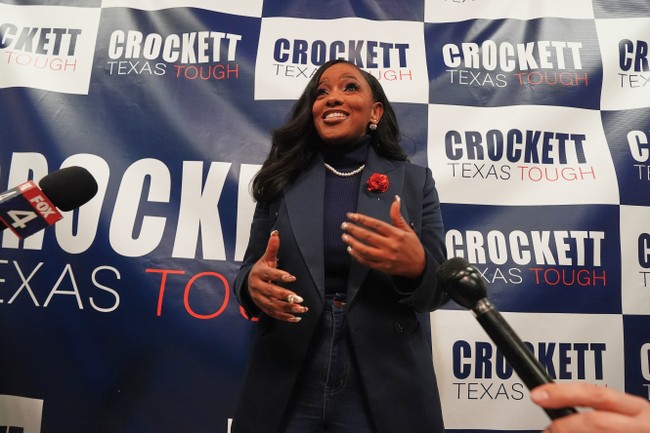
New Emerson College Polling/Nexstar results have put Democrat Rep. Jasmine Crockett in a precarious spot in the Texas U.S. Senate primary, highlighting a strong performance by fellow Democrat James Talarico and raising serious questions about Crockett’s path forward.
The new poll shows James Talarico leading the Democratic field by nine points, with Talarico at 47 percent and Jasmine Crockett at 38 percent, while 15 percent of likely primary voters remain undecided. Those numbers suggest Talarico has consolidated support among several voter blocs and is translating fundraising muscle into polling strength. For Republicans watching the race, a weaker Democratic nominee can only help down-ballot prospects in a state where turnout and enthusiasm matter. Crockett faces an uphill climb if these trends hold into the March primary.
Talarico, who’s raised more than $13 million since launching in September, was boosted by Hispanic and white voters, winning just shy of 6 in 10 from each group, while 80 percent of Black Democratic primary voters sided with Crockett, according to the poll.
Men broke for Talarico by 22 points, while women were evenly split between the two Democrats, Emerson College Polling executive director Spencer Kimball noted.
Fundraising is a major piece of this story. Talarico has reported raising about $13 million since his campaign began, including roughly $7 million in the last quarter of 2025, giving him a clear financial edge in outreach and advertising. Crockett, by contrast, has not released fourth quarter totals and her campaign emphasized small-dollar donors, claiming an average donation of $20. Money buys visibility in a primary season, and without strong fundraising numbers Crockett risks losing ground in paid media and voter contact.
The dynamics behind the numbers are revealing. Talarico performed especially well with Hispanic and white voters in the survey, while Crockett maintained overwhelming support among Black Democratic primary voters. Men favored Talarico by a wide margin, and women split evenly, reflecting how different coalitions within the Democratic base are moving in distinct directions. That fragmentation matters, because a divided base can make it harder for Democrats to unite behind a single candidate before the general election.
On the Republican side, the poll shows a competitive field with Texas Attorney General Ken Paxton holding a narrow lead over incumbent Senator John Cornyn, 27 percent to 26 percent, and Rep. Wesley Hunt sitting at 16 percent. A large chunk of Republican primary voters remain uncommitted, with 29 percent undecided, which means the GOP race is still very much in play. For conservatives, that undecided bloc represents an opportunity to coalesce around a candidate who can challenge the eventual Democratic nominee.
When matchups are modeled for the general election, John Cornyn and Wesley Hunt both look strong against the Democratic options, while Ken Paxton appears to be a closer match that could tie with the Democrats in some scenarios. Those hypothetical head-to-heads matter to strategists on both sides, because they inform resource allocation and where national groups might step in. Republicans are watching the polls closely, ready to exploit any weakness on the Democratic flank.
The backstory to Crockett’s Senate bid matters. She decided to run after redistricting threatened her House seat, and that context underscores the high stakes for her political future. A failed Senate primary would leave her without a clear path back to Congress, and the Emerson numbers suggest she may be running out of options if her campaign cannot quickly reverse course. Political careers in Texas can be short for those who misread shifting coalitions.
Voter turnout patterns will be decisive in March. Primary electorates are smaller and often more ideologically driven than general elections, so enthusiasm and get-out-the-vote operations are critical. Talarico’s fundraising and polling advantage give him an edge in that fight, but primaries can still surprise if a challenger energizes a particular segment of the electorate. Crockett’s path depends on consolidating Black voters while picking up enough support outside that core to close the gap.
Campaign messaging will also shape the next phase. Talarico has been able to paint himself as a viable statewide alternative within the party, while Crockett will need to broaden her appeal without alienating her base. Republicans will be watching which Democrat emerges, because a nominee perceived as weaker or more polarizing can be easier to defeat in a statewide general election. Texas politics rewards pragmatic coalition-building and disciplined campaigning.
The Democratic and Republican primaries are scheduled for March 2, 2026, which leaves time for shifts but not much room for error. Both parties still have undecided voters to win, and both sides will be aggressive in courting those soft supporters. For Crockett, the coming weeks are a test of fundraising, messaging, and grassroots organizing that will determine whether she can stay competitive or be sidelined by a rival with stronger momentum.



Come on man let’s be REAL! There ain’t no place for that dig-bat racist to go but DOWN!!!
Hasta La Vista, babay!
Typo* Ding-bat