
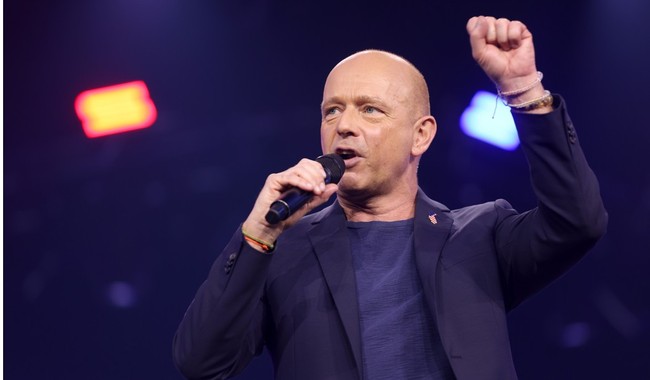
The California governor’s race has a new wrinkle: Republican candidate Steve Hilton reports strong fundraising that outpaces prominent Democrats, and he argues this shows growing voter dissatisfaction with current state leadership.
Steve Hilton says his campaign raised more than $4 million in the last six months and a total of $5.7 million, putting him ahead of Democratic contenders in donor cash. Those figures, if sustained, change the narrative about a one-sided contest in a state that has not elected a Republican governor since 2006. The fundraising edge is already fueling a sharper campaign tone and a message focused on reversing what Hilton calls years of mismanagement.
Hilton frames his campaign as a grassroots insurgency built from scratch, emphasizing broad small-dollar support and rapid momentum. He credits more than 30,000 donors for the haul and has positioned the money as proof that voters want a real alternative to the entrenched Democratic machine. The numbers, he argues, are not just statistics but a sign that Californians are ready to demand accountability on issues like homelessness, crime, and high costs.
“BREAKING: STEVE HILTON DOMINATES FUNDRAISING,” the post read. “We are leading this race and building a grassroots political revolution.”
“THANK YOU to the 30,000+ people who have made this possible,” he added. “We will keep fighting to kick out the failed, corrupt Democrat machine and SAVE CALIFORNIA!” These exact lines have become the backbone of his messaging, repeated at events and across social posts to rally supporters. The language is blunt and unapologetic, aimed at voters who say they are fed up with long-term one-party control and the practical consequences they see on the streets and in their wallets.
Hilton, who became a U.S. citizen in 2021, tells audiences he is an outsider with business experience rather than a career politician. He uses that outsider status to attack what he calls the Sacramento status quo, promising to dismantle the cozy relationships he says have allowed problems to fester. That pitch is shaped to appeal to swing voters and frustrated Democrats who prioritize results over party loyalty.
Part of Hilton’s pitch is a so-called Golden Ticket team approach, highlighting his partnership with Gloria Romero, a former Democratic leader who switched parties. He presents this alliance as proof his campaign can bridge partisan divides and bring practical experience into a reform agenda. Voters hearing this are told it’s not only about rhetoric but a strategic combination of outsider energy and insider knowledge.
“I think it’s time for a change in California. A majority of Californians agree with that, over 60%, but it’s not going to be easy to win as a Republican in the state,” Hilton told the host. “It’s been a long time since a Republican won statewide. So, I’ve always said we’ve got to do it differently. And I’ve always believed in the idea of a team that’s going to turn things around in California.”
On the campaign trail, Hilton repeats poll numbers that show a clear pessimism among residents about the state’s direction, citing surveys where 60 to 65 percent say California is on the wrong path. He argues that this broad dissatisfaction creates an opening for a Republican who can unite concerned voters around concrete policy changes. His speeches focus on restoring order, fixing broken systems, and lowering costs that burden families and small businesses.
Critics point to California’s long history as a Democratic stronghold and warn that fundraising alone does not guarantee a win in statewide contests. Still, Hilton’s team sees the cash advantage as an operational boost—more resources for paid staff, outreach, and the ability to respond quickly when the campaign needs to counter narratives. They say this shift in resources can convert momentum into actual votes if strategies are executed well.
The campaign is making clear bets on key issues voters consistently name as top priorities: homelessness, public safety, housing affordability, and rising living costs. Hilton claims a focused, results-oriented plan that rejects the status quo and offers a contrast to what he calls sixteen years of one-party rule. That message resonates with voters who want measurable improvements rather than ideological promises.
Recreating a Republican path to victory in a blue state is a tall task, but Hilton’s team argues the early donations prove there is a base ready to invest in change. They present the fundraising totals as evidence that Californians are not content with familiar answers and are willing to back a different approach. Whether this financial lead turns into electoral success will depend on turnout, message discipline, and how well the campaign translates enthusiasm into votes.
For now, the campaign keeps pushing a simple promise: overhaul the systems they say have failed Californians and restore common-sense governance. The coming months will test whether the fundraising edge can be turned into a competitive statewide coalition capable of breaking a long Democratic streak. The energy, at least, is unmistakable, and the debate over California’s future just got louder.
Add comment