
California’s top-two primary system is producing an odd and politically significant wrinkle: recent polls show two Republicans frequently occupying the top slots for the June primary while Democrats remain split across several candidates, making a GOP runoff a real possibility even in a deep-blue state.
The top-two jungle primary was meant to calm California politics by forcing the best two vote-getters into November, regardless of party. That setup rewards consolidation and punishes fragmentation, a reality becoming clear as polling data trickles in from different firms. What looks like an unlikely outcome on paper suddenly seems plausible on the ground because Democratic voters are scattered across multiple hopefuls.
California has not elected a Republican to statewide office since 2006, and registration heavily favors Democrats, so a Republican showing well in primary polling is striking. Multiple recent surveys are consistent: Republicans Chad Bianco and Steve Hilton repeatedly appear among the top two in the early snapshots. The pattern is not limited to partisan pollsters and shows up even in surveys commissioned by Democratic actors.
One late-January survey conducted for a Democratic-aligned public-sector union produced topline numbers that placed two Republicans ahead of prominent Democrats. Those results included a large share of undecided voters, highlighting how volatile early primary dynamics remain. When voters are uncertain, rank order, not party fidelity, shapes who advances under the top-two rule.
Chad Bianco: 16%
Steve Hilton: 15%
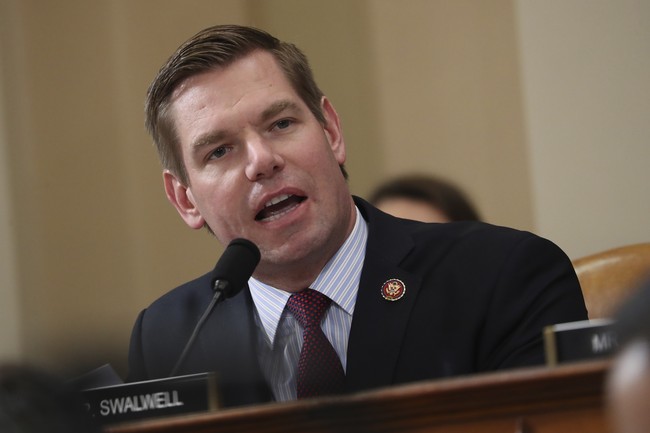
Eric Swalwell: 14%
Katie Porter: 13%
A separate poll commissioned by one candidate’s campaign also failed to show that Democratic consolidation has taken hold. Even in a survey run for a Democratic contender, a Republican came out on top, with the other Republican not far behind. These internal and aligned polls indicate visibility alone does not fully explain the gap; consolidation and voter choice patterns are driving the ranking.
Chad Bianco (R): 21%
Eric Swalwell (D): 18%
Steve Hilton (R): 17%
Katie Porter (D): 12%
That internal memo described the Democratic candidate as “competitive for a top-two spot,” which understates the structural challenge. If Democrats split their share of the electorate across multiple names while Republicans coalesce around two options, the arithmetic of a jungle primary can produce a Republican-versus-Republican November contest. The system only awards positions by finishing order, not by overall party advantage.
Across multiple credible pollsters the pattern repeats: Democrats cluster across several bids while Republican support is concentrated. Polls also show a substantial undecided bloc, often exceeding 30 percent in early surveys, underscoring that many voters are still making up their minds. In such a crowded field, undecided voters and minor shifts in consolidation can determine which candidates survive to the general election.
For Democratic strategists, the remedy is straightforward in theory but politically painful in practice: narrow the field. That would require candidates to step aside or campaigns to rapidly coalesce behind fewer names so Democratic votes are not diluted. Without that, the math favors a concentrated Republican vote emerging as the decisive force in June.
For Republican voters and strategists, the situation presents a clear opening: maintain focus and keep support clustered to maximize the chance of occupying both top slots. The top-two design hands outsized influence to unified voting blocs, and a disciplined Republican electorate could turn structural quirks into actual electoral gains. Winning the primary is not the same as winning November, but getting two Republicans past June would remake the fall contest entirely.
It is important to note that California remains a deep-blue state for November contests, and the primary outcome does not rewrite that reality. Still, the jungle primary treats June as the decisive round, and the current polling suggests California voters might hand Democrats an outcome of their own making by staying divided. The system that Democrats created to stabilize politics might instead produce an unexpected twist if consolidation does not happen quickly.
Polling snapshots are snapshots, and many variables remain unsettled in a long campaign year. Yet the consistent theme across recent surveys is clear: Democratic fragmentation, Republican consolidation, and a meaningful undecided share make the top-two format unpredictable. In a state where November usually favors Democrats, the June math could deliver a surprise built into the rules themselves.


Add comment