
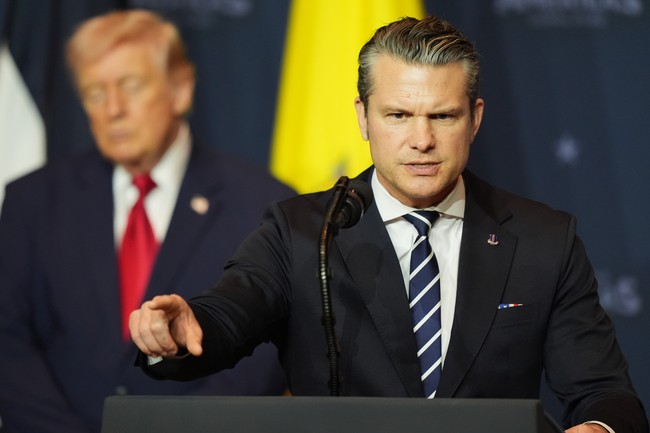
Pete Hegseth used a sermon illustration to accuse legacy media of acting like Pharisees, arguing their coverage of Operation Epic Fury and broader national security efforts is politically driven and blind to American military achievements.
At a Department of War briefing, Secretary of War Pete Hegseth borrowed a passage from the Book of Mark to frame his critique of the press. He says he was struck during church when his pastor read about Jesus healing a man with a withered hand and the Pharisees watching for something to accuse him of. Hegseth compared those self-appointed elites to reporters who he believes are more interested in scoring political points than in acknowledging successful missions.
“This past Sunday, I was sitting in church with my family. And our minister preached from the Book of Mark, the third chapter. And in the passage, Jesus entered a synagogue and healed a man with a withered hand. The Pharisees came to watch, and as scripture reads, they came to see whether he, Jesus, would heal him on the Sabbath, so that they might accuse him. You see, the Pharisees, the so-called and self-appointed elites of their time, they were there to witness, to write everything down, to report. But their hearts were hardened. Even though they witnessed a literal miracle it didn’t matter. They were only there to explain away the goodness in pursuit of their agenda. As the passage ends, the Pharisees went out and immediately held counsel against him, how to destroy him.”
Hegseth said the same impulse to dismiss or explain away success is at work in coverage of Operation Epic Fury, where reporters focus on flaws instead of mission outcomes. He singled out what he called the legacy press and tied their criticism to political hostility toward President Trump. That linkage framed his argument that media bias is not random but targeted at a set of leaders and policies he supports.
“I sat there in church and I thought: Our press are just like these Pharisees. Not all of you. Not all of you. But the legacy, Trump-hating press. Your politically-motivated animus for President Trump nearly completely blinds you from the brilliance of our American warriors. The Pharisees scrutinized every good act in order to find a violation. Only looking for the negative.”
The secretary acknowledged the criticism directed at him personally, but he dismissed it as driven by the same motivation he identified in the press corps. He pointed to multiple campaigns run under his watch that, he said, achieved their objectives with precision, suggesting the coverage has often ignored results. Hegseth called the pattern “incredibly unpatriotic” when journalists seem to cheer one side and explain away failures by another.
“This same press corps, not this exact same press corps, but at least an older press corps, bent over backwards during the Biden administration to explain away, you explained away the disastrous and disgraceful Afghanistan withdrawal. You called it ‘the greatest airlift in American history.’ It’s almost like you’re cheering only for one side.”
He argued that ignoring precision, training, and mission focus while attacking leaders is not neutral reporting but the construction of an anti-military narrative. Still, Hegseth appealed to anyone in the press capable of seeing past partisan impulses to notice concrete successes on the battlefield and diplomatic openings. He invited journalists to recognize achievements that, in his view, are being dismissed.
Hegseth listed specific positives he believes are being overlooked, from battlefield victories to rescue missions and diplomatic deals that could curtail Iran’s nuclear ambitions. He described recent operations as demonstrations of American capability and warned that a press calibrated to find fault misses the broader picture. Those comments framed recruiting gains and morale improvements as tangible evidence the nation is moving in the right direction.
“The hardened hearts of our press are calibrated only to impugn. I would ask you to open your eyes to the goodness: the historic success of our troops, the courage of this president, and this historic moment for a deal that could end the Iranian nuclear threat. The incredible battlefield victory laid before your eyes. The not one, but TWO incredible rescue missions — miracles, you might say. Or a locked in blockade.”
Hegseth turned to recruitment numbers as proof of renewed American enthusiasm for service, noting that the Air Force and Space Force met higher FY26 goals months ahead of schedule. He contrasted that with just a few years earlier, when meeting even lower targets was a struggle, and asked why such positive developments receive little coverage. He argued this silence fits the pattern he’s criticizing, where newsrooms credit or excuse only certain narratives.
“Or how about historic recruiting numbers? Yesterday, we announced that the Air Force and the Space Force met new, higher goals in FY26, five months in advance of the end of the fiscal year. Five months ahead of time. The Marine Corps and the Army will soon do the same.
“Two, three years ago we couldn’t meet lower recruiting numbers — not even close. Where are the reports on that? Where’s the coverage of the new spirit in the country, the new spirit in the ranks, the surge of Americans wanting to join the greatest military in the world. Nothing from the fake news. We sense a pattern.
“You see, on the battlefield, these are demonstrations of uniquely American capabilities. Strength and resolve, it’s all around you, each and every day. But in the press, you only seek the negative. Earning, each and every day the fake news label.”
He closed by saying ordinary Americans can see through the criticism and recognize the courage and achievements of the troops. Hegseth urged the public to judge results, not rhetoric, and to acknowledge that perfection is impossible in war but effectiveness should be visible. His remarks were both a defense of current operations and a challenge to media outlets to change how they report on national security.
WATCH:

Add comment