
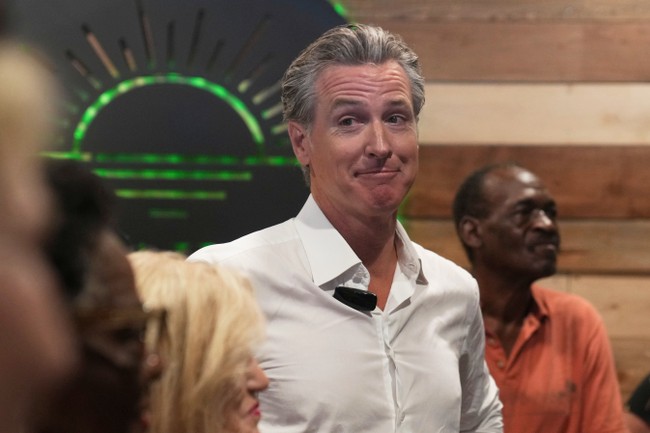
Gavin Newsom has been touring the national stage, hinting at a 2028 White House bid while drawing fresh criticism over comments that undercut his credibility and raise questions about priorities, competence, and honesty.
California’s governor has clearly been cultivating a national profile, attending high-profile events like the Munich Security Conference to showcase foreign policy chops. But that attention comes while the state wrestles with deep problems that many expect a governor to prioritize at home. From infrastructure to public safety, Californians may wonder why their top elected official spends so much time away.
Newsom’s public exchanges lately have not helped his image as a serious contender. In a back-and-forth with Sen. Ted Cruz over the National Guard deployment to Los Angeles, Newsom appeared unfamiliar with the term “historically illiterate” as he tried to defend his position. That kind of stumble makes it easier for critics to paint him as out of touch and unprepared for higher office.
He compounded the problem with a personal anecdote that landed awkwardly. Newsom insisted he lost his birth certificate and hadn’t known where it was since he was seven, an explanation that invited skepticism and mockery. For a public figure angling for the presidency, such details become fodder for questions about readiness and attention to basic documentation.
In an interview with CNN’s Dana Bash, Newsom said the decision to run would hinge on family considerations and recounted his youngest son’s reaction. “My son texted me a few months ago when there was some headline that suggested that I made some decision, and he goes, ‘Dad, are you running for president?’ I said, ‘No, we’ll make this decision as a family.’ And he goes, ‘You can’t.’ And I said, “Why? He goes, ‘I’m too young. You need to spend more time with us.'”
He tried to signal that family matters more than politics, but the message is muddled by his continued travel and public campaigning. “The point is the point, and so what matters is what matters. Like what matters is what matters.” Those lines sounded like political theater rather than a clear explanation, and they left many listeners puzzled. Voters expect straight talk, not rhetorical loops that dodge substance.
Newsom also left open the possibility that family counsel could be reframed as national necessity if he chooses to run. That makes his current behavior look calculated: spend time building a national brand now, then claim later that the family endorsed a run for the good of the country. Skeptics will see that as prioritizing optics over transparency and over his responsibilities as governor.
There is also a legal and factual wrinkle embedded in his story about the missing birth certificate. If someone truly misplaced crucial birth documents at a young age, reasonable observers ask how they later obtained government-issued ID and a passport. That gap in the narrative invites both practical and constitutional questions for a would-be presidential candidate.
Newsom has the trappings of international travel and public engagements, which indicate a functioning passport and a global agenda, yet the birth certificate tale contradicts that image. The inconsistency fuels attacks from opponents who argue he either lacks competence for higher office or is being evasive. Either explanation damages the trust voters need to consider him presidential material.
Beyond paperwork, the optics of leaving California to chase national attention while problems fester at home are politically damaging. Critics argue that campaigning for relevance on the national stage is different from governing well at the state level, and Newsom’s critics are using that contrast to question his priorities. If a governor wants to credibly claim he can lead the nation, he needs a record of steady, competent leadership at home.
Newsom’s rhetorical missteps, inconsistent explanations, and travel-focused agenda create openings for opponents on multiple fronts. From perceived ignorance in a public spat to a puzzling personal anecdote about a lost birth certificate, these moments are being stitched into a larger narrative about judgment and accountability. For a Republican audience, those failings underscore a broader point: national ambition should not come at the expense of state duty or personal credibility.
His Munich appearance shows he can operate on the world stage, but critics will keep asking why he isn’t more present in Sacramento and with his family if that presence truly matters. The questions about documentation, honesty, and priorities are the kinds of issues that can stall a political rise before a formal campaign even begins.
Ultimately, voters and pundits will be watching how he answers the simplest of questions: Is he putting California first, or is he running for a job that requires clear competence and full transparency? That choice will shape whether he arrives in 2028 as a credible candidate or just another national celebrity with unfinished business at home.

Add comment