
Checklist: Summarize the governor’s response, report the voter-registration numbers, show the vendor’s statement, include Sherrill’s quoted remarks, and discuss broader implications for election integrity.
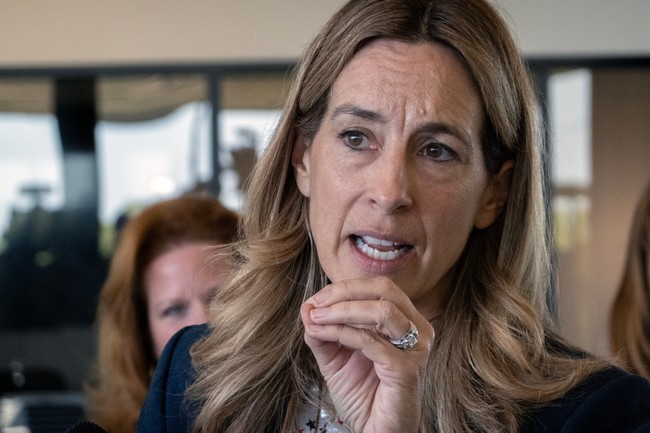
New Jersey Governor Mikie Sherrill pushed back hard against the Department of Justice inquiry into non-citizen registrations, casting the probe as political theater while acknowledging the state found thousands of problematic entries on its rolls. Her reaction came after state officials disclosed that 6,600 non-citizens were listed as registered voters and that about 400 of those people had actually voted. The situation has sparked fierce debate over responsibility, the role of vendors, and what it says about election procedures.
Sherrill sought to pin the immediate blame on a voting technology vendor, describing a software problem and saying her new MVC administrator was replacing the company that ran the system. That stance aims to make the issue look technical rather than administrative or systemic. It’s an approach meant to deflect political heat while promising fixes behind the scenes.
https://x.com/theblaze/status/2079641411855458611
The vendor pushed back, making clear its role was limited to transmitting motor vehicle information and that voter eligibility validation is the state Division of Elections’ responsibility. That response undercuts the governor’s narrative that a simple vendor glitch alone created the problem. When the party contracted to move data says it is not the final arbiter of eligibility, accountability shifts back to election officials.
Despite the vendor’s clarification, the governor escalated the rhetoric and widened the target list, accusing federal actors of weaponizing the discovery for partisan purposes. She framed the DOJ’s attention as an attempt to score political points instead of focusing on fair elections. That rhetoric is familiar in partisan disputes over election integrity and federal oversight.
The governor then made sweeping claims in a public statement that compared the current president’s impact on elections to foreign interference, invoking heavyweight language to describe the threat. Her remarks included this passage, presented here exactly as spoken:
We move very quickly because the people of New Jersey obviously deserve accountability and transparency.
We’re running an independent investigation right now to get to the bottom of exactly how this happened and what’s going on.
But, you know, it is not a surprise to me that the federal government, that the Trump administration, wants to immediately weaponize this against people as opposed to focusing on making sure that we’re running free and fair elections. That’s my focus.
I would say, again, that Trump has done more to undermine our election system than anyone in my lifetime, including Vladimir Putin. He has attacked the 2020 election, which he ran. He has also sent out an insurrection against us when we were trying to certify that election. He then has defunded all the ways in which we protect and keep our elections safe.
So, contrary to what he’s doing here in New Jersey, we are focused on running fair elections and getting to the bottom of what took place.
The bluntness of that attack shifted attention from the mechanics of voter rolls to a broader partisan clash, with Sherrill accusing opponents of political opportunism. Observers noted that such language tends to rally an audience but doesn’t by itself fix registration systems or verification processes. Meanwhile, investigators at the state and federal levels say they need clear access to records to sort out errors and determine whether wrongdoing occurred.
Critics argue the governor’s posture is defensive and that the discovery of thousands of non-citizen registrations reflects weaknesses in oversight and verification. They point out that systemic gaps—whether in data validation, interagency communication, or vendor oversight—can create opportunities for mistakes to propagate into the voter rolls. Fixing those gaps requires transparency and cooperation rather than accusations aimed at political rivals.
The DOJ has opened an inquiry into how the non-citizen registrations happened, prompting objections from state officials who call the move federal overreach. That tension plays out nationally whenever states report serious problems with voter rolls and a federal agency seeks to confirm facts. The debate becomes about more than a single state’s administrative failures; it’s also a fight over who sets and enforces standards for election integrity.
Advocates for stronger security point to reforms like paper ballots, voter ID, and single-day voting as sensible measures that would reduce errors and increase public confidence. Opponents often label such steps as exclusionary, and the clash continues as both sides trade claims about intent, impact, and proportional responses. For voters watching the New Jersey story, the main question is whether officials will move beyond blame to practical, verifiable fixes that stop non-citizens from appearing on active rolls.
At stake is how states balance seamless voter registration with accurate verification, and how federal investigators should respond when large-scale anomalies appear. The controversy surrounding New Jersey highlights the friction between local control of elections and federal civil rights enforcement when irregularities arise. Whatever the final findings, the episode is likely to fuel continued debate over election safeguards and the responsibilities of vendors, election offices, and federal watchdogs.


Add comment