
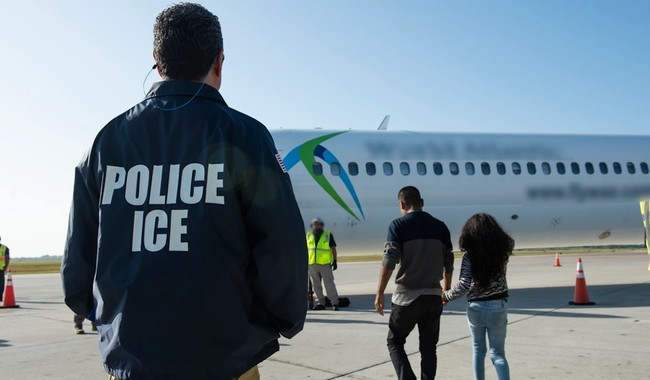
The Department of Homeland Security confirmed a Washington Post account that it signed a contract to acquire six Boeing 737 planes for nearly $140 million to support Immigration and Customs Enforcement deportation operations, and DHS officials say the purchase will save taxpayers money and improve efficiency.
The announcement confirms that DHS has moved beyond relying on chartered flights and is positioning ICE to run its own fleet for deportation missions. Officials argue the move responds to funding increases from Congress and seeks to reduce long-term costs and logistical hurdles tied to contractors. For Republicans who pressed for stronger border enforcement, the fleet signals a tangible step toward executing deportations more reliably.
The Department of Homeland Security recently signed a contract worth nearly $140 million to purchase six Boeing 737 planes for deportations — a move that will allow the agency to operate its own fleet after receiving a massive funding increase from Congress.
U.S. Immigration and Customs Enforcement, the arm of DHS that carries out deportation flights, has long relied on charter planes, but two officials familiar with the contract and records reviewed by The Washington Post indicate ICE has broader plans.
DHS Assistant Secretary Tricia McLaughlin publicly pushed back on the notion that the purchase was anything but prudent, telling critics the agency expects to save $279 million by owning aircraft rather than remaining dependent on charters. She framed the acquisition as an efficiency and cost-savings play that will let ICE use more direct and fuel-efficient routing. In her message she also tied the action to the administration’s priority of removing criminal illegal aliens more quickly and effectively.
“I guess they didn’t want the public to know?” she wrote. “These planes will allow ICE to operate more effectively, including by using more efficient flight patterns.”
McLaughlin also stated, “President [Donald] Trump and Secretary of Homeland Security Kristi Noem are committed to quickly and efficiently getting criminal illegal aliens out of our country.” That line makes the political intent explicit: to use newly appropriated resources to accelerate removals and bolster enforcement. From a Republican perspective, delivering on promises to secure the border and enforce immigration laws requires the operational tools to match rhetoric.
The department went further in its response, describing the acquisition as a “cost-effective and innovative” approach to fulfilling what officials called the American people’s mandate for mass deportations of criminal illegal aliens. That language underscores an administration focus on scale and speed — not just a handful of flights but a capability to act swiftly when removals are warranted. Critics will point to civil liberties and oversight concerns, but proponents will counter that controlled, predictable government assets reduce risk compared with third-party contractors.
Longstanding proposals within Republican circles have included the idea of ICE operating its own fleet, a concept bolstered by recent budgetary increases. Earlier reporting suggested Noem was exploring options to equip ICE with a ready fleet so deportation flights are not at the mercy of charter availability. That thinking treats airlift capacity as a strategic asset, akin to having federal vehicles and equipment dedicated to law enforcement missions.
A report popped up on Wednesday that Noem was looking to use an influx of cash into ICE, courtesy of the One Big Beautiful Bill (OBBB), to equip the agency with the equivalent of its own airline that can be at the ready for deportation flights. Right now, ICE relies on charter planes to get the job done.
Cost estimates for acquiring commercial aircraft vary, and some analysts warned the sticker price could climb into the hundreds of millions or billions if a larger fleet is pursued. The Pilot Institute and other aviation cost studies show a wide range of purchase and operating costs, but bulk acquisitions and government-negotiated maintenance contracts can change the calculus. DHS insists the upfront outlay will be offset by years of reduced charter fees and more efficient flight operations.
Republican officials will use the move as proof that robust funding and clear priorities produce concrete enforcement outcomes. For those focused on border security, an internal ICE fleet promises more predictable scheduling, faster response to removal orders, and the potential to control logistics in ways charters cannot. As this program unfolds, the debate will sharpen over oversight, costs, and the balance between efficiency and civil liberties.



Add comment