
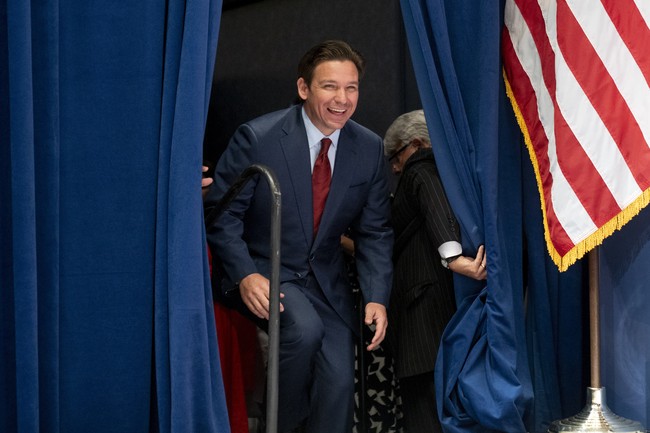
Ron DeSantis seized the moment this week, answering House Minority Leader Hakeem Jeffries’ taunts with a mix of mockery and political maneuvering after Florida passed a new congressional map. Jeffries warned of consequences if Florida moved forward, and DeSantis turned that warning into fuel for his campaign message while the state legislature acted quickly. The exchange and the map victory crystallize how redistricting fights can become loud, public tests of political wills.
One of the quickest lessons of politics is that picking the wrong fight invites consequences, and Jeffries discovered that the hard way. He tried to lecture Florida about redrawing districts and warned of a national backlash, but his warnings landed with less force than he intended. That miscalculation gave Republicans cover to push forward and present their map as a clean, decisive win for voters and the state.
Jeffries said, “If they go down the road of a DeSantis dummymander, the Florida Republicans are going to find themselves in the same situation as Texas Republicans, who are on the run right now,” which was meant as a threat but read more like a public relations gripe. He also said, “The Republicans are dummymandering their way into the minority before a single vote is cast.” Those lines were meant to scare, but instead they provided a narrative Republican strategists could use to paint Democrats as alarmists.
The Minority Leader added, “Our message to Florida Republicans is, ‘F around and find out,'” and that blunt phrasing only made the moment more combustible. DeSantis seized on it almost immediately, riffing with a mix of sarcasm and showmanship to make Jeffries’ rhetoric backfire. That response turned a potential distraction into a political advantage, showing how a lively, combative style can reshape a national talking point.
DeSantis’ public remarks were equal parts theater and strategy. He invited Jeffries to come to Florida, quipping that the state GOP would welcome his presence and his money with open arms, then moved quickly to finalize a new map. The speed of the legislature’s action underscored the point: threats from national Democrats wouldn’t intimidate state leaders or halt their plan. Instead, the map passed and Republicans framed it as the result of focused governance.
When the Supreme Court issued its decision in Louisiana v. Callais, the national conversation heated up and Jeffries grew more agitated in public statements. That legal backdrop gave Republicans an opening to highlight judicial outcomes that reinforced their arguments about election rules and state authority. DeSantis used the moment to deliver a performance-style address celebrating the map passage while contrasting it with what he called Democratic bluster.
He mocked the rhetoric with a line delivered in a New York accent: “We gon’ do maximum warfare against Republicans! Florida Republicans, you F around, you gonna find out!” The mocking imitation drove home that Jeffries’ threats were easy to lampoon and easier for Republicans to use as proof that Democrats prefer high drama over policy. DeSantis framed the exchange as evidence that Republicans would not be bullied by national party figures.
“He’s like, ‘oh, if you do the redistricting, we’re going to take out all your members, we’re going to do all this stuff.’ And what I said was, go ahead, make my day,” DeSantis said, making his stance crystal clear. That quotation captured the tone of the response: confident, confrontational, and unapologetically forward. The governor then urged outside groups to weigh the risks of spending in Florida, calling on them to “roll the dice” if they wanted to challenge the state’s plan.
“You want to come down here and spend money in Florida, roll the dice, and take your chances. But don’t think that you can come down here, issue threats to us, and somehow you’re going to make us flinch,” DeSantis added, framing the choice for out-of-state actors as a gamble. Republican messaging pushed hard on the idea that Florida was defending voter integrity and local control against outside intimidation, a narrative that plays well with a driven base.
DeSantis concluded that the flinching “did not happen, because as soon as he came out and started doing that last week, the Florida legislature turned around and they passed a new map.” That factual sequence—statement, response, map passage—was presented as proof that bold political leadership pays off when opponents try to dictate terms from afar. For conservatives, it underscored the value of decisive state-level action.
The scene also featured moments of levity and relief for DeSantis’ supporters as the governor basked in a rare, clean win on a complex policy fight. Republicans noted how Jeffries’ threats gave the governor ammunition and helped crystallize the issue for voters who value state sovereignty over national political theater. That dynamic will likely reverberate as campaigns ramp up and national figures test local resolve.
Watch:
Republicans don’t call him the “” for nothin’, y’all. You love to see it, you truly do.
Editor’s Note: The 2026 Midterms will determine the fate of President Trump’s America First agenda. Republicans must maintain control of both chambers of Congress.



Add comment