
Checklist: assess Iran’s public bluster versus reality; note doubts about the new supreme leader’s public statements; explain how sanctions and naval control constrain Iran’s options; examine oil market implications and U.S. leverage; include the original quoted statements exactly as given.
Iran keeps talking a big game while the facts on the water and in the economy tell a different story. The recent state-televised statement attributed to Ayatollah Mojtaba Khamenei turned heads, but the context around that message matters more than the rhetoric. After heavy losses to Operation Epic Fury, Tehran’s public posture is mostly aimed at saving face rather than signaling real capability.
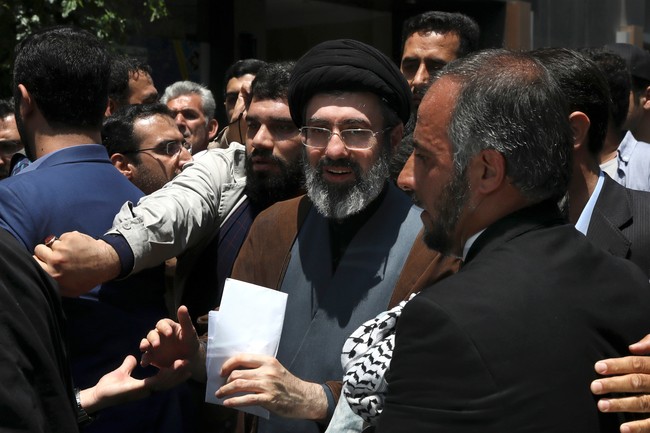
We still lack reliable proof that the person on state television is the new supreme leader speaking as himself. Reports say he was badly wounded when his predecessor was killed in the opening airstrikes, and the official narrative includes talk of disfiguring injuries and recovery. Without clear, independent verification, skepticism is reasonable about whether these statements reflect the man himself or a staged presentation.
Iran’s supreme leader vowed Thursday in a defiant tone to protect the Islamic Republic’s nuclear and missile capabilities, which U.S. President Donald Trump has sought to curtail through airstrikes and as part of a wider deal to cement the war’s shaky ceasefire.
In a statement read by a state television anchor, Ayatollah Mojtaba Khamenei said the only place Americans belonged in the Persian Gulf is “at the bottom of its waters” and that a “new chapter” was being written in the region’s history. Khamenei has not been seen in public since taking over as supreme leader following the killing of his father in the war’s opening airstrikes.
The quote itself is loud and dramatic, but the delivery and timing raise more questions than it answers. Iran’s leadership thrives on symbolic gestures, and those gestures can be useful for internal propaganda even when the outside world knows the reality is weaker. In short, strong words do not equal strong tools.
Economic pressure and naval interdiction have tightened the screws on Iran’s options at sea and onshore. U.S. naval actions have limited Iranian tankers’ ability to get out to sea, and recent incidents showed attempts to spoof navigation signals that were detected. Evidence collected so far points to many Iranian carriers remaining stuck in the Persian Gulf rather than cruising freely through the Strait of Hormuz.
His remarks come as Iran’s economy is reeling and its oil industry is being squeezed by a U.S. Navy blockade halting its tankers from getting out to sea. The world economy is also under pressure as Iran maintains its chokehold on the Strait of Hormuz, through which a fifth of all crude oil is transported. On Thursday, the global benchmark for oil, Brent crude, traded as high as $126 a barrel.
That blockquoted passage captures the official spin, but the claim that Iran maintains a chokehold on Hormuz is misleading. Control of the Strait is not a one-sided advantage when a U.S. fleet and coalition partners can bottle up shipping and monitor transits. The dynamics on the water right now favor those enforcing the blockade more than those threatening it.
From a leverage standpoint, the United States still holds much of the upper hand. Tehran has limited options to retaliate without exposing its already damaged military and economy to further pain. The political goal for the U.S. side is to finish the job in a manner that reduces economic fallout at home, especially with oil prices still trading near the high end of historical ranges.
Energy markets are sensitive to conflict in the region, and Brent hovering near $126 a barrel is a reminder that inflationary pressure can ripple through consumers’ wallets quickly. That creates a strong incentive for the administration to conclude operations and restore stable flows to bring prices down before the political calendar becomes a major factor. Stability at the pumps is a short-term political win tied directly to how swiftly shipping and production normalize.
Iranian leaders can issue grandiose statements about national assets, science, and missile programs, but the lived reality for ordinary Iranians is different. Many citizens likely resent the ruling class’s extravagant rhetoric when basic needs and economic prospects are worsening. Public bravado is useful domestically, yet it does little to change the material limits imposed by sanctions and naval interdiction.
“Ninety million proud and honorable Iranians inside and outside the country regard all of Iran’s identity-based, spiritual, human, scientific, industrial and technological capacities — from nanotechnology and biotechnology to nuclear and missile capabilities — as national assets, and will protect them just as they protect the country’s waters, land and airspace,” Khamenei said.
Those words aim to rally an identity-based defense of programmatic capabilities, but the assertion that the population uniformly supports the regime’s path is likely optimistic propaganda. Political legitimacy is not fixed by slogans alone, and when economic lifelines are choked, popular patience frays. Iran’s future posture will be shaped as much by its internal fractures as by any external pressure it attempts to project.

Add comment