
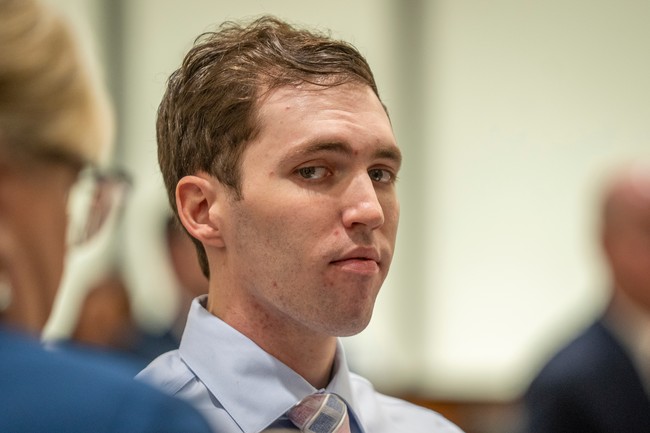
‘Hit the Intended Target’: Tyler Robinson Defense’s Stunning Death Penalty Argument
The article examines the defense strategy in the Tyler Robinson case, explaining how lawyers argue the fatal shot “hit the intended target” and why that claim matters for the death penalty question. It lays out the court timeline, summarizes the defense’s legal theory, captures reactions from Turning Point USA and others, and points to the upcoming probable cause hearing set for September 1. The piece keeps the focus on the core legal conflict over whether others were placed in grave danger at the event. Quotes from filings and public responses are reproduced exactly where relevant.
We are less than one month away from the first anniversary of the Charlie Kirk assassination, and the legal fight has intensified as Robinson’s defense team files an unusual argument for why the death penalty should be excluded. The case continues to move through Utah courts, with a preliminary hearing already held and a probable cause hearing scheduled for September 1. At this stage the defendant has not entered a plea, and the filings are part of routine pretrial maneuvering that can shape potential charges and penalties.
The defense is not admitting guilt on the record; instead it is challenging a specific aggravating factor prosecutors rely on to seek capital punishment. That aggravating factor concerns whether the shooter knowingly created a great risk of death to others at the event. The defense asks the court to reject that enhancement by arguing the shot was confined to the intended victim, thereby arguing against the legal threshold for a capital case.
In court papers the defense frames the issue bluntly: the shooting “hit the intended target.” Those four words have provoked disbelief among many observers, in part because they invert common-sense assumptions about public shootings. The legal claim rests on technical interpretations of state law, intent, and evidentiary proof about risk to the crowd, rather than on a factual concession about what happened at the scene.
Prosecutors, on the other hand, argue that firing a weapon in a crowded venue and striking a person in the middle of a large audience inherently exposes others to danger. That point underpins their pursuit of an aggravating circumstance required to elevate a murder to capital status. The state will need to show probable cause that others were placed at grave risk, a burden the defense now disputes through its filings.
The defense claim has grabbed attention not just for its legal framing but for its rhetorical boldness, asking judges to treat a precise, fatal shot as evidence against heightened punishment. To many outside the courtroom that reasoning seems tone-deaf to the trauma of the victims and the chaos a shooting introduces to a public event. Yet from a courtroom strategy perspective, attacking the legal elements that permit a death-penalty case is a standard defensive move.
Turning Point USA and those aligned with Charlie Kirk quickly voiced strong reactions to the defense tactic, calling the argument “unreal” and questioning its moral resonance. Andrew Kolvet, a longtime associate and spokesman for Turning Point USA, publicly criticized the filing and underscored how shocking the strategy appears to supporters of the victim. That pushback underscores how legal arguments can collide with public sentiment during high-profile cases.
Public reaction has been fierce on social platforms, with many insisting that intent to harm a single person does not negate the broader danger created by a shooter in a packed arena. Observers say it should be obvious that pulling a gun in a crowd risks others even if the shooter focuses on one person. The debate now centers on how Utah law defines an aggravating factor and whether the state’s evidence can clear the probable cause bar for that element.
Quoted coverage from outlets and responses by commentators reproduce the defense language exactly and raise legal questions about the standards the court will apply. “The apparent defense strategy here isn’t to prove that Tyler Robinson didn’t kill Charlie Kirk, but that he didn’t intend to kill anyone else, and that therefore, this should not be a death penalty case.” “Robinson’s lawyers argued the state has failed to establish probable cause that the shooter knowingly created a great risk of death to another other than Charlie Kirk and himself.” Those lines come straight from filings and public statements and show the defense’s narrow focus on legal criteria.
Whether that narrow focus will persuade a judge is an open question, and it sets the stage for the September 1 hearing where probable cause will be weighed. The prosecution will push back by emphasizing the crowd size, the setting, and the inherent peril of discharging a firearm at a public gathering. The judge’s interpretation of the statutory aggravating factor and the sufficiency of the state’s proof will determine whether capital charges proceed.
https://x.com/nypost/status/2087656733271368123
This legal sparring highlights how courtroom strategy can look at odds with public sentiment, especially in politically charged cases that involve prominent conservative figures. The defense has chosen to litigate the narrow legal issue that controls eligibility for the death penalty, while critics argue moral clarity should override a technical reading of risk elements. The coming hearings will reveal whether that technical path narrows or closes off the avenue to a capital prosecution.


Add comment