
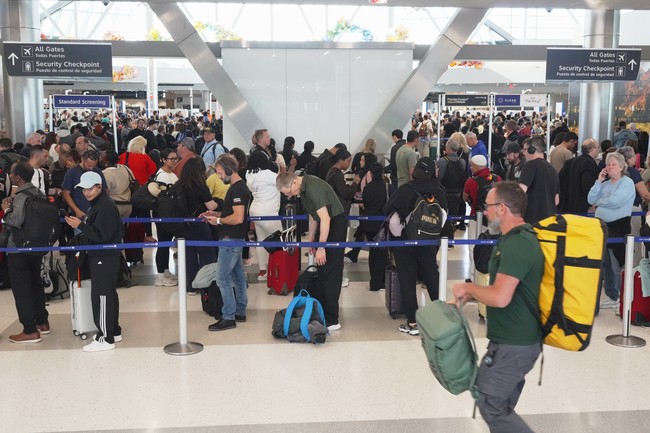
The airports are snarled because Democrats refused to fund DHS and TSA, hundreds of agents quit, and the administration sent ICE to help; this piece lays out what happened, the political response from Democrats like Sen. Richard Blumenthal, and the White House and allied voices pushing back against dangerous rhetoric and chaos at travel hubs.
Flight lines have ballooned at airports after a funding fight led to TSA staffing problems, leaving travelers stuck and security strained. This crisis has real consequences for safety and timeliness, and it did not happen in a vacuum. The choice to withhold funds from the Department of Homeland Security has ripple effects across the system responsible for keeping Americans safe.
The administration moved quickly to plug the gap by deploying ICE personnel to assist at affected airports, focusing on support tasks that free TSA officers to resume screening duties. Border Czar Tom Homan explained that ICE agents can take over certain posts and relieve TSA staff so the screening process can speed up. That kind of targeted, pragmatic help is the kind of common-sense response people expect when systems break down.
Instead of acknowledging the problem and fixing it, Democratic leaders have sought to politicize the situation and attack the agencies brought in to help. Some of the rhetoric has been extreme, reckless, and directly aimed at undermining public trust in law enforcement. When leaders cast federal officers as threats rather than allies in a chaotic moment, they risk making the real problem worse.
Sen. Richard Blumenthal offered a line of attack that crossed into dangerous territory, claiming law enforcement would behave violently and without restraint. That claim paints officers with the broad brush of brutality and creates fear at a time when calm cooperation is essential. Casting professional agents as a menace can deter people from complying with lawful instructions and could spark needless confrontations at busy checkpoints.
The Senate Democrats’ account amplified the claim by sharing it, which served to validate the charge instead of distancing itself from it. That retweet amounted to an endorsement and signaled a willingness to stoke fear rather than soothe it. Political advantage should never come at the cost of public safety or the morale of the men and women who serve in uniformed roles.
The White House pushed back hard and publicly through its rapid response channels, refusing to let misinformation and inflammatory remarks stand unchallenged. Officials made clear that portraying ICE as a rogue force was inaccurate and irresponsible amid a sensitive operational moment. This pushback was both tactical and principled, aiming to restore confidence and focus attention on the real cause of the backlog.
Senior officials and staff used their personal accounts to respond, adding an authoritative voice to the institutional rebuttal. Katie Zacharia posted from her account to correct the record and to explain how the deployment was intended to help, not harm. Those clarifications helped paint a clearer picture for the public about how federal agencies coordinate during crises.
Deputy Chief of Staff Dan Scavino also weighed in personally, calling out the misleading claims and framing the issue plainly for readers. Direct, no-nonsense pushback cut through the hysteria and refocused the debate on facts and practical outcomes. That kind of straightforward communication matters when public safety and common sense are at stake.
Democrats who double down on incendiary language during operational emergencies only deepen public confusion and erode trust in institutions that protect daily life. When political messaging encourages fear of law enforcement, it can have real-world consequences for cooperation and for the safety of travelers. The public deserves honest debate, not alarmist talking points designed to rile up base voters at the expense of stability.
Leaders who prioritize political theater over practical fixes are responsible for letting the problem grow, and voters notice the difference between governance and grandstanding. If the priority had been maintaining essential services, these lines and delays could have been avoided or mitigated sooner. Accountability begins with admitting mistakes and restoring functionality, not weaponizing crisis for partisan gain.
At the end of the day, the solution is straightforward: fund critical security roles, support the professionals who take risks to keep people safe, and stop turning every operational hiccup into a political cudgel. Americans want functioning airports and secure borders, and they will judge parties on who delivers results rather than who scores points. The current mess is a reminder that elections and appropriations have consequences for everyday life.
Editor’s Note: Do you enjoy RedState’s conservative reporting that takes on the radical left and woke media? Support our work so that we can continue to bring you the truth.
Join RedState VIP and use the promo code FIGHT to get 60% off your VIP membership!


Add comment