
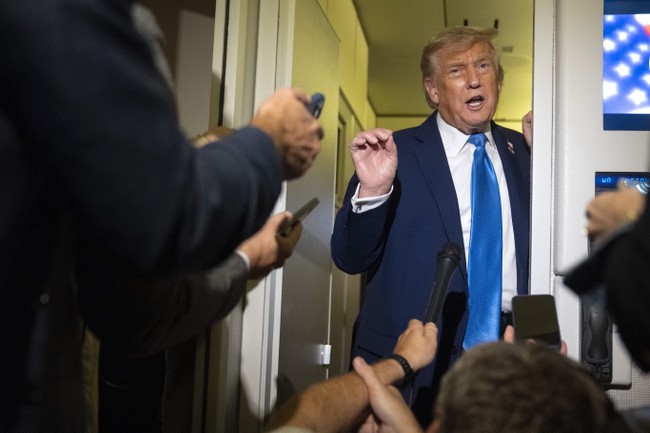
President Trump returned to Washington after a fraught holiday at Mar-a-Lago where he mixed diplomacy and force, including talks on Ukraine and Israel and a bold operation in Venezuela that led to Nicolás Maduro’s arrest and U.S. criminal charges. On Air Force One he briefed reporters alongside senior officials, praised the service members involved, warned regional leaders, and suggested further U.S. action against narco-states in South America.
President Trump described the service members injured in the Venezuela mission as being in “good shape” and said he had personally placed calls to them. “The bravery was incredible,” he said, acknowledging the risks and signaling ongoing support for troops involved in overseas operations. The administration framed the operation as decisive action against narco-terrorism, presenting it as a demonstration of strength that sent a clear message to hostile regimes.
Asked about who’s running things in Venezuela, Trump answered plainly, “We’re in charge,” a terse claim of U.S. influence in the region following the capture of Maduro. He also issued a direct warning to Delcy Rodriguez, saying she “will face a situation probably worse than Maduro” if she fails to cooperate. Those remarks underscore a posture that mixes warnings with readiness to follow through if intermediate leaders resist U.S. goals.
The president rejected nation building as a primary aim, explaining, “We’re in the business of having countries around us that are viable and successful and we’re the oil is allowed to freely come out because that’s good. It gets the prices down. That’s good for our country.” He framed U.S. interest in stability as economic and strategic, tying energy flows to domestic benefits and arguing that a weakened Venezuela had broad regional consequences.
Senior officials also flagged the fallout for Cuba, noting that Maduro’s security apparatus included a heavy Cuban presence. The president suggested Cuba will suffer when Venezuelan funds stop flowing, saying, “Cuba looks like it’s going down.” That assessment highlights the administration’s belief that targeting Maduro will ripple through regimes that depend on Venezuela’s resources.
Trump shifted focus to Colombia in blunt terms, calling the situation there “very sick” and accusing its leader of enabling cocaine production destined for the United States. “Colombia is very sick, too. Run by a sick man who likes making cocaine and selling it to the United States. And he’s not going to be doing it very long, let me tell you,” he said, signaling intolerance for drug-linked regimes near U.S. borders. The language is pointed and personal, aimed at both the Colombian leadership and the American audience fed up with the drug flow.
Pressed to clarify, the president repeated, “He’s not going to be doing it very long. He’s not doing it very long. He has uh cocaine mills and cocaine factories. He’s not going to be doing it very long. So, there will be an operation by the US and it sounds good to me. Secretary Rubio mentioned, you know why? Because they kill a lot of people.” That line ties potential operations directly to the violence and human cost associated with the drug trade, and it signals a willingness to contemplate cross-border actions to disrupt cartels and regimes.
The administration framed its recent moves as part of a broader strategy to restore stability to nations that affect U.S. security and markets, with energy access and migration cited as central concerns. Officials stressed that striking leadership figures and their protection networks could be a path to wider regional shifts, and they highlighted how allied pressure and enforcement actions can compound those effects. The messages combined hard-edge rhetoric with concrete operational claims, aiming to reassure supporters that decisive measures are underway.
Republican lawmakers and allies have generally welcomed a forceful approach, viewing decisive operations as the kind of “peace through strength” policies they favor. Critics warn about escalation and unintended consequences, but the administration is presenting the Maduro arrest and the threat of further action as calibrated moves to degrade narco-regimes. The debate now centers on how far the U.S. will go and what mix of military, economic, and diplomatic tools will follow.
You can watch the president’s gaggle here:


Add comment