
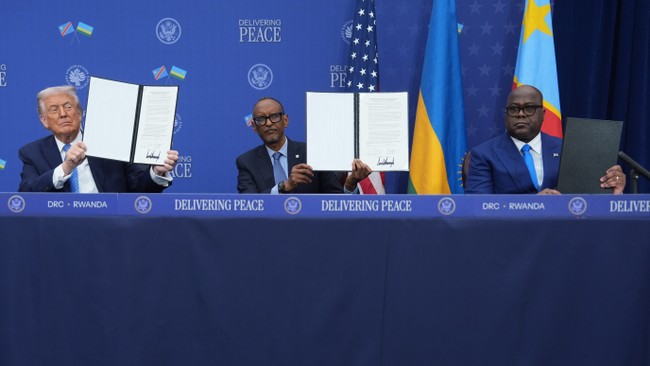
The story: long-running violence between the Democratic Republic of Congo and Rwanda took a new turn when leaders met at the White House and signed the Washington Accords, a pact that aims to halt decades of fighting and open a path for stability, diplomatic engagement, and potential reconstruction in a region scarred by war.
The conflicts in central Africa have deep roots stretching back to the early 1990s and the Rwandan genocide, when ethnic massacres and cross-border fallout set off cycles of displacement and armed struggle that evolved into the first and second Congo wars. Millions of lives were affected by those campaigns of violence, and the instability never fully faded, giving rise to localized insurgencies and regional tensions through the 21st century. For the people living in the eastern DRC, daily life has often been defined by insecurity, militia rule, and economic devastation that prevented meaningful development for decades.
On Thursday in Washington, the leaders of the Democratic Republic of Congo and Rwanda faced that history head-on with a public commitment to end years of mutual hostility and cross-border operations that fueled killings and displacement. President Trump hosted the session and stood alongside Rwandan President Paul Kagame and Congolese President Felix Tshisekedi as they signed the Washington Accords, an agreement framed as a concrete step toward peace. First, President Trump, Rwandan President Paul Kagame, and Congolese President Felix Tshisekedi .
Regional leaders and allies greeted the deal with cautious optimism, recognizing that diplomacy can halt open hostilities but that a durable settlement will require on-the-ground verification and sustained political will. Many observers note the hard work ahead: disarming militias, rebuilding infrastructure, addressing refugee returns, and creating economic opportunities that remove incentives for renewed conflict. International partners will have a role in monitoring the terms and supporting reconstruction, but primary responsibility rests with the signatories and local authorities to implement what they pledged in Washington.
Kenya’s president, William Samoei Ruto, added weight to the moment by offering public praise and context for why the agreement matters beyond borders, stressing the regional implications if the pact holds. Next, the President of Kenya, William Samoei Ruto, said a:
Today’s signing of the Washington Peace Accord. For (Rwanda) and DRC, it is not merely a monumental diplomatic milestone. It is a decisive act to end a devastating conflict that has scarred the region for decades. Mr. President (Trump), what you have achieved is not only transformative, it is consequential, it is historic.
That declaration is not hyperbole when you look at the human toll and the economic collapse caused by repeated wars and militia rule; even short-term cessation of hostilities can allow humanitarian access and a chance for local governance to reassert itself. Still, the region’s past teaches caution: agreements can be fragile if they do not neutralize the many armed groups and criminal networks that profit from chaos. A functioning, long-term peace requires both top-level commitments and practical mechanisms to hold spoilers accountable.
For the United States, the event represents a diplomatic win and reinforces a posture of active engagement in a part of the world often overlooked until crises become full-blown emergencies. The White House gathering put pressure on leaders to deliver and signaled American readiness to support implementation, whether through diplomatic leverage, development assistance, or security cooperation geared to stabilize the immediate hotspots. This kind of visible engagement also sends a message to rival powers that Washington still plays a decisive role in international peacemaking when it chooses to lead.
On the ground, citizens in both countries will look for immediate improvements: safer travel routes, restored markets, and the return of displaced families to their homes. Reconstruction and reconciliation will take time, and success hinges on credible security guarantees and economic policies that create jobs and restore public confidence. If authorities can translate the accords into tangible gains for ordinary people, the pact could change daily life in towns that have suffered under years of armed predation and governance breakdown.
There are no guaranteed outcomes from a single ceremony, but the Washington Accords do offer a clear alternative to perpetual conflict: a negotiated path, international scrutiny, and political accountability. For now, leaders must follow words with action, demobilize armed actors, and open channels for justice and development that can cement a fragile peace.
Editor’s Note: Thanks to President Trump and his administration’s bold leadership, we are respected on the world stage, and our enemies are being put on notice.



Add comment