
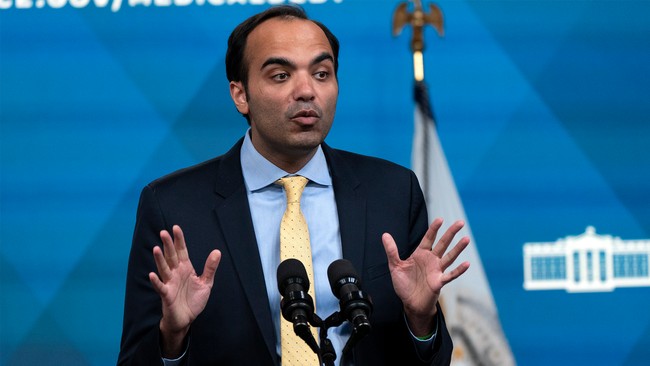
Rohit Chopra’s move from the federal Consumer Financial Protection Bureau to a top California role has conservatives worried that the same regulatory overreach that hit fintech and borrowers at the national level will now be repeated by Sacramento. This piece recounts Chopra’s record at the CFPB, highlights controversial policies he backed, and explains why his new state post matters for lenders, small businesses, and consumer choice across California.
Scott Adams’ Dilbert Principle jokes about promoting incompetence into management feel oddly applicable when partisan officials are rehired into bigger state roles. Rohit Chopra, who led the Consumer Financial Protection Bureau under a Democratic administration, drew strong criticism for aggressive enforcement and regulatory experiments that many saw as partisan. His departure from the CFPB followed clashes with industry and was hailed by critics as necessary, but his return in another powerful public office raises fresh concerns.
Governor Gavin Newsom has appointed Chopra to run California’s new Business and Consumer Services Agency, a cabinet-level body that will take effect July 1, 2026. That agency will house the Department of Financial Protection and Innovation and several other consumer-facing departments, consolidating regulatory power under one roof. For conservatives who value limited government and market freedom, the centralization of authority in a national-sized state agency is a red flag.
Yesterday, Governor Gavin Newsom appointed Rohit Chopra as Secretary of the state’s newly created Business and Consumer Services Agency. The Trump administration fired Chopra from the CFPB in February 2025 after he clashed repeatedly with the financial industry over nonbank supervision, junk fees, and algorithmic lending. Companies that assumed his exit from Washington meant he was out of the picture should revisit that assumption.
The BCSA is a cabinet-level restructuring that takes effect July 1, 2026, when the existing Business, Consumer Services, and Housing Agency dissolves and splits into two standalone bodies. Chopra will run the consumer-facing half. His agency will house the Department of Financial Protection and Innovation, the Department of Consumer Affairs, the Department of Real Estate, the Department of Cannabis Control, and the Department of Alcoholic Beverage Control, among others.
Chopra’s record at the CFPB includes several high-profile moves that drew fire from Republicans and industry groups alike. One case involved a long-running dispute with a Midwestern finance company over alleged redlining, a probe that stretched for years and ended with the agency returning a six-figure fine. Critics argued the case showed an eagerness to pursue ideological narratives rather than sound, evidence-based enforcement.
CFPB abused its power, used radical ‘equity’ arguments to tag Townstone as racist with zero evidence, and spent years persecuting and extorting them – all to further the goal of mandating DEI in lending via their regulation by enforcement tactics. The more we uncover at CFPB, the more we see how this agency was weaponized against targeted Americans,” said Acting Director Russ Vought.
Another controversial policy from Chopra’s CFPB era restricted how lenders could consider immigration status, effectively pushing institutions to extend credit without regard to lawful residency considerations. Opponents characterized this as pressuring banks to make loans to illegal aliens and undermining sensible underwriting standards. Supporters framed it as protecting borrowers from discrimination, but the policy had real implications for risk assessment and compliance burdens on community banks.
The Consumer Financial Protection Bureau (CFPB) and Justice Department today issued a joint statement that reminds financial institutions that all credit applicants are protected from discrimination on the basis of their national origin, race, and other characteristics covered by the Equal Credit Opportunity Act, regardless of their immigration status.
Chopra also backed rules that forced lenders to collect detailed demographic and business information from loan applicants, then report that data to the agency. Section 1071 required institutions to compile information about small business borrowers, including sensitive identifiers and geographic details, which critics warned could be made public. That requirement raised privacy concerns and risked exposing small borrowers to unintended disclosure of competitive or personal data.
- Section 1071 requires covered financial institutions to collect and report certain personal information on small business loan applicants and report that to the CFPB. The CFPB may then make certain parts of that information public, including data that could publicly identify the small business credit applicant.
- In order to comply with the Biden CFPB rule, financial institutions would have to collect information about applicants, including the applicant’s census tract, North American Industry Classification System and years in business, among other personal information.
For critics who supported President Trump’s move to fire Chopra at the federal level, the California appointment looks like the Swamp rewarding its own. The concern is less about one man than about a policy approach that prioritizes centralized oversight, expansive data collection, and enforcement-first regulation. California’s new agency gives that approach a much bigger stage, where state rules could influence how banks, fintech firms, and small-business lenders operate nationwide.
The constitutional critique is straightforward for many conservatives: agencies like the CFPB operate with broad powers that rest uneasily with the limits of federal authority and the 10th Amendment. Whether in Washington or Sacramento, expanding regulatory reach into private lending decisions is seen as a state-driven policy experiment that can stifle innovation and burden consumers with higher costs. For those who favor smaller government, Chopra’s new role signals a policy direction to watch closely.



Add comment