
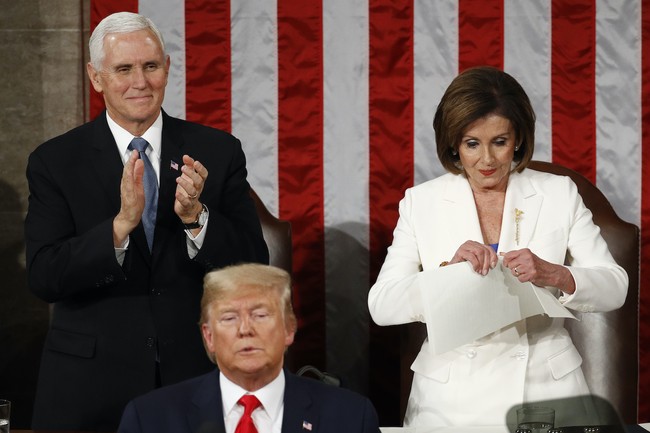
The State of the Union page tear was more than a theatrical moment; it symbolized a shift in how political conflict is staged in Washington. This article revisits that February 4, 2020 incident, the reactions that followed, and why many conservatives see it as emblematic of a broader cultural and institutional problem. It examines Nancy Pelosi’s defense, the lingering charges about Russia, and what her retirement means for Democratic leadership. The goal is to lay out the facts, preserve key quotes, and make clear why that single gesture still matters in today’s politics.
What happened in the House chamber that night was simple to describe but hard to accept for many: the speaker of the House tore up the president’s speech in full view of the nation. For conservatives, the rip felt like a surrender of decorum and a headline-grabbing symbol of contempt for the voters who put that president in office. It was a raw, theatrical act that many saw as more about scoring points than exercising leadership responsibilities.
Pelosi later defended the act as spontaneous and moralistic, insisting she ripped the speech because she believed it was full of lies. She framed the gesture as a visceral response to a falsehood-packed address, portraying it as a moment of conscience rather than calculation. To critics, though, the move looked like classic performative politics — a power play that normalized extreme partisan one-upmanship.
“People like the tearing up of the speech. I didn’t intend to go to the speech to tear it up. I just, the first part of it, I tore a page because he was lying. And then the next page, then the next page. I thought it was a manifesto of lies all throughout, so I better tear up the whole speech. Now, the speeches are on strong paper, so you have to do it a few times to get it done. But I had no intention of doing that. I thought my staff was going to die,” Pelosi said.
That quote still circulates because it captures the unapologetic, performative spirit of the act. It’s not just the tearing that stuck in people’s minds; it’s the candid explanation, delivered with a smile, that suggested a willingness to place spectacle over statesmanship. For Republicans and many independents, it was proof that a significant portion of leadership on the other side had chosen political theater over trying to bridge differences.
There’s another layer to the story: the context of the Russia collusion narrative and the long, bruising investigations that followed. Despite multiple probes failing to produce proof of the central collusion claims, some Democrats continued to treat the idea of foreign influence as the default explanation for political setbacks. That persistent framing fed a cycle in which institutions and media were weaponized into ongoing investigations and sensational headlines rather than treated as neutral arbiters.
“You know what I’m saying when I go out the door? I’m leaving here because I’ve had it with you, Mr. President. With you, all roads lead to Putin,” she told Karl, who noted that the White House put the picture out and called Pelosi “crazy.” This line exemplified how rhetoric escalated from policy disagreement to personal indictment and international conspiracy, further poisoning political discourse.
Pelosi’s announced retirement ends a long and polarizing era, and conservatives view that as an opportunity to reset norms in the House. Her likely successor has not demonstrated Pelosi’s knack for command and organization, and many Republicans see that as a rare structural advantage. The hope among conservatives is that less theatrical, more policy-focused leadership will reduce incentives for the kind of headline-driven stunts that degrade governing institutions.
The tear remains a touchstone because it shows how a single, theatrical moment can reframe a political narrative for years. For Republicans who watched it unfold, the act was confirmation that the other side would prioritize raw political advantage over rules or civility. Whatever one’s take on the policy merits of that era, the episode serves as a warning about how quickly norms can be abandoned when partisan scoring becomes the dominant goal.
Watch:
But the “Speaker Emerita” still thinks she’s some sort of hero:


Add comment