
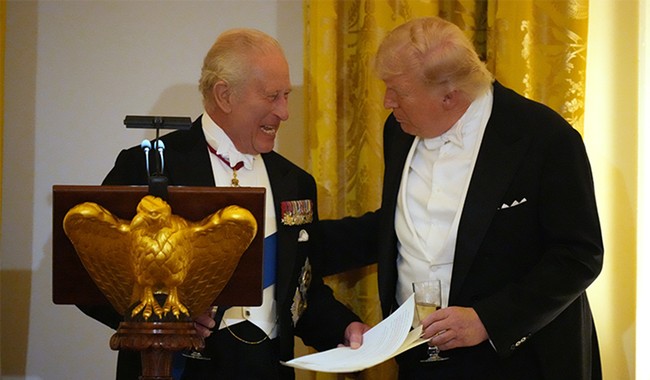
King Charles III visited the White House and used wit and a symbolic gift to shore up U.S.-U.K. ties, praising President Trump’s courage after the White House Correspondents’ Dinner shooting and presenting an heirloom bell as a personal gesture meant to underscore shared history and ongoing cooperation.
The Dems Aren’t Going to Like This: King Charles Gives Trump a Gift, Praises His Courage
King Charles III arrived at the White House with a clear diplomatic aim: mend fences and reaffirm the special relationship between the United States and the United Kingdom. His visit came at a sensitive moment after tensions over the U.K. government’s stance on military action in the Middle East, so his gestures carried weight beyond ceremony.
At the state dinner he offered a personal and historically resonant gift to President Trump, one that spoke to shared service and sacrifice rather than empty platitudes. The present was framed as more than a trinket; it was presented as a tangible link to a past where both nations stood shoulder to shoulder in global conflict.
The King gifted Trump the original bell from HMS Trump, a British submarine launched in 1944 that served in the Pacific during World War II.
“Tonight, Mr. President, I am delighted to present to you as a personal gift the original bell,” Charles said, noting it “may stand as a testimony to our nation’s shared history and shining future.”
He then added with a smile, “And should you ever need to get hold of us… just give us a ring,” prompting a warm reaction from guests.
The bell was described as coming from HMS Trump, a submarine with service in World War II, and the symbolism was obvious: continuity, duty, and a nod to alliances that matter in hard times. The king paired the gift with an easy joke and an invitation that underscored reciprocal responsibility between allies.
Charles was clearly drawing a contrast between the British crown’s approach and what many see as weak responses from some in British politics. He signaled quietly that the special relationship is not one-sided; gifts and jokes are fine, but actions must follow words. That tone resonated with a crowd expecting leadership and firmness on the world stage.
NOW: King Charles gets a laugh at the White House State Dinner.”
I cannot help noticing the readjustments to the East Wing, Mr. President, following your visit to Windsor Castle last year.”
“And I’m sorry to say that we British, of course, made our own small attempt at real estate redevelopment of the White House in 1814.”
Charles mixed humor with gravitas, and that balance played well in a room that needed both. He moved from laughter to a sincere acknowledgment of a recent violent incident, offering empathy and respect for how the president and his team handled the emergency.
WOW! Major respect moment as King Charles III took time to pay TRIBUTE to President Trump after he survived another assassination attempt
To think — this angers the left.
“May I also just start by paying tribute to your own courage and steadfastness, as well as to your security services for their swift actions on Saturday evening in preventing further injury.”
“My thoughts and sympathies are very much with you, the First Lady and all those guests, for whom this must have been a very upsetting incident.”
Pray for 47!
Those lines were delivered with clarity and respect, and the praise for the president’s composure was unmistakable. In a political environment where symbolic acts are scrutinized, Charles chose to publicly commend calm leadership under pressure.
The visit will likely ease some diplomatic friction, but it also placed a spotlight on expectations: Britain’s gestures must match policy when it matters. If the U.K. wants the special relationship to remain meaningful, London has to back words with concrete support when shared security is on the line.
For conservatives who value strong alliances and clear-eyed diplomacy, Charles’ visit was a welcome reminder that tradition and toughness can be paired. The bell, the jokes, and the public praise were all parts of a single message: alliances endure when leaders act like allies.


Add comment