
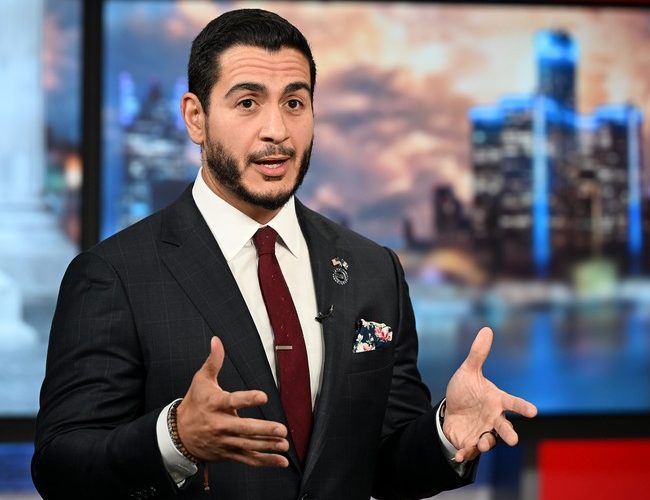
I’ll walk through Abdul El-Sayed’s recent appearance on Jesse Watters’ show, point out where his answers fell apart, look at his positions on ICE and Medicare for All, highlight his responses on guns and the NFL, and zero in on the awkward exchange about circumcision and minors.
Abdul El-Sayed showed up on Jesse Watters’ Fox program expecting a friendly forum, but the interview turned into a string of evasions and missteps that are hard to spin as competence. He frequently tried to interrupt and talk over Watters, which made him look defensive rather than confident. That tone set the stage for several moments where his answers failed to land with voters who want clarity on law and order, healthcare, and values.
When the topic of abolishing Immigration and Customs Enforcement came up, El-Sayed reached back to the old Immigration and Naturalization Service as if that history cleared him. He said we used to have INS, implying it shows a precedent for dismantling modern enforcement. The exchange forced Watters to walk him through the practical similarities: both agencies carried guns, apprehended people entering illegally, and handled removals, even if politics around enforcement have shifted.
El-Sayed amplified that political shift by framing ICE as “tyranny” we supposedly threw off 250 years ago, which is a jarring comparison to law enforcement officers doing deportation work. Calling the enforcement of immigration laws tyranny insults federal agents and ignores the reality that laws need to be enforced for a country to function. He then tried to argue that fewer illegal border crossings during the INS era proved ICE was ineffective, a conclusion that doesn’t follow and glosses over policy choices and presidential priorities that actually drive border security outcomes.
https://x.com/JesseBWatters/status/2092045610505396470
The candidate repeatedly deflected blame for the modern surge at the border, calling it primarily a Customs and Border Protection issue rather than an ICE responsibility. That dodge ignores the fact that CBP apprehensions still require deportation processes, and ICE handles the removals and interior enforcement. Republicans point to the clear contrast between administrations: when the executive branch makes enforcement a priority, the flow changes quickly. Voters hear that and want to know who will put policy into practice, not rewrite how agencies are labeled.
On Medicare for All, Watters pressed El-Sayed about the cost and how much people would actually pay. El-Sayed ducked the question and sidestepped specifics, a pattern he has shown before when tax increases are the obvious implication of sweeping government-run healthcare. Avoiding a straight answer left room for the claim that his plan would require higher taxes, and that lack of transparency is political poison in a battleground state where fiscal concerns matter to many voters.
The interview slid into foreign policy when El-Sayed defended the Obama administration’s Iran nuclear deal as containment rather than capitulation. That defense struck critics as weak because the agreement did not permanently prevent Iran from advancing toward a nuclear weapon and in many eyes propped up the mullahs. For voters worrying about both security and clarity, fuzzy rationales on major international agreements raise questions about judgment.
Watters also confronted El-Sayed about a past comment suggesting he wanted to replace the Second Amendment with a “right to healthcare,” and the candidate’s response was telling. He didn’t deny the formulation and actually shrugged when it was mentioned, which played like a lack of regard for constitutional protections to many viewers. He later said he was “fine” with people having “hunting rifles,” but that distinction feels evasive rather than reassuring to gun-rights supporters.
That answer left Watters calling out the dodge, and it highlighted a broader theme: on core issues El-Sayed often answers politically instead of directly. Voters who prioritize clear boundaries on the Constitution and public safety are unlikely to be satisfied by partial concessions around specific gun types while the candidate avoids affirming the full right to self-defense.
The conversation veered into culture and sports when Watters brought up El-Sayed’s comment that the NFL is racist. El-Sayed pivoted to complaining about ticket prices instead, which felt like a deflection instead of a clear justification for his earlier criticism. These moments add up for voters who want candidates who stand firm on their statements or at least explain them coherently.
Perhaps the most jarring segment came when the topic of medical treatments for minors arose and El-Sayed oddly shifted to discussing circumcision instead of addressing sex-change procedures for children. That move was striking and left the host and many viewers scratching their heads. The comparison was out of left field and did not answer the policy concern some parents have about irreversible medical interventions for minors.
“Circumcision is different from castration,” Watters tells him. The line underscored how El-Sayed’s detour into unrelated territory failed to satisfy the question at hand. Watters called the proposed practices “sick stuff” for Michigan, and that blunt framing will resonate with voters who see a boundary being crossed on medical ethics and parental consent.
Taken together, the interview painted a picture of a candidate who can be slick but often chooses rhetoric over direct answers, which is a risky mix on the campaign trail. In a tight race, repeated evasions across immigration, healthcare, and social issues hand opponents a steady stream of attack lines and make it harder to convince undecided voters he has the steady judgment they expect in a senator.


Add comment