
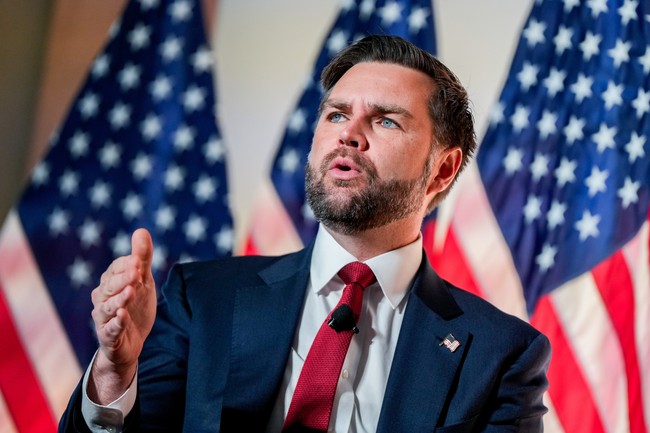
The vice president visited his Ohio hometown to champion working people and used the opportunity to criticize Democrats he says have drifted from traditional values, calling out Michigan Senate nominee Abdul El-Sayed over comments about Sharia law and a social media reply that escalated the dispute.
Vice President JD Vance spoke at the Cleveland-Cliffs Middletown Works steel plant about standing for working people and defending common-sense values in his community. He framed his remarks around a broader critique of how the Democratic Party has changed, arguing it no longer reflects the people who built towns like his. Vance highlighted the contrast between old-school local Democrats and what he described as a more radical national agenda.
To make his point, Vance singled out Abdul El-Sayed, the Democratic nominee in neighboring Michigan, pointing to past remarks that drew controversy. He referenced El-Sayed’s comments about Sharia law and the claim that criticizing it was tied to white supremacy, using that example to argue Democrats have moved far from the party his family supported. The line he delivered on stage was sharp and personal, aimed at connecting with everyday voters who worry about cultural shifts.
https://x.com/Acyn/status/2090853892993241569
“I would love to go back in time and tell my papaw, that there is a man who claims to stand for working people, who says not only should we have Sharia law, but if you criticize it, you are a white supremacist. That’s not my papaw’s Democratic Party, my friends.”
The exchange forced El-Sayed’s team into clarification mode, insisting he supports the separation of church and state and does not favor codifying religious rules into American law. Still, past statements on the matter have given Vance a clear opening to argue that El-Sayed’s worldview is out of step with mainstream voters in battleground areas. Republicans see these moments as critical in persuading undecided voters concerned about law, tradition, and cultural change.
El-Sayed has criticized legal efforts to ban consideration of Sharia in courts, linking those efforts to historical patterns of exclusion and violence against minority communities. That line of argument drew a rebuke from Vance, who painted it as evidence that Democrats are relying on divisive identity politics rather than focusing on bread-and-butter issues. For voters in places like Ohio and Michigan, the tone and emphasis of each party matter when it comes to economic and cultural stability.
El-Sayed criticized a 2010 ballot measure known as State Question 755, which sought to amend the state constitution to ban courts from considering Sharia law in their decisions. The measure was approved by 70% of voters but was ultimately blocked by federal courts.
“The same exact forces that drove native peoples from their land two centuries ago, destroyed Black Wall Street a century ago, bombed a building decades ago and tried to ban Sharia law not a decade ago, those forces are alive and well today,” El-Sayed said.
The debate turned personal after El-Sayed responded to Vance with a social post that many conservatives called tone-deaf and unhelpful. He wrote a comment referencing “Usha” alongside Vance’s hypothetical meeting with his papaw, a note that opponents read as an attempt to make the exchange about race and ancestry rather than policy. Vance and his supporters framed the reply as an example of Democrats trying to shut down legitimate policy criticism by accusing critics of bigotry.
El-Sayed’s social reply was short and sarcastic, and it quickly drew a heavy reaction online from conservative accounts and ordinary voters alike. Many replies highlighted what they saw as a pattern: instead of answering policy concerns, El-Sayed shifted the frame to identity and personal relationships. In a close state like Michigan, even small missteps can matter to voters who are wary of cultural escalation and want practical problem-solving.
Responses to El-Sayed’s post flooded in, with critics posting screenshots, GIFs, and mockery aimed at undercutting his message and questioning his judgment. Those replies became a part of the larger narrative Republicans are pushing: that Democrats are more interested in cultural signaling than in improving working-class lives. Vance’s team has worked to keep the spotlight on everyday economic concerns while using moments like this to draw a clear contrast.
Beyond the Sharia controversy and the social media volley, El-Sayed has made other comments comparing his agenda to religious figures, a stance that has unsettled some voters across the aisle. That background helps explain why even some Democrats are reportedly nervous and why Republicans believe they can make inroads with moderate and independent voters. In tight contests, perceptions about temperament, priorities, and cultural sensitivity are often just as decisive as policy proposals.
Vance framed his criticism as a defense of the kind of neighborhood values his family taught him, aiming to appeal to voters who want pragmatic leadership and clear priorities. The fight over these messages will play out in campaign ads, debates, and local conversations as both sides try to define the stakes. For Republicans, moments like this are tools to show that their message remains rooted in economic security and respect for local traditions, while portraying opponents as distracted by divisive rhetoric.



I get paid over 220 Dollars per hour working from home with 2 kids at home. i never thought i’d be able to do it but my best friend earns over 15k a month doing this and she convinced me to try. it was all true and has totally changed my life. This is what I do, check it out by Visiting Following Website
HERE—————⊃⫸ PayAtHome1.Com