
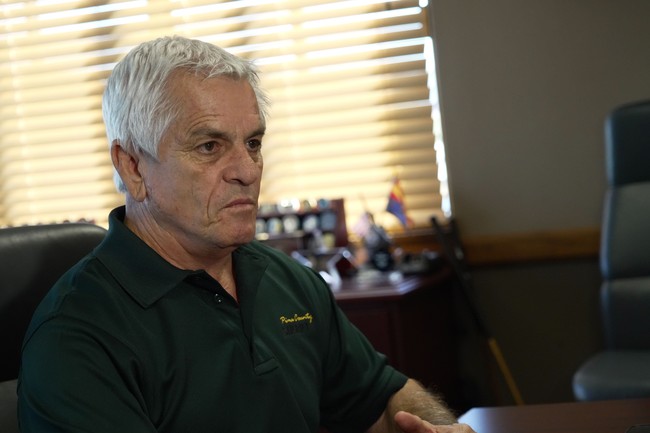
The Pima County investigation into Nancy Guthrie’s disappearance has drawn national attention after reports that local officials declined to send some physical evidence to the FBI’s Quantico lab, opting for a long-used private lab instead. Sheriff Chris Nanos has publicly pushed back on claims of bad blood with federal agents, while former President Trump and others have weighed in on the pace and coordination of the probe. This piece explains the disputed lab decisions, the public statements from Nanos, the alleged FBI reactions, and how the politics around the case are shaping public perception.
Reports surfaced that the sheriff’s office routed key items from the Guthrie home to a contracted Florida lab rather than sending everything to the FBI’s crime lab in Quantico. Sources told news outlets that items including gloves and DNA swabs were not immediately shared with the FBI, which some federal sources said hindered their ability to assist. Those accounts raised questions about evidence handling and whether local-federal coordination was as seamless as it should be in a high-profile missing persons case.
Sheriff Chris Nanos responded forcefully to the allegations, explaining that his office has long used the same private lab and that much of the Guthrie family’s DNA and other swabs were already on file there. He argued it made practical sense to send new material to the lab that already housed related samples so matching could be performed immediately rather than splitting evidence between labs. Nanos also said the FBI understood the reasoning and was not being shut out of the process.
Nanos claims his office has been using the same contracted private lab for decades, long before he was in office. He says his office started sending the Guthrie evidence to this lab from the start and that the GUTHRIE FAMILY DNA and OTHER DNA SWABS are there too — so it makes sense to keep sending the incoming evidence there so that the lab can immediately run the new evidence against what is already in house. Nanos claims the FBI was on board with this. He says why split evidence between the private lab and Quantico. “We trust the FBI’s crime lab, we’ve used them before, but in this case we started with that lab. It’s just that simple.”
Federal agents reportedly described access as minimal and expressed frustration that evidence was not turned over for FBI analysis at Quantico. One source called the decision “insane,” saying the FBI’s specialized technology and resources could accelerate results. That account fed a narrative among some observers that local officials were protecting turf rather than leaning into federal resources during a sensitive investigation.
Nanos rejected the notion that there is any acrimony between his office and the FBI, and he disputed claims they delayed involving federal partners after Guthrie’s disappearance. He told reporters that the sheriff’s office contacted the FBI early in the investigation and that agents were allowed to lead certain technical aspects, such as analyzing ransom notes, where the bureau has unique capabilities. He emphasized cooperation while defending the evidence-handling path chosen by his team.
Nanos claims he is working together WELL WITH THE FBI, claims he would have NO REASON not to seek their help and partnership. “Absolutely crazy,” that he wouldn’t use their partnerships.
Nanos claims he called the FBI the next working day, the Monday after Nancy went missing. He shoots down claims he was reluctant to include the FBI and says for example they quickly let the FBI take the lead on the ransom notes because the FBI is better at that with their technology.
Among the disputed facts is whether a glove was found inside Guthrie’s house. Nanos denied that the FBI’s description matched his office’s findings, saying that while various gloves had been reported in the broader area, not all were proximate to the home or directly tied to the investigation. He cautioned against assuming every reported item is material to the case and stressed that investigators prioritize forensically relevant evidence.
The political dimension intensified when former President Trump publicly commented that federal involvement had helped produce progress and suggested local authorities had been reluctant to cede control. Trump said the decision to keep jurisdiction rests with the community and local officials, but he framed federal engagement as a positive force when it occurs. His remarks highlighted how high-profile criminal cases can quickly become part of broader political debate.
Even as officials stress cooperation, Nanos was careful not to rule out any angle in the search for Guthrie. “Nobody is ever really eliminated,” he said when asked whether anyone had been cleared. That line underscores the unresolved status of the investigation and the forensic priorities driving detectives’ next steps as they try to build a clearer timeline and identify potential suspects or leads.
With families and the public watching, the clash of narratives — private lab continuity versus federal lab resources, local control versus federal involvement, and differing accounts of what was found at the scene — has left many questions. What remains critical is that evidence is handled in a way that yields reliable forensic results and that investigative partners share information quickly to help find answers for the Guthrie family and the community.

Add comment