
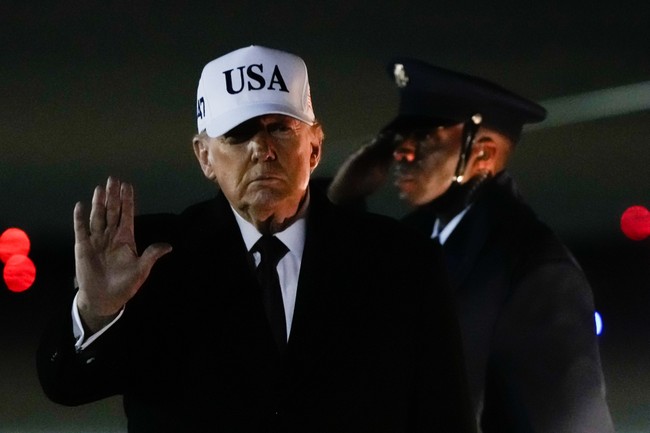
President Trump has made clear the United States sees Greenland as strategically vital and pushed back hard after Greenland’s prime minister said he “chooses Denmark.” This piece lays out Trump’s public reaction, the Greenland leader’s comments, and the security context involving NATO, Russia, and China. It also reviews recent intelligence warnings and why the White House meeting with Danish and Greenland delegations matters to U.S. national security.
President Trump signaled bluntly that he will not let Greenland’s comments slide, calling the island’s prime minister’s resistance “going to be a big problem for him.” The confrontation followed a public statement from Greenland’s leader rejecting the idea of U.S. control and insisting allegiance to Denmark. From a Republican perspective, that response prompted a plainspoken warning: U.S. strategic priorities are not up for debate when vital assets are at stake.
When asked about Prime Minister Jens-Frederik Nielsen’s remarks, Trump said: “Well, that’s their problem. That’s their problem. I disagree with him. I don’t know who he is. Don’t know anything about him, but that’s going to be a big problem for him.” Those words came as Washington prepared to host delegations from Denmark and Greenland, alongside Vice President JD Vance and Secretary of State Marco Rubio, for talks at the White House. The tone and timing signal a straightforward insistence that American security interests will be defended.
Prime Minister Nielsen had publicly declared his preference for Denmark and warned against any U.S. takeover, asserting NATO should guarantee Greenland’s defense. His statement included: “The United States has once again reiterated its desire to take over Greenland. This is something the government coalition in Greenland cannot accept under any circumstances. Greenland is part of the Kingdom of Denmark. As a part of the Realm, Greenland is a member of NATO, and the defense of Greenland must therefore be insured through NATO.” Those lines present a political stance at odds with American leaders who view Greenland as vital to U.S. defense posture in the Arctic.
From the U.S. perspective, NATO’s ability to act is shaped by American resources and leadership, and some in Washington see the alliance as unlikely to pursue Greenland with the urgency required if strategic rivals move first. President Trump reiterated on social platforms that “the United States needs Greenland for the purpose of National Security,” emphasizing its role in defense planning. He argued that Greenland’s location and infrastructure are central to broader strategic projects being advanced by his administration.
Trump also framed the issue in blunt geopolitical terms, warning that if NATO does not step up, Russia or China will seize the opportunity. He wrote that “NATO becomes far more formidable and effective with Greenland in the hands of the UNITED STATES,” and that “Anything less than that is unacceptable.” That language makes clear the administration’s view: leaving Greenland ambiguous invites strategic competitors to expand their influence in the Arctic, where access and bases matter.
Danish intelligence has recently underscored that concern in formal analysis, pointing to Chinese and Russian interest in Arctic access, including Greenland. The Danish assessment warned that “China is preparing for a military presence in the Arctic” and that “China’s long-term Arctic interests include Greenland.” That same report noted Chinese air, sea, and submersible activities, and it suggested closer military coordination between China and Russia in the region.
The Danish report further said Russia “uses every available tool to monitor and chart the waters between Greenland, Iceland, the Faroe Islands, and the United Kingdom” and is preparing “as part of the preparations for a potential confrontation with NATO.” Those findings mirror U.S. threat assessments that highlight Beijing and Moscow as active competitors in the Arctic theater, making Greenland a strategic flashpoint rather than a symbolic toy for diplomatic posturing.
U.S. intelligence agencies have reached similar conclusions in annual threat assessments, noting expanded activity by both China and Russia in Arctic approaches and adjacent maritime routes. Given that context, calls for NATO to lead on Greenland defense sound less convincing to American leaders who point out that the alliance’s operational muscle relies heavily on U.S. funding and capabilities. That mismatch in urgency is why Washington has been explicit about protecting vital positions.
The upcoming Washington meetings are therefore more than a diplomatic routine; they will test whether allies align on the practical steps needed to secure Greenland against hostile ambitions. For Republicans focused on national security, the issue is straightforward: secure strategic terrain before rivals establish footholds, and don’t hand ambiguous signals to adversaries. The situation will likely remain tense as policymakers weigh sovereignty, alliance commitments, and the hard realities of Arctic geopolitics.



Jens-Frederik Nielsen is an Imbecilic Moron; so crush him like the cockroach he is!
What a STUPID Bastard!