
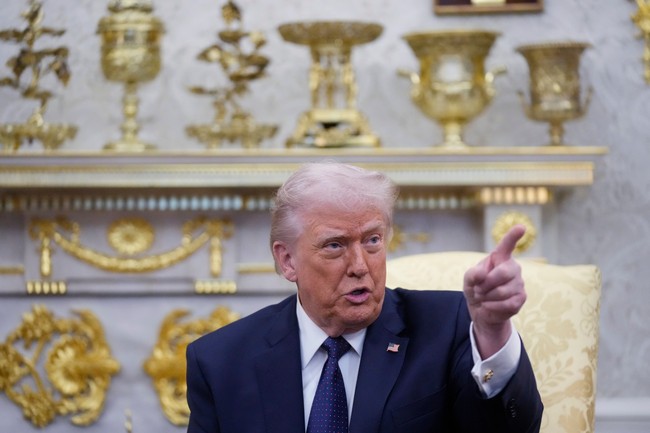
I’ll explain the Oval Office briefing, the president’s warning about Iran’s nuclear intent, Vice President Vance’s solid backing, the military operations named, and why this administration views the Iranian regime as an existential threat.
President Trump addressed the nation from the Oval Office on Monday about operations targeting Iran, including Operation Epic Fury and the earlier Operation Midnight Hammer. He framed the effort as necessary to stop a regime that has repeatedly shown it would use extreme violence and pursue nuclear capability. The president spoke plainly about the stakes and about acting before Tehran could field a weapon that it would not hesitate to employ. Vice President JD Vance stood alongside him, reinforcing a united administration posture.
Embedded footage and media accompanied the briefing to show parts of the president’s remarks and the operational context.
At the heart of the president’s message was a blunt assessment of Iran’s leadership, their methods, and their intent. He emphasized that the threat is not just technical—it’s moral and political, rooted in a theocratic regime willing to kill its own people and the people of others. That assessment shaped the decision to act militarily and to prevent the regime from obtaining a nuclear weapon that, in the administration’s view, would be used without hesitation.
They (the Iranian regime) are violent people. If they had a nuclear weapon, they would use it. And sometimes we’ll have some of the people who feel very strongly, like I do, about wars, and I say, “Do you think Iran is violent, and do you think their people are violent?” Yes, leadership. “Do you think they should have a nuclear weapon?” Which is massive power. I don’t even want to discuss how powerful, because it’s depressing. And they said, “No, they shouldn’t have (a nuclear weapon).”
The administration argues that this whole confrontation began with Iran’s long-running effort to build a bomb, and that prior actions aimed to halt that program before it reached a tipping point. The president and his allies point to historical precedent and to common sense: when a regime has motives and the capacity to kill in mass, denying it a nuclear option is a national security imperative. That logic underpins Operation Midnight Hammer and the subsequent Operation Epic Fury.
Trump highlighted Iran’s domestic brutality, citing claimed casualty figures for protestors and condemning the regime’s violent repression. He also praised advanced U.S. systems, naming the B-2 Spirit bomber for its stealth and accuracy and crediting such capabilities with success in earlier strikes. The administration framed those assets as a strategic edge no other country currently possesses, and as tools that let the U.S. act precisely while protecting its forces.
The most revealing moment came when a reporter tried to imply a split between the president and his vice president, only to face a firm rebuttal by VP Vance. That exchange underscored the message of unity at the top of the administration and left little room for doubts about overall policy direction. The press attempt to sow discord was short-lived because the vice president answered directly and forcefully.
After that exchange another embedded clip carried the rest of the pressroom back-and-forth to capture the tone and content of the questions and responses.
VP Vance: I know what you’re trying to do, Phil, you’re trying to drive a wedge between members of the administration, between me and the president. What the president said, consistently, going back to 2015, and I agreed with him, is that Iran should not have a nuclear weapon. We have taken this military action under the president’s leadership. I think all of us, whether you’re a Democrat or a Republican, should pray for success and pray for the safety of our troops. That’s the approach I’ve taken. Make it as successful as possible.
Questioner: So there’s no hesitation, given your past statements, with the current operation?
VP Vance: What do you mean, there’s no hesitation with my past statements?
Q: Given your skepticism, (inaudible) in the global war on terror previously?
VP Vance: I think one big difference, Phil, is that we have a smart president, whereas in the past we’ve had dumb presidents, and I trust President Trump to get the job done, to do a good job for the American people, and to make sure that the mistakes of the past aren’t repeated. Absolutely.
The administration’s case is simple: Iran’s capacity to build a bomb is dangerous, but the regime’s intent to use one is the urgent, existential problem. Officials painted a scenario where a crude device could be smuggled aboard a commercial freighter and detonated in a port city, a possibility they say Israel, the United States, and others cannot afford to tolerate. That grim calculus explains why the White House sees decisive, preemptive action as the only responsible path.
Officials also stressed cooperation with allies, especially Israel, and made clear that the current actions are meant to prevent a cascading, catastrophic outcome. The president framed the operations as protection of American interests and partners while trying to avoid a wider war. Standing together, the president and vice president presented a message that the threat will be addressed aggressively and with the capabilities the U.S. uniquely possesses.
Observers watching the briefing saw an administration determined to change the old pattern of warnings without consequences. The president’s tone was resolute and the vice president’s support was unequivocal, sending a simple signal: the U.S. will not allow a hostile, violent regime to develop a weapon it intends to use.


Add comment