
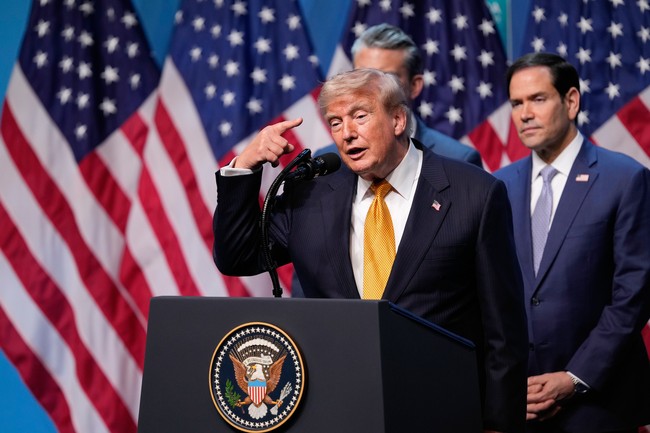
President Donald Trump says he’s prepared to order overwhelming retaliation if Iran succeeds in assassinating him, and the growing threats from Tehran have prompted heightened concern inside his circle and changes to his movements. This article explains the context of those threats, the president’s stated instructions, and the strategic and legal questions that follow without offering extra opinion or calls to action.
Trump has been a primary target for Iran since he ordered the strike that killed General Qassem Soleimani in 2020, a move that dramatically escalated tensions. Recent operations described as diminishing Iran’s nuclear and leadership capabilities appear to have provoked fresh, public threats from Tehran. At a high-profile funeral for Iran’s Supreme Leader, banners and public displays reportedly included references to the president alongside other provocative imagery.
The president altered travel plans after a NATO summit, switching aircraft in a move that aides say reflected security considerations amid the chatter of plots. Those close to the administration say the change was precautionary and consistent with a posture of high vigilance. Secret Service protection around the president has, by necessity, tightened given both public threats and past attempts. The pattern of precaution underscores the unusual level of direct personal risk being discussed openly by senior officials.
https://x.com/nypost/status/2075587614598459455
In an interview with the New York Post, Trump said he has left explicit instructions about how to respond if Iran were ever to succeed in killing him. He was quoted directly: “I’ve been on their list for a long time. That’s what we’re dealing with,” he said. “… The only thing is, I’ve left instructions — if anything happens, to just literally bomb them at levels that they’ve never seen before.”
The president reiterated that Israel had not provided evidence of an active, new plot to assassinate him but stressed Tehran’s long-standing desire to eliminate him. “No, no. Israel came up with nothing. No, no,” he said. “I’ve been No. 1 [on Iran’s kill list] for a long time, and it’s the way life is, you know.” That blunt framing keeps the focus on deterrence and the administration’s willingness to respond decisively to attacks on U.S. leaders.
Officials have resumed strikes against Iranian targets after negotiations faltered, a campaign described by supporters as necessary to degrade capabilities and deny safe haven to bad actors. That military pressure, combined with public threats, fuels debate over what level of response would be justified if an assassination occurred. The president’s phrasing about bombing “at levels that they’ve never seen before” raises difficult operational and legal questions for planners and policymakers.
The toughest question centers on proportionality and the choice of munitions. Would an Iranian attack on the American president trigger a conventional massive strike, a campaign of precise high-yield attacks, or something more extreme? Some officials and analysts frame a catastrophic assassination as an act of war that could justify the most severe responses available short of nuclear weapons. Others argue for calibrated options that preserve escalation control while delivering unmistakable punishment.
Regardless of the exact weapons chosen, Washington retains a wide array of means to dismantle Iran’s capacity without resorting to nuclear arms, from targeted strikes on command nodes to sustained degradation of military infrastructure. The administration’s public posture is intended to deter Tehran by signaling that any attack on U.S. leadership would elicit a crushing and unambiguous response. That posture also places heavy responsibility on the vice president and military leadership to make rapid, consequential decisions if lines are crossed.
Within the U.S. system, the continuity of command matters. Were Iran to carry out an assassination, the vice president would assume the presidency and the authority to direct military action. Pre-written instructions can guide immediate retaliation, but final decisions would rest with the acting commander in chief and the military chain of command. That institutional framework means contingency planning and legal review are essential long before any crisis unfolds.
For now, the administration’s combination of public threats, repeated strikes, and heightened security measures aims to make assassination both difficult and clearly suicidal for those who would try. The president’s blunt warning is a deliberate part of that strategy: to deter by promising overwhelming force and to reassure supporters that he and his team view threats to national leaders as red lines.


Add comment