
I’ll explain the fight over the Senate parliamentarian, reproduce President Trump’s exact statement, outline why the SAVE America Act hinges on reconciliation, summarize Senator Thune’s response, and clarify the parliamentarian’s role and how it affects Republican strategy.
President Trump has again demanded the removal of Senate Parliamentarian Elizabeth MacDonough, this time directing his call at Senate Majority Leader John Thune. The president used Truth Social to say the parliamentarian is biased against Republicans and to urge immediate action to replace her. This direct appeal to Thune escalates a long-running dispute over procedural gatekeeping in the Senate and the path forward for the SAVE America Act.
Trump framed MacDonough as a partisan obstacle who repeatedly blocks Republican priorities, arguing that her rulings have kept key items out of reconciliation. The immediate dispute centers on a funding item tied to White House ballroom security that the parliamentarian ruled out of order. From the White House team’s perspective, that ruling is a clear example of how a single unelected official can stop legislation from reaching the floor, which frustrates many Republicans who want to move fast on their agenda.
https://x.com/RapidResponse47/status/2064049895082741822
Senate Majority Leader John Thune should immediately fire the Parliamentarian, who treats Republicans, and everything that they stand for, horribly! She was put there by then Senate Majority Leader Harry Reid, and Barack Hussein Obama, need I say more? She is a nasty holdover from Mitch McConnell (A man who has proven to be very disloyal to John Thune!), who decided to keep her because he loved giving Trillions of Dollars to the Democrats, but for the Republicans, including the Wall, where I ended up having to go “around him” to build over 1,000 Miles, and close up our Open Border, he gave NOTHING! She is known as a Radical Left Lunatic that caters to Democrats, and has no respect for Republicans, or Republican Ideology. Just the other night, as an example, she ruled against us on a proposal that would have easily been approved, and should have been, by anyone else. We have every right to change her, and should do so, IMMEDIATELY. As long as she’s there, we will never get our desperately needed, SAVE AMERICA ACT, approved, and put into full force and effect! President DONALD J. TRUMP
This is not the first time Trump has publicly attacked MacDonough, but it is the first time he has directly asked Thune to act. The complaint is familiar to anyone who follows Senate procedure: when the parliamentarian says a provision violates reconciliation rules, that provision cannot be included without jeopardizing the reconciliation vehicle. Republicans see that as a chokepoint that lets unelected arbiters effectively veto what a Senate majority tries to do.
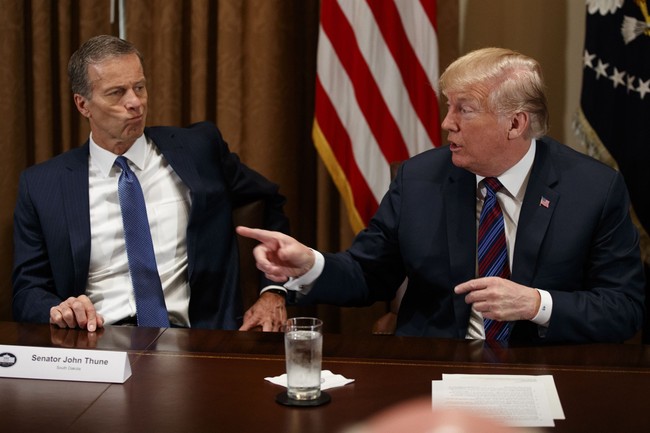
Senator Thune’s reaction has been cautious and practical. He has acknowledged seeing the post and said he needs to review it, but he has also warned that firing the parliamentarian could create chaos. Thune argued that removing someone in that role would complicate the ability to get Republican legislation through the Senate, since it would raise new procedural and vote-count issues.
The constitutional and institutional reality is that the Senate parliamentarian is appointed by the Senate majority leader to advise on rules and procedure. The office is meant to be nonpartisan in function, though in practice rulings are often perceived through a partisan lens. That perceived bias is the core of the current dispute: Republicans want the freedom to use reconciliation to enact their priorities, and they see the parliamentarian as a blockade when she interprets rules in a way that rejects election-related language or other contested items.
The practical stakes are straightforward. Reconciliation allows budget-related legislation to pass the Senate with a simple majority instead of the 60 votes usually required to overcome a filibuster. If the parliamentarian rules the SAVE America Act, or parts of it, are election policy rather than budget policy, those parts cannot ride the reconciliation train. Democrats can then force those items back into the regular process and demand 60 votes, which blocks the Republican strategy.
Republicans argue that this procedural hurdle is precisely why the parliamentarian should be replaceable at the discretion of Senate leadership. From their view, leaving a figure who repeatedly thwarts majority priorities in place denies voters the policy the majority seeks to pass. For conservatives focused on election integrity and border security, the inability to use reconciliation is not merely a technicality but a major policy roadblock.
Many Republicans want to move aggressively because they believe time is short to enact priorities before the next election cycle. They see a clear link between procedural control in the Senate and the party’s ability to deliver on promises. That urgency explains the public pressure campaign and the calls for leadership to take steps that would clear the way for the SAVE America Act to proceed under reconciliation rules.
Whether Thune will push for a personnel change or instead keep the parliamentarian in place while pursuing other paths remains uncertain. The debate highlights a broader tension about how much deference the Senate should give to non-elected procedural officials versus the will of the elected majority. For Republicans, this is a test of both strategy and resolve as they try to convert a simple majority into tangible policy wins.



Add comment