
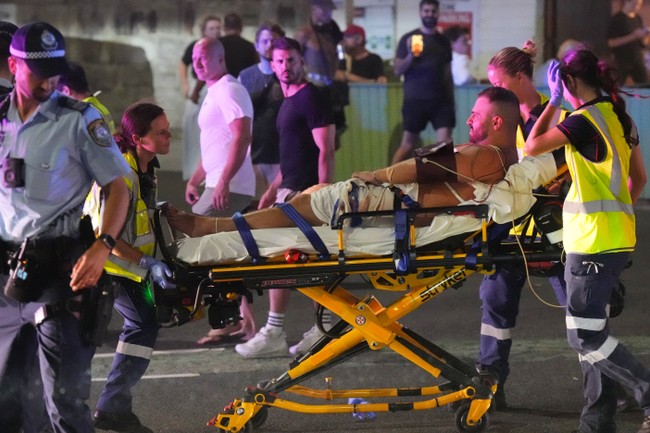
The Sydney Bondi Beach attack that killed 15 people, many of them Jewish families celebrating Hanukkah, has stirred a furious debate over motive, media framing, and public safety; this article examines ABC editor Laura Tingle’s dismissal of religion as a factor, political reactions calling that view irresponsible, the evidence tying the attackers to ISIS, and the broader policy questions raised about security and gun laws.
Early reports made clear the victims were gathered for the first night of Hanukkah when gunmen opened fire, and Australian leaders say evidence points to ISIS inspiration. Prime Minister Anthony Albanese stated plainly that “there’s evidence that this was inspired by a terrorist organization, by ISIS.” That matters because the attackers reportedly displayed an Islamic State flag in their vehicle, a signal most people do not ignore.
Instead of taking that connection seriously, a senior ABC journalist publicly insisted the violence had no religious basis. Laura Tingle told podcast hosts, “Their actions are not based on their religion.” When pressed, she doubled down with, “have got nothing to do with religion.” Those words landed badly with many Australians who saw clear signs of ideological motivation aimed at Jewish worshippers.
Political figures reacted quickly and sharply to Tingle’s comments. Sarah Henderson called the remarks “deeply offensive and grossly irresponsible.” Her critique echoed a broader concern that dismissing ideological or religious links to terrorism hampers the public’s ability to identify and confront threats.
Other leaders echoed that frustration in blunt terms. Josh Frydenberg said, “I heard one of the leading journalists from the ABC say that this (Bondi massacre) has nothing to do with religion,” he said. “Well, you know what that is, that’s propaganda.” Such language reflects a belief held by many conservatives that downplaying motive is part of a political narrative rather than an honest accounting of facts.
The human toll is stark: fifteen victims, including a 10-year-old child, not counting the shooter, are now dead. Albanese emphasized how some of the tangible evidence supports the terrorism claim: “Now, some of the evidence which has been procured, including the presence of Islamic State flags in the vehicle that has been seized, are a part of that,” added Albanese. “Radical perversion of Islam is absolutely a problem. It is something that has been identified globally as a problem as well.”
That admission from the prime minister runs counter to the ABC editor’s dismissal and highlights a split between political leadership and some media voices. When officials point to clear symbols and stated inspiration, the public expects journalists to report those facts without what looks like political spin or selective blindness.
The furor over Tingle’s comments is not just rhetorical. It shapes policy debates about public safety, counterterrorism, and civil liberties. If a major broadcaster tells the country to ignore religious or ideological cues, that affects how the public and authorities assess risk and respond to extremist movements.
Debates about gun policy also surfaced immediately, with those seeking to restrict firearms using the attack to argue for tighter control. Critics counter that stripping law-abiding citizens of defensive options leaves them more vulnerable to violent criminals and ideologically motivated killers. The Bondi hero who subdued the attacker did so without a weapon, and many conservatives ask whether better-armed, regulated civilians might have reduced the death toll.
Beyond the immediate aftermath, this episode fuels a larger argument about media consistency and bias. Laura Tingle has previously described Australia as “We are a racist country, let’s face it. We always have been, and it’s very depressing.” That earlier blanket judgment of Australians contrasts with her recent reluctance to call out religiously inspired violence, which critics view as selective outrage.
The clash underscores a demand for equal treatment in reporting: if outlets are willing to label broad swaths of society in harsh terms, many expect the same clarity when confronting violent extremism. Observers argue that failing to identify motive openly is not neutral reporting but a form of downplaying that can have real-world consequences.
As details continue to emerge from investigations and inquests, the public debate will churn between those urging restraint in labeling motive and those insisting that symbols, statements, and actions point to a clear ideological source. What is not in dispute is the tragedy itself: 15 lives lost, families shattered, and a community in mourning.
Add comment