
The weekly roundup highlights five stories that grabbed attention: a Senate GOP rift over funding, a senator’s false claim about voter ID, an odd Wisconsin candidate scandal, reports of strikes on an Iranian nuclear site, and Elon Musk’s blunt media confrontation. Below you’ll find concise, punchy takes on each item, preserving key quotes and embeds for context.
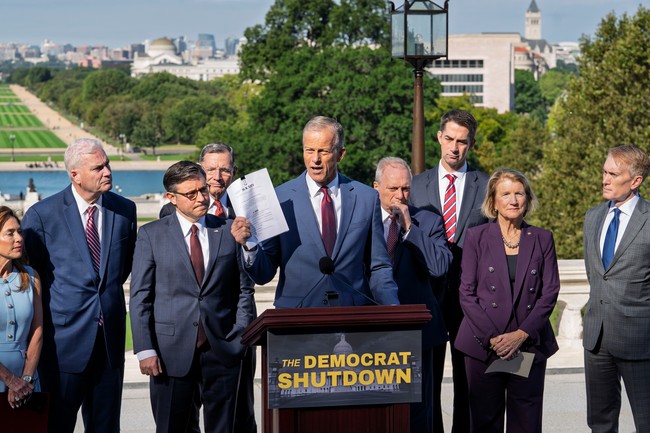
First up is the fallout from Senate Republican John Thune’s maneuvering around a House continuing resolution. Conservatives are rightly frustrated that leadership games once again stall commonsense action and leave the grassroots hanging. When national security and funding are treated like chess pieces, voters pay the price and candidates get hammered on the campaign trail. This is precisely the kind of political theater that weakens GOP unity and hands the left talking points.
Apparently. It is exactly what the American people don’t want, and as Congress prepares to recess yet again, they will be hearing about it when they return to their states and especially on the campaign trail. Thune has played “Tommy Two-Face” too often, and his pretense at leadership while stabbing Republican and MAGA voters in the back, has worn thin.
Next, Democratic Senator Mark Warner tried to claim Virginia’s elections prove Democrats embrace voter ID, but the exchange didn’t hold up. ABC News pushed back and exposed the false comfort that Warner offered about election integrity. Plain fact is voters want secure elections and honest answers, not convenient talking points. The clip captures the moment the senator’s claim crumbled under simple scrutiny.
According to Warner, everything is hunky dory with our election system, and, hey, just look his home state of Virginia. The Old Dominion, claimed Warner, requires voters to present an ID in order to cast their ballot, so no one can say we Democrats don’t support this!
There’s just one thing, noted Karl. That’s simply not true.
Here’s the exchange:
In Wisconsin, a Democrat candidate for governor faces a Platner-like scandal involving old social media posts that his campaign calls irrelevant because they are a decade and a half old. Conservatives see that as a dodge, a way to minimize genuine character questions while campaigning. Voters deserve transparency about who’s running for high office and why past statements matter when they reveal enduring viewpoints. Political spin won’t wash when policies and public trust are at stake.
Now, here is what I think is the “tell” that Crowley is… not being honest about who ran that account. Notice how both he and his campaign were careful to note that the posts were from “a decade and a half ago.” Why would that matter except to downplay their current significance, as if to imply “Even if it was something I wrote back then, I’m not the same person today”?
The Middle East story grew louder as reports surfaced that missiles struck Darkhovin, an Iranian nuclear facility, prompting furious reactions from Tehran. From a conservative perspective, if hostile regimes are moving toward nuclear capability, targeted hits on suspect sites can be warranted and justifiable. The question now is who carried out the strike and whether regional partners or outside powers acted to blunt Tehran’s nuclear ambitions. Details remain murky, and the international community should watch closely for escalation or confirmation.
https://x.com/RNCResearch/status/2078846822575988799
This is precisely the kind of target American forces should be razing to the ground. Iran’s Atomic Energy Organization, in its outrage, is again dissembling; nothing this regime does is peaceful or has an entirely peaceful purpose. If this facility had been allowed to move to completion, it somehow would have been folded into Iran’s attempts to develop a nuclear weapon. And yet, the Trump administration has not acknowledged the strike, nor indicated if it was American weapons that struck Darkhovin; there are unconfirmed reports that the site was struck by at , but so far, it’s not clear who fired the missiles; it may well have been one of the Gulf Arab states that Iran has targeted with missile and drone attacks.
Finally, Elon Musk delivered a classic mic-drop moment in a heated interview, refusing to play the media’s usual game and calling out bias directly. His blunt line landed hard: “Maybe some people do loathe me, and that’s probably true. I don’t care.” That bit of candor was followed by his sharper retort about the media’s standing compared to his audience, which stirred strong reactions on both sides.
“But the fact that, as you pointed out, a quarter of a billion people follow me, is that I think a lot more people actually like me than don’t. And I think a lot more people hate you and the media, more than you realize.”
Each of these stories touches on a simple theme: leadership matters, accountability matters, and the truth matters. Whether it’s internal GOP fights, Democratic talking points on election law, questionable political characters, foreign threats, or media sparring, voters are watching and judging. Expect these threads to keep driving debate in the weeks ahead as campaigns and policymakers scramble to respond.
Keep an eye on how these narratives evolve, because the political consequences of missteps and misstatements will show up where they count—on ballots and in the public square. No single moment defines a movement, but the accumulation of these moments shapes credibility and trust for politicians, institutions, and media alike.

If we only had a strong Republican Senate instead of some planted Rino’s that don’t want to do anything that the American people want.
Exactly! We’ve got Two-faced, Phony, Self-Serving, Greedy, Betrayers instead! Look at Mitch McConnell who should be in some Permanent Sanitarium but he still occupies the Republican GOP Senate while more months he’s been totally absent both physically and mentally from the Senate! He is NOTHING but a total FRAUD!
He and his Chinese brother-in-law have been in the cargo shipping industry out of China for years and some of those vessels have been known to be carrying large quantities of illicit drugs like cocaine which McConnell himself has purportedly played around with! He is the epitome of a slimy, two-faced, lying and backstabbing RINO!
He is holding his Senate Seat to betray the Republican party and America one final time so that the Evil DSA can finish what they started decades ago and ramped-up exponentially during the Criminal Biden/Harris Fraud administration!
The Republicans now had the opportunity to straighten-out this country and kick butt doing it but instead they slowly milk and play the system readying for the next Communist DSA takeover! Probably the final hand-off of power and control; the Coup d’ Grace for the Big Agenda 2030 to light-up!
Even the death of Lindsey Graham appears suspect as another weakening of any hinge-pin of the party.
The Approval Rating of Congress is in the single digits or in other words in the toilet bowl!